The Financial Action Task Force (FATF) has pointed out that stablecoins are the preferred choice for illegal transactions involving North Korea, Iran, and others, with estimated fraud amounts reaching $51 billion. To prevent vulnerabilities in non-custodial wallets, they strongly urge countries to strengthen anti-money laundering regulations on issuers.
FATF: Stablecoins Are the Top Choice for Illegal Transactions
According to a 42-page report released by the Financial Action Task Force (FATF), stablecoins are currently the most popular virtual assets used in illegal transactions (including sanctions evasion). Participants include countries like Iran and North Korea, prompting calls for stricter regulation of stablecoin issuers.
In January this year, FATF stated that stablecoins account for the majority of on-chain illegal activity transactions. The organization estimates that in 2024, illegal stablecoin activities related to scams and fraud will total approximately $51 billion.
North Korea and Iran Favor Stablecoins
FATF further explained that North Korea’s Lazarus Group and other organizations use stablecoins to purchase military equipment; Iran’s Islamic Revolutionary Guard Corps also relies on stablecoins to acquire drone parts; terrorist groups and drug trafficking organizations heavily depend on Tether ($USDT) and USDC for fund transfers and money laundering.
On July 2, 2025, Tether, the issuer of USDT, conducted the largest-ever freeze of Iran-related funds, freezing 42 cryptocurrency wallet addresses, over half of which are heavily linked to the local exchange Nobitex.
As a global standard-setting body focused on international anti-money laundering efforts, FATF points out that stablecoins, with features like price stability and high liquidity, are attractive tools for criminals to transfer funds.
Further Reading:
Fiat currency devalued by 90%! Iran’s central bank buys $500 million USDT to save rial exchange rate. Iran’s banks are paralyzed, and exchanges have been hacked! Can Bitcoin hedge against information warfare in the Taiwan Strait?
Vulnerabilities in Non-Custodial Wallets Record Illegal Stablecoin Receipts
In its latest report from March 2026, FATF again warns that stablecoins pegged to the US dollar have become key tools in illegal financial activities.
The organization cites a report from blockchain analysis firm Chainalysis, stating that in 2025, illegal virtual asset transactions totaled $154 billion, with stablecoins accounting for 84%, a stark contrast to the Bitcoin-dominated illegal transactions of 2020.
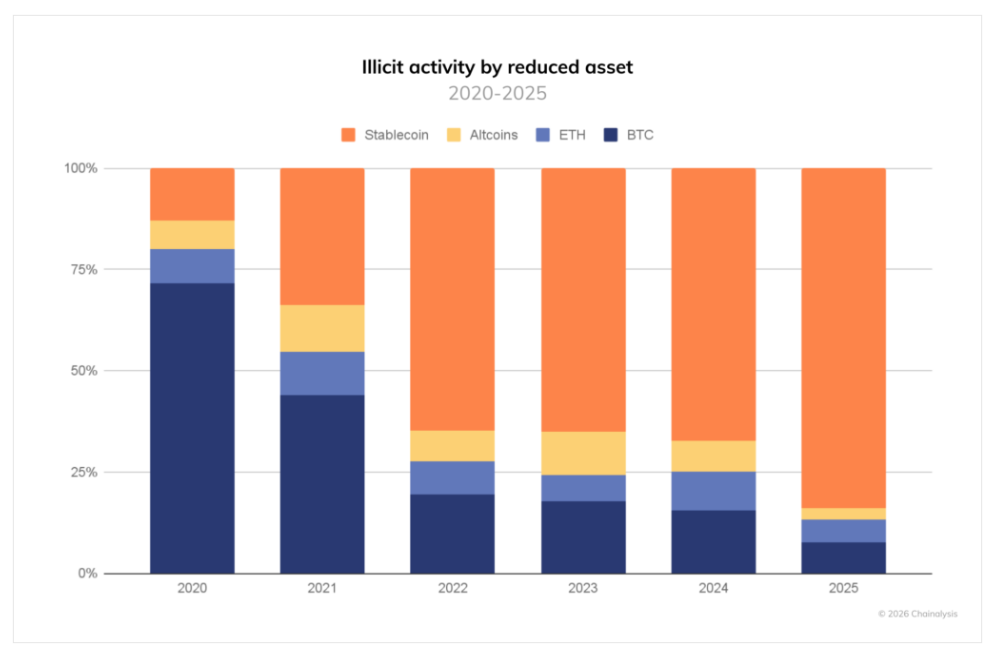
Source: Chainalysis — In 2025, illegal virtual asset transactions reached $154 billion, with stablecoins accounting for 84%
Additionally, according to a report released in mid-February by blockchain analysis firm TRM Labs, illicit entities received a total of $141 billion in stablecoins in 2025, setting a five-year high. The report notes that last year, overall stablecoin activity repeatedly exceeded $1 trillion per month, with 86% related to sanctions.
The report emphasizes that malicious actors often hide their funds using cross-chain technology, decentralized exchanges, and OTC brokers. FATF highlights that peer-to-peer transfers through non-custodial wallets are a critical vulnerability, as these transactions occur in environments lacking anti-money laundering controls, making it difficult for regulators to track geographic locations and beneficiaries.
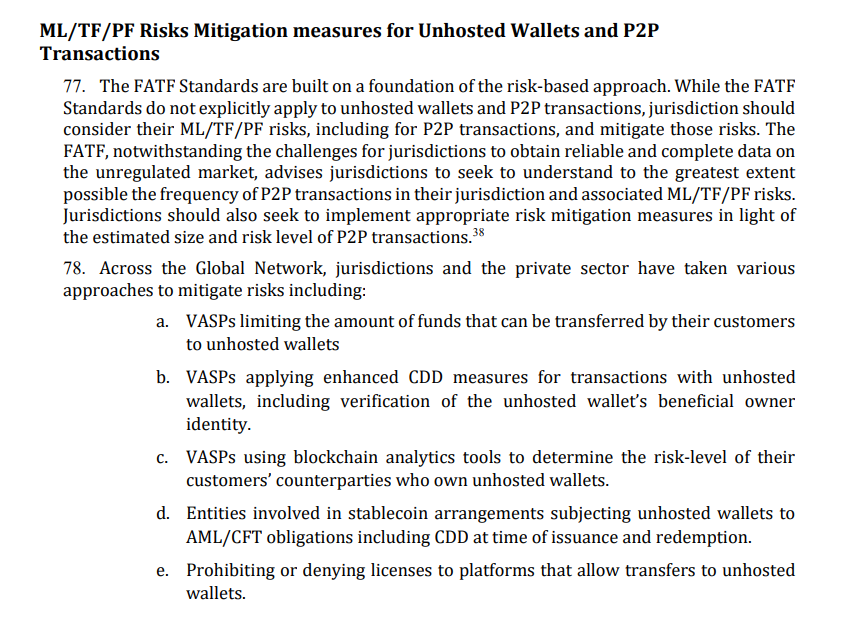
Source: FATF report — Peer-to-peer virtual asset transfers via non-custodial wallets are a key vulnerability
Stablecoin Market Cap Surpasses $300 Billion, Urgent Need for Regulation
It’s important to note that FATF does not call for banning stablecoins outright but strongly urges countries to impose anti-money laundering obligations on stablecoin issuers and intermediaries.
FATF recommends that stablecoin issuers utilize smart contract control features to establish whitelists and blacklists to restrict certain wallet transactions. Issuers should have the technical capability to intercept, freeze, and destroy suspicious stablecoins in secondary markets. To address cross-border operational challenges, FATF encourages countries to establish international regulatory bodies to enhance information sharing and joint oversight.
Currently, the global stablecoin market value has exceeded $300 billion. As adoption accelerates and integration with traditional finance deepens, FATF believes that regulators worldwide must act swiftly and implement blockchain analysis tools to close regulatory and compliance gaps.
Further Reading:
Preparing for Crypto Legislation! E.SUN Bank: Banking sector to adopt three-tier financial models, not missing out on stablecoins and tokenization
Conflict impacts Gaza banks! Trump’s Peace Commission plans to use US dollar stablecoins to promote digital transactions
Disclaimer: The information on this page may come from third parties and does not represent the views or opinions of Gate. The content displayed on this page is for reference only and does not constitute any financial, investment, or legal advice. Gate does not guarantee the accuracy or completeness of the information and shall not be liable for any losses arising from the use of this information. Virtual asset investments carry high risks and are subject to significant price volatility. You may lose all of your invested principal. Please fully understand the relevant risks and make prudent decisions based on your own financial situation and risk tolerance. For details, please refer to
Disclaimer.
Related Articles
Gold plummets, "safe haven for funds" changes hands? JPMorgan: During wartime, "Bitcoin becomes the new darling of hedging."
JPMorgan Chase指出,在中东冲突中,比特币展现出强大的抗跌韧性,资金大规模涌入,交易活动活跃,而黄金和白银则面临资金外流。在高利率和强势美元的压力下,黄金价格下跌约15%。比特币凭借无国界特性成为避险选择,机构投资者也调整了布局,显示黄金流动性下降,而比特币流动性上升。
区块客2h ago
U.S. Vice President Vance: The United States has no intention of staying in Iran and will withdraw quickly after handling affairs.
U.S. Vice President Vance stated that the United States will swiftly withdraw from Iran, believing that all military objectives have been achieved, and the current military actions are to ensure that Iran no longer poses a threat to the U.S. He pointed out that the current rise in oil prices is a temporary reaction to the U.S.-Israel-Iran conflict, and that oil prices will fall after the withdrawal.
GateNews3h ago
The President of South Korea nominated Shin Hyun-sung as a candidate for the new governor of the central bank, and Shin has a negative attitude towards the Korean won stablecoin.
Gate News reports that on March 29, South Korean President Lee Jae-myung nominated Shin Hyun Song, the head of the Monetary and Economic Department of the Bank for International Settlements, as a candidate for the new governor of the Bank of Korea. It is reported that Shin Hyun Song is known as a "pragmatic hawk" and holds a negative attitude towards the Korean won-pegged stablecoin promoted by the Lee administration. Shin Hyun Song believes that in countries with highly volatile exchange rates that are susceptible to capital outflows, stablecoins can easily become a tool for capital flight, and stablecoins pegged to the local currency may accelerate this trend.
GateNews3h ago
Latest on the US-Iran War: Pentagon ground forces prepare to attack, Saudi military base hit by missiles, probability of Strait of Hormuz reopening is down to 24%.
The U.S.-Iran war is escalating, with U.S. forces at a base in Saudi Arabia being attacked by Iran, resulting in at least 15 injuries. The Pentagon is drafting operational plans for ground troops, focusing on Iran's nuclear weapons. The Strait of Hormuz has become a diplomatic toll station, allowing only friendly countries to pass, and the crypto market is also under pressure due to the war.
動區BlockTempo4h ago
Inside the Trump administration, there were discussions about seizing Halk Island.
The Trump administration has recently been wavering on its stance toward the war. The White House warned that if Iran does not abandon its nuclear ambitions, it could face a devastating strike, while also considering seizing Hark Island to counter the weapon threat. Market predictions show that in the short term, the odds that Iran will no longer control Hark Island are relatively low.
BlockBeatNews4h ago
Michael Saylor seems to be signaling a bullish outlook, while Goldman Sachs claims that BTC may have bottomed out.
March 29th Cryptocurrency Market News: MicroStrategy's founder gives a bullish signal, analysts focus on Saudi production cuts, High points out that Bitcoin may have already bottomed. U.S. stocks may be approaching a short-term bottom, Canada plans to ban cryptocurrency political donations. The market needs to reset in order to start a new bull market.
GateNews5h ago


