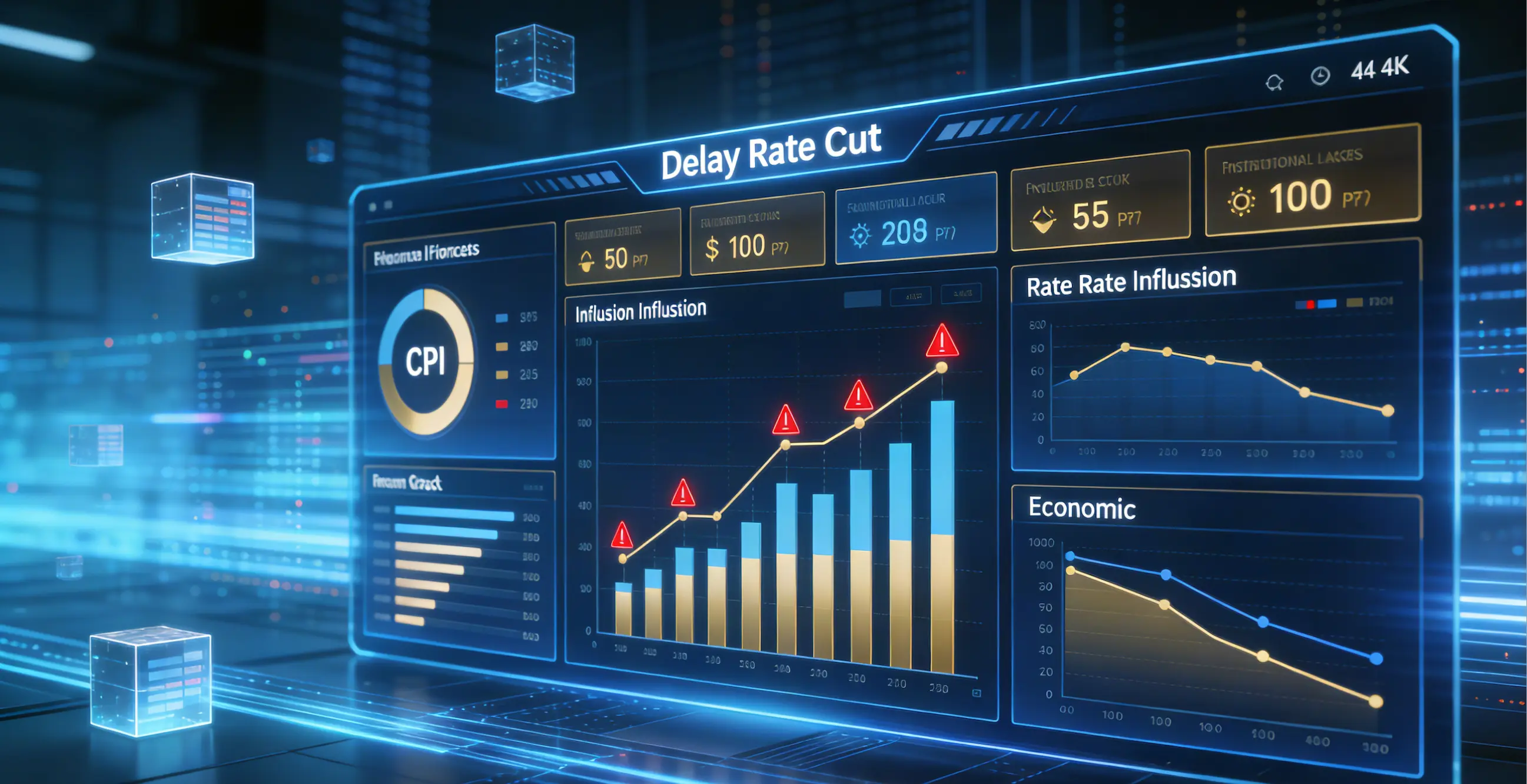
The International Monetary Fund (IMF) released its first Article IV review of the Trump administration on February 25, 2026, projecting that U.S. inflation will not return to the Federal Reserve’s 2% target until early 2027, delaying meaningful interest rate relief.
The Fund warned that federal deficits remaining between 7% and 8% of GDP and consolidated government debt on track to reach 140% of GDP by 2031 “represent a growing stability risk to the U.S. and global economy,” while recommending fiscal consolidation over tariffs to address trade imbalances.
Inflation and Interest Rate Outlook
The IMF’s assessment indicates that U.S. inflation will persist above the Fed’s target for the foreseeable future, with the 2% goal now expected to be achieved only in early 2027. This timeline suggests that the Federal Reserve’s benchmark interest rate, currently at 3.6%, may decline only modestly to approximately 3.4% absent a “material worsening” in labor market conditions.
The Fund projects U.S. gross domestic product growth of 2.4% in the fourth quarter of 2026 compared to the prior-year period, accelerating from 2.2% growth in 2025. Unemployment is forecast to decline from 4.5% in late 2025 to 4.1% during 2026, reflecting continued labor market resilience.
IMF Managing Director Kristalina Georgieva indicated the Fed can afford to push rates down to around 3.4% from current levels but should hold off on deeper cuts barring significant deterioration in the American job market. The relatively strong growth projection leaves the central bank little urgency to ease monetary policy aggressively.
Fiscal Deficits and Debt Trajectory
The IMF’s fiscal analysis presents a stark picture of U.S. government finances. Federal deficits are projected to remain between 7% and 8% of GDP in coming years—more than double the targets previously outlined by Treasury Secretary Scott Bessent. Consolidated government debt is on track to reach 140% of GDP by 2031, rising steadily from just under 100% of GDP in 2025.
“The upward path for the public debt-GDP ratio and increasing levels of short-term debt-GDP represent a growing stability risk to the U.S. and global economy,” the Fund warned in its assessment.
Georgieva told reporters that the U.S. current account deficit is “too big,” with the Fund estimating it at 3.5% to 4% of GDP in the near term. The IMF’s prescription for addressing this imbalance—fiscal consolidation through spending cuts—clashes directly with the administration’s reliance on tariffs as a primary trade policy tool.
Policy Divergence: Tariffs vs. Fiscal Consolidation
The IMF’s recommendations arrive amid ongoing trade policy developments. The Supreme Court recently struck down broad emergency tariffs imposed by the administration as illegal, forcing the administration to invoke Section 122 of the Trade Act of 1974 for replacement levies.
Nigel Chalk, the Fund’s Western Hemisphere Director, explicitly stated that fiscal consolidation—not tariffs—represents the best path to narrowing the deficit. The report warned that protectionist trade policies “could represent a larger-than-expected drag on activity” despite the U.S. economy benefiting from strong productivity growth.
The IMF noted that the U.S. economy would have performed even better without the president’s tariffs on foreign imports, suggesting that trade restrictions may undermine rather than strengthen economic performance.
Contrast With Administration’s Economic Messaging
The IMF review landed one day after the State of the Union address, where the president presented an optimistic picture on borrowing costs. He claimed mortgage rates had hit four-year lows and that annual mortgage costs had dropped nearly $5,000 since he took office, framing lower rates as the solution to housing affordability challenges.
The IMF’s assessment directly contradicts this narrative, indicating that structural factors—including persistent inflation and expanding fiscal deficits—will keep rates elevated. The Fund’s analysis suggests that the administration’s own fiscal expansion, including historically large tax cuts noted in the review, is the primary driver of deficits that prevent meaningful rate relief.
While the IMF stopped short of predicting a sovereign crisis, noting that “the risk of sovereign stress in the U.S. is low,” the trajectory described points to an environment where rate relief arrives slowly. The Fund’s projection of resilient 2.4% growth for 2026 reinforces the case for higher-for-longer rates.
Implications for Risk Assets and Crypto Markets
The IMF’s assessment carries significant implications for financial markets. Sticky inflation and an expanding fiscal deficit reduce the probability of aggressive rate cuts in 2026. For crypto markets, which rallied on rate-cut expectations through late 2025, the outlook reinforces caution as the higher-for-longer interest rate environment persists.
The structural irony highlighted by the IMF is that the administration’s own policies—particularly fiscal expansion through tax cuts—contribute to the deficit that keeps rates elevated. While the president seeks lower rates, the policy framework described in the Article IV review structurally prevents them.
FAQ: Understanding the IMF’s U.S. Economic Assessment
Q: Why does the IMF expect inflation to remain above the Fed’s target until 2027?
A: The IMF projects persistent inflation due to resilient U.S. growth (2.4% in 2026), tight labor markets with unemployment declining to 4.1%, and large fiscal deficits between 7-8% of GDP that continue stimulating demand. These factors collectively keep price pressures elevated despite the Fed’s tightening efforts.
Q: How large are U.S. fiscal deficits and debt according to the IMF?
A: The IMF projects federal deficits will remain at 7-8% of GDP in coming years—more than double the administration’s stated targets. Consolidated government debt is on track to reach 140% of GDP by 2031, rising from just under 100% in 2025, which the Fund warns represents a “growing stability risk”.
Q: What is the IMF’s position on tariffs versus fiscal consolidation?
A: The IMF explicitly recommends fiscal consolidation through spending cuts rather than tariffs to address trade imbalances. Fund officials stated that protectionist trade policies “could represent a larger-than-expected drag on activity” and that the U.S. economy would perform better without tariffs on foreign imports.
Q: How might the IMF’s outlook affect cryptocurrency markets?
A: The projection of delayed rate cuts and persistent inflation reduces the probability of aggressive monetary easing in 2026. For crypto markets that rallied on rate-cut expectations, this outlook reinforces caution as the higher-for-longer interest rate environment persists, potentially dampening near-term risk appetite.
Disclaimer: The information on this page may come from third parties and does not represent the views or opinions of Gate. The content displayed on this page is for reference only and does not constitute any financial, investment, or legal advice. Gate does not guarantee the accuracy or completeness of the information and shall not be liable for any losses arising from the use of this information. Virtual asset investments carry high risks and are subject to significant price volatility. You may lose all of your invested principal. Please fully understand the relevant risks and make prudent decisions based on your own financial situation and risk tolerance. For details, please refer to
Disclaimer.
Related Articles
The U.S. employment data for March is expected to add 60,000 jobs, with the unemployment rate remaining at 4.4%.
In March, the U.S. job market is expected to improve, adding 60,000 jobs, with the unemployment rate remaining at 4.4%. Despite disappointing employment data in February, inflation concerns triggered by the Middle East war and the return of medical industry personnel to work may stimulate hiring.
GateNews49m ago
Why bitcoin's 'compressed' valuation offers reduced downside risk versus stocks
Bitwise suggests Bitcoin has priced in tighter monetary policy impacts, while stocks remain vulnerable to macroeconomic shocks. Rising energy prices pressure inflation, affecting Fed rate cut expectations. Bitcoin, already adjusting to risk appetites, shows resilience compared to falling equities.
CoinDesk8h ago
Energy analysts warn: Escalating attacks by Houthi forces could force oil-producing countries like Saudi Arabia to cut production.
Energy analysts warn that if the Houthis launch renewed attacks on Red Sea shipping, the oil market will face greater turmoil, which could lead to global oil supply cuts and higher oil prices. Saudi Arabia is moving crude oil to Red Sea ports to reduce the impact, but if the attacks continue, output could be constrained and force Saudi Arabia and other countries to cut production.
GateNews11h ago
The Christian community in the United States accepts cryptocurrency tithing, and the size of educational organizations has nearly doubled since 2022.
In the United States, a Christian crypto-evangelical culture has emerged, with churches accepting digital currency to pay tithes. The nonprofit event Thank God for Bitcoin has expanded in scale; despite the fall in Bitcoin prices, the community remains active. Supporters see it as a tool to prevent inflation, but it also faces controversy and risks.
GateNews12h ago
Bitcoin macro risks spike as Ukraine messes with Trump's plan to stabilize oil markets
Ukraine's drone strikes have exacerbated oil market instability during the Iran war, complicating Trump's efforts to stabilize prices. This disruption risks prolonged high oil prices, leading to inflation and potential Fed rate hikes, which could challenge cryptocurrency stability.
CoinDesk18h ago
The final consumer confidence index for the University of Michigan in the U.S. in March is 53.3, lower than the expected 54.
Gate News message: On March 27, the University of Michigan consumer sentiment index (an important measure of U.S. consumer confidence) for March in the U.S. came in at 53.3, below the market expectation of 54, after a prior reading of 55.5.
GateNews03-27 14:02


