As the US-Israeli coalition escalates military actions against Iran, Tehran’s years-long “shadow economy” has once again become an international focus. This parallel system, combining Bitcoin mining and stablecoin trading, has become Iran’s last shield in seeking survival outside the battered banking system and dollar dominance.
Exchanging cheap electricity for Bitcoin
Iran legalized cryptocurrency mining as early as 2019, allowing licensed operators to mine using government-subsidized electricity on the condition that all mined Bitcoin must be sold to the Central Bank of Iran. This has become an important tool for paying for imported goods and settling foreign trade, effectively bypassing the US dollar system and Western banking sanctions to some extent.

According to statistics, Iran’s Bitcoin mining hash rate accounts for about 2% to 5% of the global total, but much mining activity remains unofficial, so the actual scale may be higher than reported.
Blockchain analytics firm Chainalysis found that Iran’s cryptocurrency ecosystem had grown to a $7.8 billion scale by 2025, nearly equivalent to the GDP of Maldives or Liechtenstein. Notably, crypto activity tends to spike during military conflicts or domestic unrest, including during last year’s 12-day conflict between Iran and Israel.
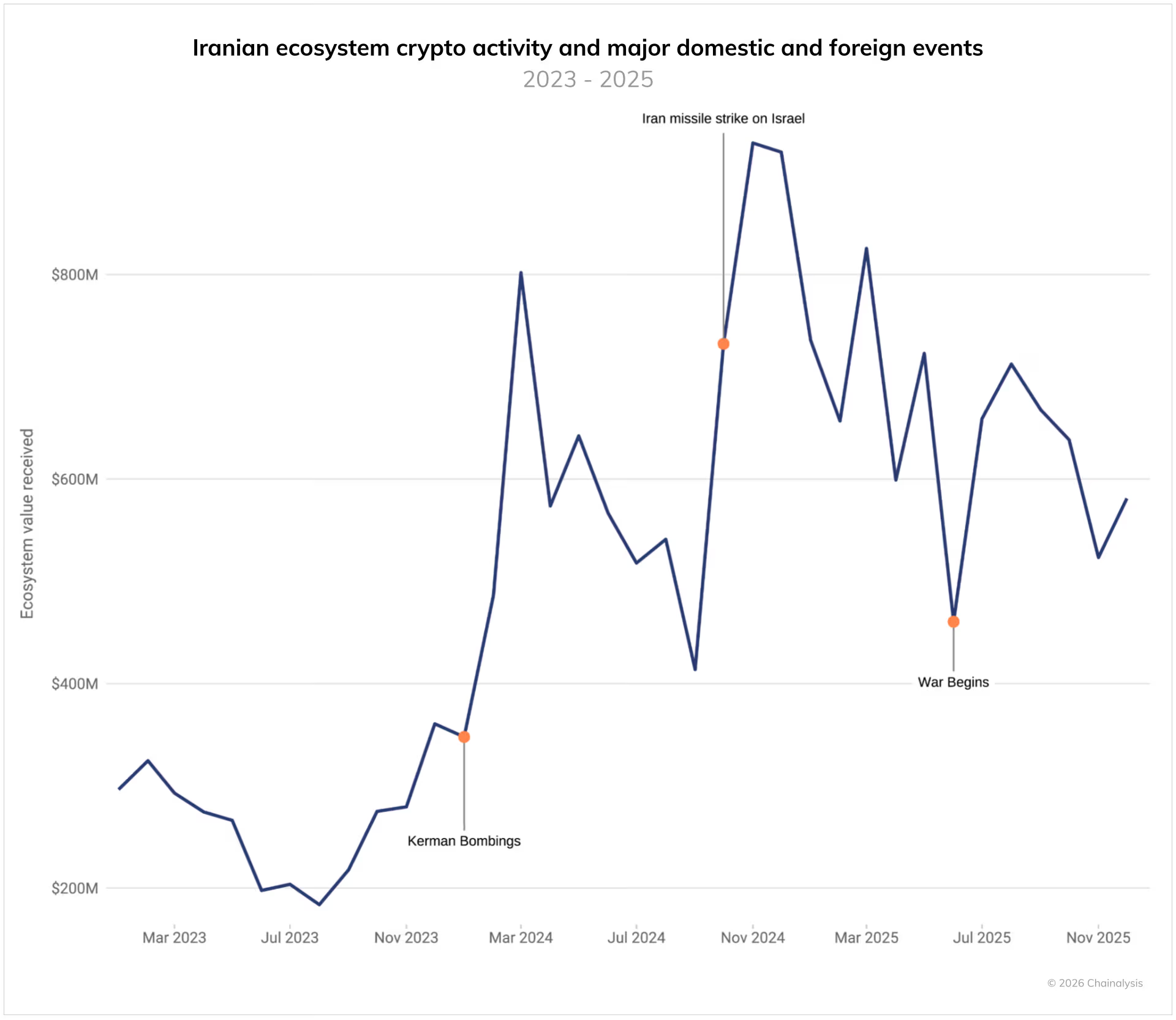
As Iran’s main military force, the Islamic Revolutionary Guard Corps (IRGC) has increasingly relied on cryptocurrencies in recent years. Chainalysis estimates that in Q4 2025, wallets associated with the IRGC accounted for over 50% of Iran’s total cryptocurrency inflows, receiving assets worth over $3 billion last year.
These figures only include publicly known wallet addresses directly linked to sanctions lists; the actual scale could be higher.
Rial plummets 96%, USDT becomes the new favorite for trade settlement
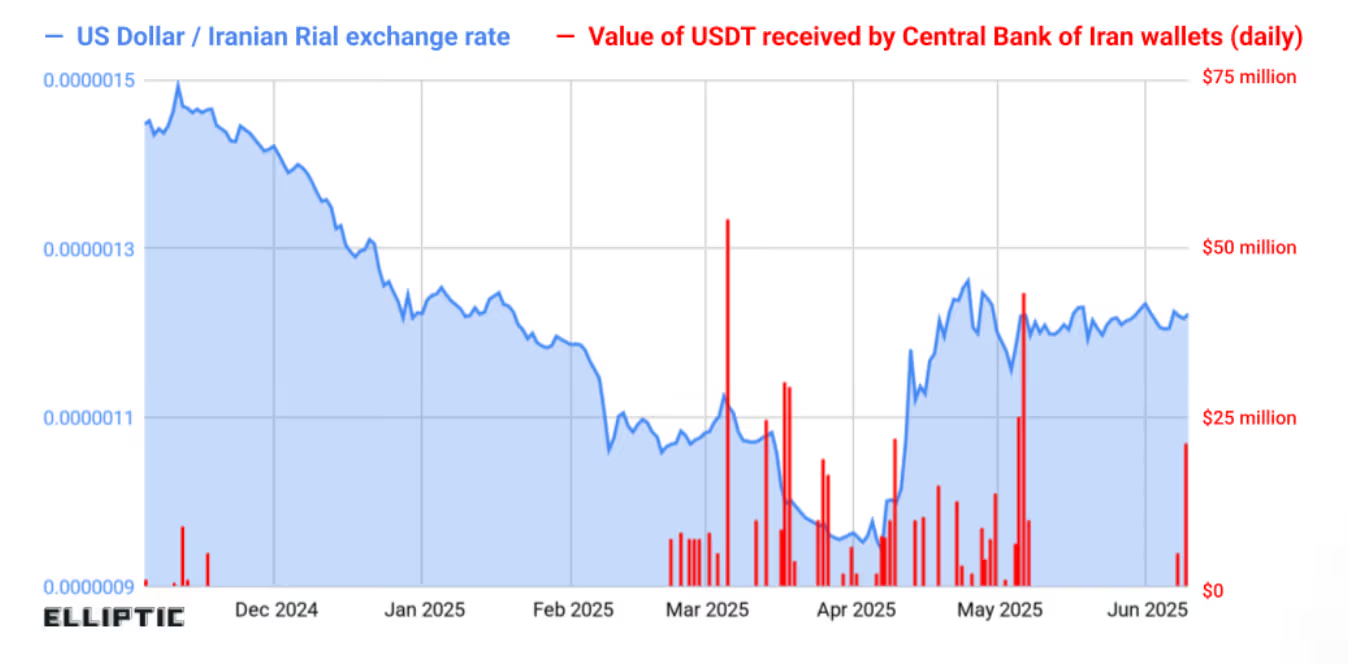
Besides Bitcoin, stablecoins also play a key role. Elliptic, a blockchain analysis firm, indicated that by 2025, Iran’s central bank had accumulated at least $507 million in USDT, likely used to stabilize the Rial exchange rate and support foreign trade. However, this financial defense appears to have been largely ineffective, as the Rial has depreciated over 96% against the US dollar.
Faced with deep-rooted hyperinflation and an economy on the brink of collapse, ordinary Iranians are increasingly turning to Bitcoin. Data shows that during recent anti-government protests, the amount of Bitcoin withdrawn from centralized exchanges to personal wallets surged sharply, indicating that locals are trying to keep their assets under their own control.
Mining costs are only about $1,300 per Bitcoin
Estimates suggest that the cost of mining one Bitcoin in Iran is around $1,300. Miners sell the mined Bitcoin to the central bank, which then transfers funds overseas to pay for equipment, fuel, or daily necessities.
Disclaimer: The information on this page may come from third parties and does not represent the views or opinions of Gate. The content displayed on this page is for reference only and does not constitute any financial, investment, or legal advice. Gate does not guarantee the accuracy or completeness of the information and shall not be liable for any losses arising from the use of this information. Virtual asset investments carry high risks and are subject to significant price volatility. You may lose all of your invested principal. Please fully understand the relevant risks and make prudent decisions based on your own financial situation and risk tolerance. For details, please refer to
Disclaimer.
Related Articles
Iran reiterates that it will blockade the Strait of Hormuz as a countermeasure and will study opening other potential fronts
Gate News news, on April 1, the Office of Iran’s Supreme Leader posted on social media the first remarks of Supreme Leader Mojtaba Khamenei, released that day, reaffirming that Iran will continue to use the blockade of the Strait of Hormuz as a countermeasure. The Office of Iran’s Supreme Leader also said in the remarks that Iran is studying ways to open up “other potential fronts,” and believes that the adversary in the relevant area “lacks experience and has clear weaknesses.” The remarks stated that if the fighting continues, after taking into account the relevant factors comprehensively, “these fronts will be activated.” (CCTV News)
GateNews5h ago
Insider: U.S. Vice President Vance says Trump has lost patience with the Iran issue
Gate News message, April 1, according to sources, U.S. Vice President Vance held talks with an "intermediary" on the Iran conflict on Tuesday. U.S. President Trump instructed Vance to privately convey that, as long as certain U.S. demands are met—such as reopening the Strait of Hormuz—he is willing to accept a ceasefire. Vance relayed Trump's "tough" message, saying that Trump has lost patience and warning that unless Iran reaches an agreement, pressure on Iran's infrastructure will increase.
GateNews6h ago
The Strait of Hormuz remains restricted for navigation, and Brent crude oil futures are holding above $100
Gate News message, April 1, although expectations of a de-escalation in the Iran war situation have warmed somewhat, navigation through the Strait of Hormuz is still constrained, and tensions have not been fully eased. Brent crude oil futures (the international crude benchmark price) are currently holding at around $100 per barrel, indicating that the market is still waiting to see whether the situation improves. Forex.com market analyst Fawad Razaqzada noted that in the absence of a clear timetable for the Strait of Hormuz to reopen and sufficient credibility, oil prices are unlikely to sustainably fall below $100.
GateNews7h ago
St. Louis Fed President Musalem: The Iran war energy shock will raise overall inflation
Gate News reports that on April 1, the President of the St. Louis Fed, Mousalem, stated on Wednesday at an event hosted by the American Enterprise Institute in Washington that energy shocks related to the war with Iran will definitely impact overall inflation and may exert pressure on core prices. Mousalem said, "I expect increases in commodity prices to feed into overall inflation on a one-for-one basis, and there will be a period of high overall inflation." He added, "Core inflation will also be affected to some extent by pass-through; I will closely monitor the degree of pass-through and the correlation between the two."
GateNews7h ago
Google Quantum AI Warns Crypto Wallet Encryption May Be Easier to Break Than Expected
Google Quantum AI warns that 256-bit elliptic curve cryptography may be broken in minutes with under 500,000 qubits, a 20-fold reduction from prior estimates. This urges the crypto sector to expedite the transition to post-quantum cryptography.
CryptoNewsFlash7h ago
Trump: The U.S. will withdraw from Iran soon but without a timeline, saying Iran will not have nuclear weapons
Gate News message. On April 1, U.S. President Trump issued a statement saying that the United States will soon withdraw from Iran, but will not provide a specific timetable. Trump said Iran will not have nuclear weapons and does not want nuclear weapons; the United States does not care about nuclear materials issues and will monitor it via satellites.
GateNews7h ago


