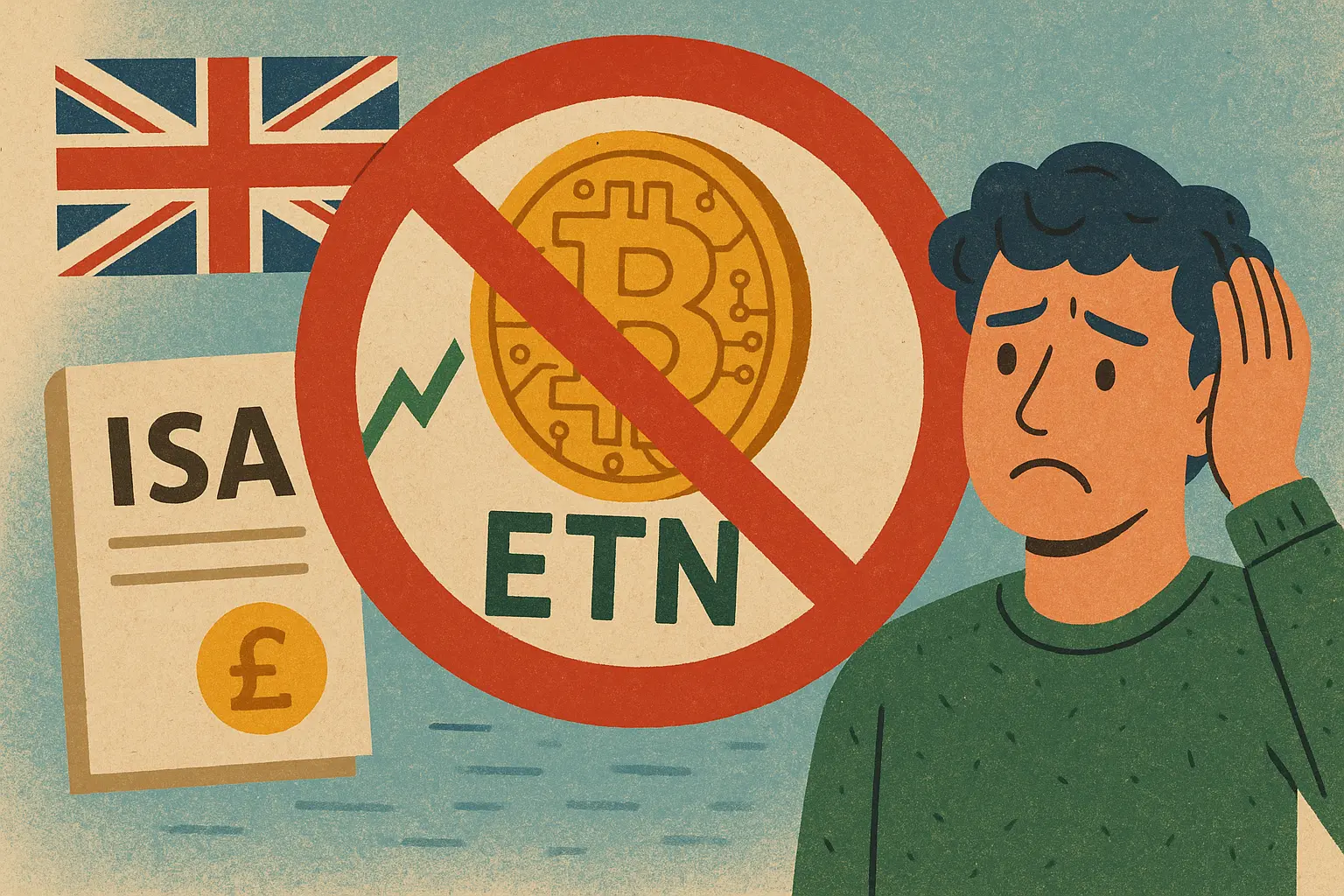
The UK Individual Savings Account (ISA) cryptocurrency investment channel will officially close in April 2026. HMRC’s regulatory policy adjustments have reclassified cryptocurrency exchange-traded notes (ETNs) as securities that do not qualify as ISA accounts, resulting in major investment platforms no longer legally offering such products within ISA accounts.
HMRC Reclassification: The Core Mechanism of Policy Shift
Individual Savings Accounts (ISAs) are the core tax-advantaged investment vehicles in the UK, allowing investors to exempt their capital gains and gains from taxation. For many years, eligible stocks, funds and certain exchange-traded products have been held within the ISA.
Crypto ETNs are exchange-traded notes that track the price of digital assets such as Bitcoin or Ethereum, and investors can buy them through traditional brokerage accounts without directly holding digital tokens, combining compliance convenience with crypto exposure. However, HMRC’s reclassification shattered the assumption that some investors expected ISA tax benefits for such products.
The key implications of this regulatory adjustment are as follows:
Disqualification: Crypto ETNs are classified as a category of securities that do not comply with the current ISA rules, and platforms cannot legally provide such services within the framework of the ISA
Tax implications: Investors who purchase crypto ETNs outside of ISAs are subject to tax declaration and tax at the standard rate
Alternative gap: There are currently no alternative packaging structures on the market that can restore crypto ETN ISA qualifications
Platform compliance obligations: Investment platforms that originally provided crypto ETNs in ISA accounts must stop such services by April
Real-World Implications for UK Retail Investors: From Financial Planning to Market Participation
For long-term investors, ISAs’ tax benefits have a compounding effect, and the tax-free framework can significantly enhance capital accumulation efficiency. The removal of crypto ETNs from ISAs changes the basis for risk-return assessment for investors who originally planned to deploy digital assets in a structured manner.
Of particular note is the young investor group. There is a growing interest in digital assets among younger generations in the UK, and many are turning to ISAs as their primary investment vehicle. This ban limits their path to incorporating crypto investments into long-term financial planning, which may indirectly prompt some investment activities to shift to overseas platforms or direct token purchases, thereby entering areas with more limited regulatory coverage.
Traditional assets (stocks, funds, bonds) remain eligible for ISA, allowing investors to adjust their existing asset allocation while closely monitoring policy directions.
Policy controversy: protecting retail investors or weakening competitiveness
The ban reflects the long-standing divergence in direction of UK regulators on digital asset policy.
Supporting HMRC’s reclassification argues that the cryptocurrency market remains volatile and regulated tax-exempt accounts should not provide tax subsidies for high-risk assets, a move that can reduce the systemic risk of retail investors over-allocating without adequate risk awareness.
Critics point out that crypto ETNs are regulated exchange-traded products, and their transparency and risk management standards are much higher than those of direct token purchases. Excluding such regulated products from ISAs may instead divert investment activity to less regulated channels, which is counterintuitive to protect investors.
The broader competitiveness concern lies in the UK’s crypto ETN ISA ban against the backdrop of the approval of spot Bitcoin ETFs in the United States and the continued opening of institutional crypto investment channels in several major markets, and the UK’s crypto ETN ISA ban is seen by some observers as a signal of regulatory conservatism that could weaken the attractiveness of the UK financial market in the global digital asset ecosystem.
Frequently Asked Questions
What options do UK investors still have for holding crypto ETNs after the ISA ban goes into effect in April?
Investors can still hold crypto ETNs through a standard taxable brokerage account, but they must report the corresponding gains in accordance with UK capital gains tax rules and maintain complete transaction records for tax filing. Some investors can also choose to hold Bitcoin or Ethereum directly on regulated exchanges, or wait for future adjustments to the regulatory framework.
What crypto-related investments for ISA accounts are still compliant?
Currently, crypto ETNs in ISAs are not eligible, but obtaining indirect crypto asset exposure by holding shares in relevant listed companies is still within the scope of permission from many ISA managers. Investors are advised to seek confirmation from their platform service providers or financial advisors on a specific basis.
Is it possible that this ban will be revoked or adjusted?
There is currently no official signal of revision of regulatory policies, but industry discussions on relevant policies continue. If the cryptocurrency regulatory environment becomes clearer globally and is accompanied by local political or market pressures, the possibility of future policy framework adjustments cannot be ruled out. Investors should pay close attention to relevant announcements from HMRC and the Financial Conduct Authority (FCA).
Disclaimer: The information on this page may come from third parties and does not represent the views or opinions of Gate. The content displayed on this page is for reference only and does not constitute any financial, investment, or legal advice. Gate does not guarantee the accuracy or completeness of the information and shall not be liable for any losses arising from the use of this information. Virtual asset investments carry high risks and are subject to significant price volatility. You may lose all of your invested principal. Please fully understand the relevant risks and make prudent decisions based on your own financial situation and risk tolerance. For details, please refer to
Disclaimer.
Related Articles
Why bitcoin's 'compressed' valuation offers reduced downside risk versus stocks
Bitwise suggests Bitcoin has priced in tighter monetary policy impacts, while stocks remain vulnerable to macroeconomic shocks. Rising energy prices pressure inflation, affecting Fed rate cut expectations. Bitcoin, already adjusting to risk appetites, shows resilience compared to falling equities.
CoinDesk2h ago
Spot Bitcoin ETF loses 4-week capital influx.
Today's crypto market revolves around three main topics: the cessation of a four-week inflow for spot Bitcoin ETFs, Morgan Stanley's low fee offering for its ETF, and ongoing discussions among U.S. lawmakers regarding a new crypto tax framework without a de minimis exemption for Bitcoin.
TapChiBitcoin5h ago
US Lawmakers Propose Digital Asset PARITY Act to Reform Crypto Tax Rules
US lawmakers introduced the “Digital Asset PARITY Act,” proposing tax exemptions for small stablecoin transactions and clearer rules for crypto taxation. While supporters welcome the initiative, critics argue it inadequately addresses broader industry needs, particularly regarding Bitcoin.
LiveBTCNews12h ago
Bitcoin macro risks spike as Ukraine messes with Trump's plan to stabilize oil markets
Ukraine's drone strikes have exacerbated oil market instability during the Iran war, complicating Trump's efforts to stabilize prices. This disruption risks prolonged high oil prices, leading to inflation and potential Fed rate hikes, which could challenge cryptocurrency stability.
CoinDesk13h ago
Bitcoin ETF ends with seven straight red days, and renewed downward pressure hits the Bitcoin price
Recently, after experiencing a net inflow for seven consecutive trading days, the U.S. Bitcoin spot ETF saw a significant outflow, with a net outflow of $163.5 million on the 18th and another outflow of $51.9 million on the 19th, indicating a simultaneous weakening of market capital and prices. Bitcoin's price briefly fell below $70,000, highlighting that the fund flows of the ETF can no longer support its rebound, and the deteriorating macro environment is putting pressure on risk assets, causing a noticeable contraction in investor preference. The testing of the $70,000 threshold has become a barometer for short-term market sentiment.
区块客14h ago
Plume’s legal counsel testified before Congress, urging the SEC to accelerate rulemaking for tokenization and move DeFi protocol ATS registrations forward
Plume legal advisor B. Salman Banaei testified before Congress, urging the SEC to expedite the development of tokenization rules and criticizing the reliance on an "innovation exemption" mechanism. He emphasized the need for public consultation to promote permanent solutions that would attract large institutions to participate in the tokenization of real-world assets, reminding SEC leadership of the urgency to act.
GateNews18h ago


