Well-known crypto venture capital firm Multicoin Capital recently made a one-time off-market purchase of 60 million WLD tokens from the Worldcoin project team, involving up to 30 million USDC. This transaction comes at a time when Worldcoin is facing multiple difficulties: its token price has fallen over 21% in the past month, on-chain active wallet addresses have sharply declined since September’s peak, and global search interest has plummeted 94% from its high. Meanwhile, the project is encountering increasingly severe regulatory scrutiny in Thailand and other regions, with demands to delete biometric data collected from over a million users. The contrarian move by institutional investors amid retail outflows and regulatory clouds has sparked deep market reflection on Worldcoin’s long-term value and the future of biometric identity tracks.
A Discrepancy Revealed by a Single Transaction: Institutional “Backstop” vs. Retail Retreat
In the crypto market, on-chain data often reveal more about real capital flows than price fluctuations. Recently, blockchain analytics firm Lookonchain detected a notable large transfer: an address associated with well-known investor Multicoin Capital transferred 30 million USDC stablecoins to an address controlled by the Worldcoin team. Shortly after, that address received 60 million WLD tokens from the project. This clear “currency-asset” swap indicates an off-market transaction rather than a purchase on a public exchange. Calculated at roughly 0.5 USD per WLD, the transaction price was close to the market rate at the time.
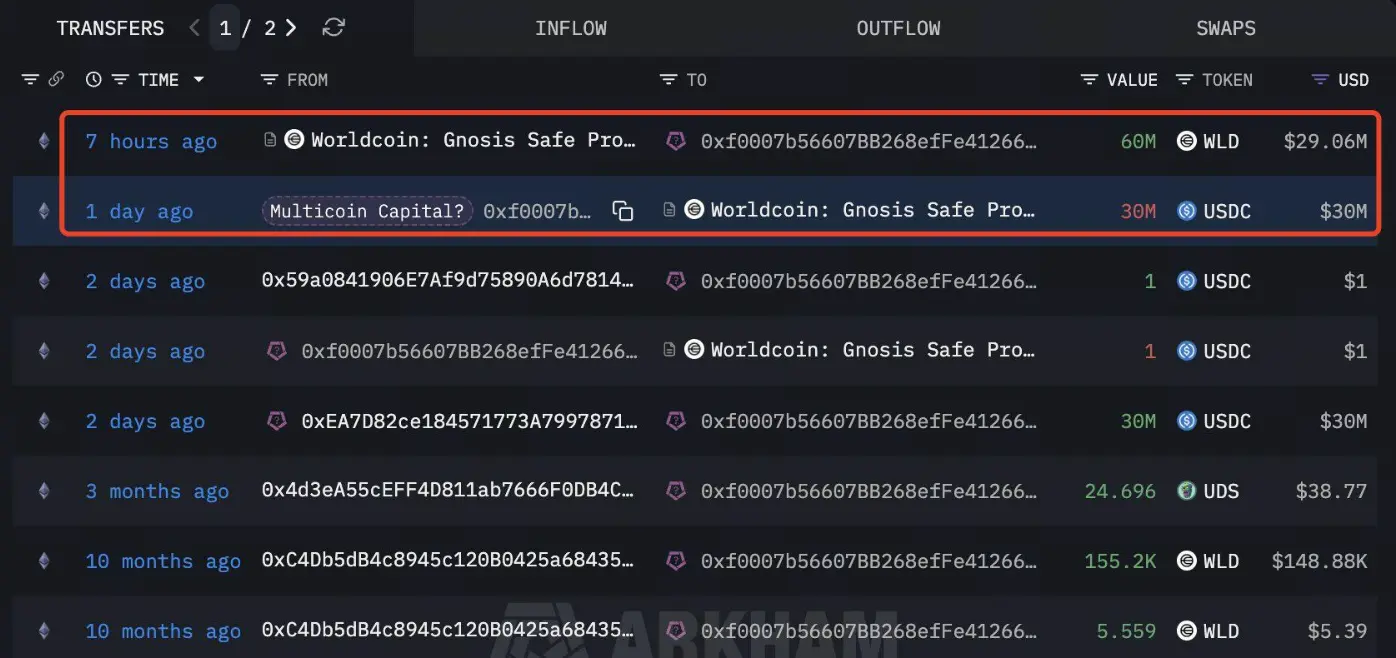
(Source: X/Lookonchain)
This move by Multicoin Capital aligns with its “ thesis-driven” investment style. Founded in 2017, the fund is known for making bold bets and holding long-term positions in promising sectors. This increase is clearly not short-term speculation based on price trends but a further bet on the long-term prospects of the “biometric identity protocol.” However, the timing sharply contrasts with the market sentiment: while institutional funds quietly entered, retail interest in Worldcoin is rapidly cooling.
Key details of Multicoin Capital’s OTC transaction:
Counterparty: Worldcoin project team
Method: Off-market trade
Payment: 30,000,000 USDC
Assets received: 60,000,000 WLD
Estimated unit price: approx. $0.5/WLD
Transaction date: Recently monitored (within the past day)
Related address: 0xf0007b56607BB268efFe4126655f077F8cf42696
Data source: Lookonchain on-chain monitoring
A series of data points confirm this retail withdrawal trend. According to Dune Analytics dashboards, the number of daily active wallet addresses on the Worldcoin network peaked in September 2025 and has since declined sharply. Meanwhile, Google Trends data show global search interest for “Worldcoin” dropping from a peak of 100 in September to just 6 at press time, a decline of over 90%. The initial hype was largely fueled by the listing of WLD trading pairs on major centralized exchanges, which briefly boosted prices, but now the tide has receded. This stark divergence between institutional and retail behaviors paints one of the most dramatic scenes in the current Worldcoin ecosystem.
Worldcoin in a Tight Spot: Weak Prices and Global Regulatory Crackdowns
If it were only retail interest waning, it might not be a fatal threat. But Worldcoin now faces a dual “stress test” from price declines and regulatory pressures. Market data reflect these fundamental challenges: according to BeInCrypto, WLD’s price has fallen over 21% in the past month. Although it rebounded slightly by 2.57% in the last 24 hours to around $0.49614, the overall downtrend remains intact. Weak prices are driven by a combination of market sentiment, supply-demand dynamics, and external risks.
More troubling than price declines are the escalating global regulatory challenges. The most notable recent action came from Thailand. In late November, Thai regulators, including the Securities and Exchange Commission, jointly ordered Worldcoin operators to immediately cease collecting biometric data via iris scanners in the country. Even more severely, they demanded the deletion of biometric data from over 1 million Thai citizens. This was not unfounded; in October, Thai officials conducted a surprise inspection of a Worldcoin iris scan station in Bangkok, paving the way for the subsequent ban.
Jomkwan Kongsakul, Deputy Secretary-General of the Thai SEC, explained that the move aims to “enhance enforcement effectiveness against unlicensed digital asset activities, protect users from legal gaps, and reduce risks of scams and money laundering.” Essentially, this frames biometric data collection within the scope of financial regulation, suggesting it may involve unlicensed sensitive activities. Thailand’s actions are not isolated; earlier in May, the project faced similar regulatory setbacks in Indonesia and Kenya, where local activities involving the “Orb” iris scanner were restricted or investigated. These events depict a clear picture: a project aiming to establish a global digital identity is clashing fiercely with national laws centered on data privacy and security.
In-Depth Analysis: Why Did Multicoin Capital Make Such a Heavy Bet Now?
In a seemingly adverse environment, Multicoin Capital’s large investment decision must have a coherent logic. To understand this, first, it’s essential to grasp what Worldcoin is. Co-founded by OpenAI CEO Sam Altman and others, Worldcoin’s core vision is to create a global, privacy-preserving digital identity network (World ID) based on biometric (iris scan) verification. Users scan their irises with a dedicated device “Orb” to obtain a unique, verifiable “Proof of Personhood,” distinguishing real humans from bots in the digital realm. The WLD token is designed as a governance and utility token within this ecosystem.
For a “ thesis-driven” fund like Multicoin, the investment likely hinges on several core judgments: first, they believe “decentralized digital identity” is fundamental infrastructure for Web3 and the future internet—a high-potential sector. Despite current regulatory friction, this is a necessary phase for a nascent technology challenging old paradigms. Second, they may see Worldcoin’s first-mover advantage, technological innovation (like zero-knowledge proofs for privacy), and Sam Altman’s personal influence as creating a strong moat. The current price weakness and regulatory pressures could be viewed as a “low-cost entry point” for acquiring significant stakes.
Furthermore, the OTC approach itself is meaningful. It avoids causing sharp price swings from large public market purchases and indicates a deep partnership with the project team. This is not just financial investment but possibly a strategic alliance—Multicoin might play a more active role in governance, ecosystem development, and compliance dialogue. Historically, top-tier VCs’ contrarian bets often have foresight—they bet on a 3-5 year horizon, not just the current market noise. This heavy bet can be seen as Multicoin’s long-term wager that “biometric identity protocols” will find a balance with global regulation and become a key digital infrastructure.
Current Status and Future Challenges of Worldcoin: Can It Cross the “Singularity”?
Setting aside capital maneuvers, the project itself is at a critical “crossing the singularity” stage. Its tokenomics tightly link token distribution with user growth (via iris verification), creating strong network effects early on. However, this growth model faces dual bottlenecks: high costs and regulatory restrictions on deploying and operating “Orb” devices, and the challenge of attracting broader mass participation and recognition of WorldID’s value as early curiosity wanes.
Long-term success depends not only on the identity protocol but also on building “killer apps” on top of WorldID—such as anti-sybil mechanisms in airdrops, governance, and community access; differentiating real users from bot armies in social/content platforms. When WorldID becomes as ubiquitous as email or phone numbers, serving as a passport to high-value services, its network value could explode. The team is working toward this, but ecosystem development takes time and faces competition from other identity solutions (social graph proofs, passport KYC, etc.).
Technical privacy concerns remain a looming threat. Despite emphasizing zero-knowledge proofs to ensure irreversibility and non-storage of raw biometric data, public trust and regulatory acceptance of handling such sensitive data by a private entity are not built overnight. Transparency audits, multi-party governance, and collaboration with regulators are long-term challenges. Multicoin’s funding can provide resources, but cannot directly solve fundamental product and trust issues.
Market Insights: Reading New Crypto Investment Logic from Institutional Moves
Multicoin’s contrarian investment in Worldcoin offers a valuable microcosm for understanding current crypto market dynamics. It highlights how institutional and retail behaviors and decision timelines are diverging further. Retail investors tend to be influenced by short-term price trends, market sentiment, and hot topics, showing trend chasing or panic selling. Top institutions focus more on fundamental research, team execution, and identifying mispriced long-term assets during downturns.
This event also reminds investors that for projects involving cutting-edge tech, complex governance, and heavy regulation, traditional technical analysis may have limited effectiveness. Their value drivers are more related to ethical and legal boundaries of biometric tech, evolution of global data governance policies, and actual adoption of identity layers in the next-generation internet. Evaluating such projects requires interdisciplinary understanding and high risk tolerance.
For ordinary market participants, institutional moves are worth noting but should not be blindly followed. It’s crucial to understand the underlying thesis and decide whether you agree with the long-term narrative. The market may be shifting from a “liquidity-driven” bull run to a “fundamentals-driven” structural trend. Capital will flow more selectively into projects with genuine technological breakthroughs, practical solutions, or clear compliance paths—even if they face short-term pressure. Whether Worldcoin ultimately overcomes regulatory hurdles and becomes a digital identity giant or falters in the face of competition, its story will serve as a valuable case study for how crypto can integrate with real-world rules.


