US Senator Cynthia Lummis has dismissed claims that the Digital Asset Market Clarity Act fails to protect decentralized finance innovators from legal repercussions, rebutting that recent changes to the draft will make it the “strongest protection for DeFi and developers ever enacted.”
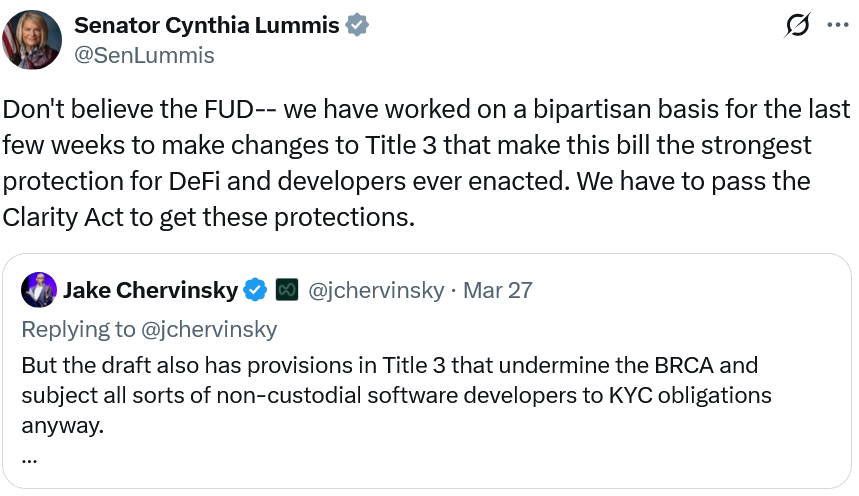
Her comments on Friday came in direct response to crypto lawyer Jake Chervinsky, who argued that Title 3 of the current draft undermines the Blockchain Regulatory Certainty Act — another crypto bill focused on developer protections — by subjecting non-custodial software developers to know-your-customer obligations.
“Don’t believe the FUD,” Lummis said, adding, “We have worked on a bipartisan basis for the last few weeks to make changes to Title 3 that make this bill the strongest protection for DeFi and developers ever enacted. We have to pass the Clarity Act to get these protections.”
The latest changes to the CLARITY Act have not been publicly released.
_Source: _Cynthia Lummis
Chervinsky said these DeFi protection provisions have been overshadowed by intense focus on stablecoin rewards provisions in the CLARITY Act.
His biggest issue with the Senate Banking Committee’s latest CLARITY Act draft is that Title 3’s money transmitter definitions could still expose many non-custodial DeFi builders to liability.
This is despite the CLARITY Act incorporating the BRCA in section 604, which clarifies that non-controlling developers and providers of non-custodial software are not to be treated as financial institutions subject to Bank Secrecy Act KYC obligations.
“The biggest challenge is ensuring non-custodial software developers aren’t misclassified as money transmitters,” Chervinsky argued.
“That’s non-negotiable for DeFi, and it’s still unsettled.”
His concerns come amid several high-profile prosecutions and convictions of developers in the US in recent months, including Tornado Cash co-founder, Roman Storm, who was convicted in August 2025 of conspiracy to operate an unlicensed money transmitting business.
**Related: **__Delaware eyes stablecoin licensing framework under banking laws
US lawmakers have said the CLARITY Act is moving closer toward a Senate Banking Committee markup expected in April after recent bipartisan progress on stablecoin rewards provisions.
Passage of the CLARITY Act is necessary to ensure DeFi developers are afforded legal protections under the BRCA, Lummis noted.
**Magazine: **__Are DeFi devs liable for the illegal activity of others on their platforms?
Cointelegraph is committed to independent, transparent journalism. This news article is produced in accordance with Cointelegraph’s Editorial Policy and aims to provide accurate and timely information. Readers are encouraged to verify information independently. Read our Editorial Policy https://cointelegraph.com/editorial-policy
- #Law
- #United States
- #Bills
- #Developers
- #DeFi
- #Regulation
Disclaimer: The information on this page may come from third parties and does not represent the views or opinions of Gate. The content displayed on this page is for reference only and does not constitute any financial, investment, or legal advice. Gate does not guarantee the accuracy or completeness of the information and shall not be liable for any losses arising from the use of this information. Virtual asset investments carry high risks and are subject to significant price volatility. You may lose all of your invested principal. Please fully understand the relevant risks and make prudent decisions based on your own financial situation and risk tolerance. For details, please refer to
Disclaimer.
Related Articles
U.S. Navy admiral: Bitcoin has become a tool for America’s “power projection,” and cyber security should have major scientific significance
U.S. Navy Admiral Samuel Paparo said Tuesday at a hearing of the Senate Armed Services Committee that Bitcoin, as a means of power projection, is “a very valuable computer science tool,” and he noted that Bitcoin’s Proof of Work (PoW) technology “imposes greater costs on attackers trying to breach networks,” adding that its cybersecurity applications have “very important” computer science significance.
MarketWhisper1h ago
Ripple CEO praises SEC’s new direction, and U.S. crypto regulation enters a reset mode
Ripple CEO Brad Garlinghouse publicly praised the regulatory shift driven by the newly appointed Securities and Exchange Commission (SEC) chair, Paul Atkins, on April 20, describing it as “a refreshing breath of sanity that helps people regain their composure.” Garlinghouse viewed the SEC’s policy pivot as the key driver behind an improvement in sentiment across the U.S. crypto market.
MarketWhisper2h ago
Russia’s State Duma has passed a crypto bill on first reading, with the central bank taking the lead in regulating bitcoin and other assets
The Russian State Duma passed on first reading the bill “On Digital Currency and Digital Rights” on April 22, with 327 lawmakers voting in favor. Once the bill formally takes effect, cryptocurrencies will be legalized in Russia, allowing ordinary Russian citizens to legally buy digital assets through licensed intermediary institutions. The Bank of Russia (CBR) will become the primary regulator, responsible for issuing licenses and approving or banning crypto transactions.
MarketWhisper2h ago
U.S. House Introduces PACE Act to Grant Qualified Digital Asset Firms Direct Access to Federal Reserve Payment System
The PACE Act would let qualified digital asset and fintech firms access the Fed's payment system, aiming to cut delays and costs through direct Fed access, with regulatory safeguards and consumer protections.
Abstract: The U.S. House introduced the Payments Access and Consumer Efficiency (PACE) Act to allow qualified digital asset, fintech, and other service providers to connect directly to the Federal Reserve's payment system. The bipartisan bill, by Reps. Young Kim and Sam Redo, aims to cut delays and fees by enabling direct Fed access under OCC oversight, with streamlined registration, consumer protections, supervisory enforcement, and bankruptcy provisions. Industry advocates argue that direct access would foster faster, cheaper, and more competitive payment services while maintaining safeguards for innovation.
GateNews2h ago
Singapore MAS Releases Guidance to Optimize Crypto Asset Capital Requirements for Public Blockchains
Gate News message, April 22 — Singapore's Monetary Authority (MAS) has released a consultation paper to establish more favorable regulatory capital guidance for crypto assets on permissionless blockchains (public blockchains) ahead of implementing
GateNews3h ago
China Strengthens Oversight of Token Trading, Cracks Down on Speculation and Illicit Activities
Gate News message, April 22 — China's Economic Daily published an article highlighting the need to regulate token trading and combat illegal activities. The report warns that tokens face risks including identity theft from leaks, permission forgery, and unauthorized commission schemes by bad
GateNews3h ago


