
The February employment report released by the U.S. Bureau of Labor Statistics (BLS) shows that the United States unexpectedly lost 92,000 jobs this month, significantly below market expectations. Meanwhile, data from the Federal Reserve Bank of St. Louis indicates that by the end of 2025, job openings in the finance and insurance sectors have fallen to their lowest level in 13 years, a 75% reduction since the peak in 2022.
Collapse of Job Openings in the Financial Sector: Multiple Historical Comparisons Indicate Structural Contraction
(Source: CNN)
According to the latest data from the Federal Reserve Bank of St. Louis, hiring vacancies in the finance and insurance industries are experiencing structural decline. Coindesk highlights several notable historical comparison points: since reaching a peak in 2022, job openings in finance and insurance have decreased by 410,000, a 75% drop; last month’s vacancies fell to 134,000, an 117,000 decrease from December of the previous year; the current level of vacancies is not only below 2012 but has also fallen below the recession lows of 2001, and is the lowest since February 2010.
In terms of vacancy rate, the vacancy rate in finance and insurance has dropped to 1.9%, meaning fewer than 2 out of every 100 positions are vacant. By comparison, during the 2008 financial crisis, the largest monthly decline was 125,000. The ongoing contraction in vacancies reflects a significant slowdown in hiring activity, often seen as a leading indicator of layoffs.
February Employment Report: Industry Layoff Details and Bright Spot in the Financial Sector
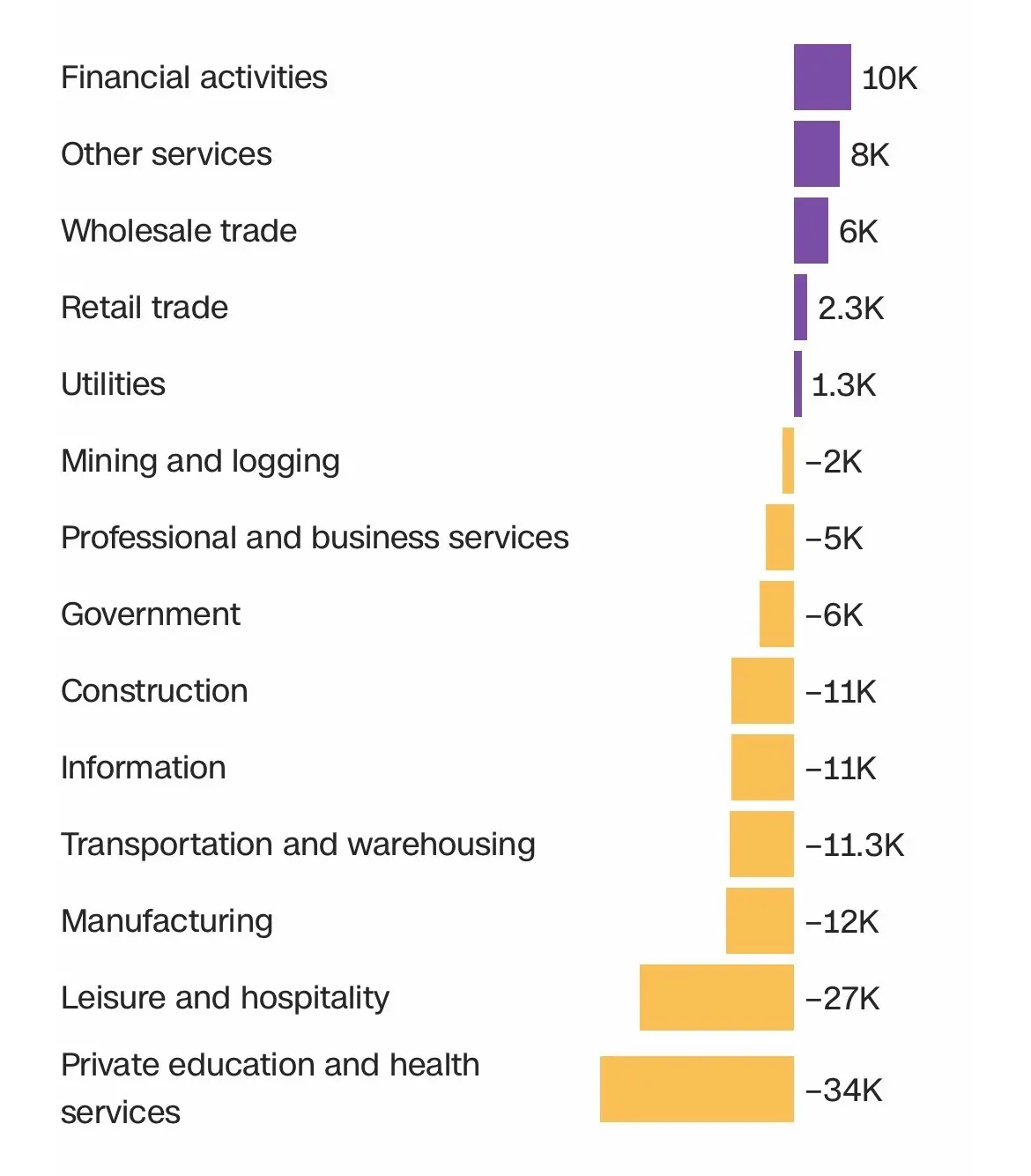
Despite the long-term decline in hiring within the financial industry, the February non-farm payroll report shows that the “Financial Activities” sector added 10,000 jobs this month, making it one of the few bright spots in the overall unemployment report.
The net employment changes across industries for February are as follows:
- Healthcare: -28,000, accounting for about 30% of total unemployment that month, mainly due to Kaiser Permanente’s four-week strike ending at the end of the month
- Information Industry: -11,000
- Transportation and Warehousing: -11,000
- Federal Government: -10,000
- Financial Activities: +10,000, a countertrend positive growth
CNN notes that extreme weather may have had some impact on the February employment data, but the BLS states that weather-related effects are difficult to quantify precisely.
Market Implications of Employment Data: Fed Policy Expectations and Dual Effects on Crypto Markets
Weak employment data is often seen as a signal to increase the likelihood of the Federal Reserve (Fed) cutting interest rates, as a cooling labor market is interpreted as a need for monetary policy to balance inflation pressures with supporting employment. In theory, a rate cut environment is favorable for risk assets, including cryptocurrencies.
However, Coindesk also points out an alternative perspective: overall weakness in the employment market may reflect economic fragility, prompting investors to adopt risk-averse strategies and reduce allocations to high-risk assets. If the contraction in financial sector hiring leads to widespread layoffs, it could further dampen overall market sentiment.
Frequently Asked Questions
Why is the number of financial sector job openings considered a leading indicator of layoffs?
A continuous decline in job openings suggests that companies are halting active recruitment over a period, which typically precedes actual layoffs. Currently, the job opening rate in finance and insurance is only 1.9%, below the levels seen during the 2001 and 2008 recessions. Historically, such contraction in vacancies often occurs months before companies begin significant layoffs.
What are the main reasons behind the unexpected loss of 92,000 jobs in the U.S. February employment market?
According to the BLS report, the healthcare industry was the largest drag, losing 28,000 jobs mainly due to Kaiser Permanente’s four-week strike. The information industry and transportation & warehousing each lost 11,000 jobs, and the federal government lost 10,000. CNN adds that extreme weather may have had some impact on the data but is difficult to quantify.
How does the financial sector employment data affect the crypto market?
Weakness in the financial employment sector could increase the chances of the Fed cutting interest rates, which is generally seen as positive for risk assets like cryptocurrencies. However, overall employment weakness may also trigger risk-averse sentiment among investors, leading to reduced allocations to volatile assets, creating a dual effect on the crypto market.
Disclaimer: The information on this page may come from third parties and does not represent the views or opinions of Gate. The content displayed on this page is for reference only and does not constitute any financial, investment, or legal advice. Gate does not guarantee the accuracy or completeness of the information and shall not be liable for any losses arising from the use of this information. Virtual asset investments carry high risks and are subject to significant price volatility. You may lose all of your invested principal. Please fully understand the relevant risks and make prudent decisions based on your own financial situation and risk tolerance. For details, please refer to
Disclaimer.
Related Articles
BTC edges up 0.46% in 15 minutes: institutional fund outflows and macro risk-off sentiment in sync drove the move
From 15:00 to 15:15 (UTC) on 2026-04-16, BTC logged a +0.46% return within 15 minutes. The price fluctuated in a range of 73,939.7 to 74,440.0 USDT, with an amplitude of 0.68%. During this time window, market attention increased, short-term volatility intensified, and fund-flow characteristics changed noticeably.
The main driver of this deviation is the continued outflow of large amounts of capital from exchanges. According to on-chain data, in the past 24 hours the net flow was -14,408.84 BTC, mainly concentrated in large transfer ranges of more than $1 million (especially>$10M net outflow -12,987.03 BTC). This shows that institutions and large holders actively reduced their BTC holdings on exchanges, and short-term selling pressure was significantly lowered. Against the backdrop of persistently weak liquidity, with order book depth remaining at a low level for a long time, the price has become more sensitive to medium-sized buy orders—amplifying the impact of even modest inflows on spot market price action.
In addition, macro conditions changed in parallel and produced a synchronized effect: easing geopolitical tensions in the Middle East boosted overall market sentiment. International gold prices rose, global equity markets hit new highs, and the market re-evaluated the probability of the Federal Reserve cutting rates within the year, further increasing investor attention to safe-haven assets (including BTC). At the same time, on-chain data indicates that the “whale” trading activity during this phase is at an annual low (>$1M transfers fell to 1,485 transactions). With heavy market wait-and-see sentiment and limited short-term supply, BTC’s responsiveness to sudden buy-side capital was further enhanced.
Investors should be reminded that current market liquidity is still fragile. Insufficient order book depth increases the market’s sensitivity to large capital movements, and short-term volatility may intensify. Going forward, focus on further shifts in on-chain large-fund flows, changes in price action as it breaks through support or resistance regions, and the risks and opportunities brought by related macro policies and geopolitical developments. Please continue to track key data and stay alert to any sudden shocks during the period of abnormal moves.
GateNews4h ago
US Energy Secretary Wright Pledges Additional Measures to Lower Gasoline Prices
Gate News message, April 16 — U.S. Energy Secretary Wright announced that the United States will take additional measures to lower gasoline prices, according to Golden Ten.
GateNews4h ago
Grayscale Signals $2.2T Crypto Inflow Potential as $110T Wealth Transfer Accelerates Allocation Shift
A generational shift in wealth is poised to influence investment strategies, with younger investors likely to increase crypto allocations. Grayscale notes that as $110 trillion in wealth transitions from baby boomers, $2.2 trillion could flow into digital assets, enhancing their portfolio roles.
Coinpedia4h ago
Philadelphia Federal Reserve Manufacturing Index Surges to 26.7, Beating Expectations of 10
The Philadelphia Federal Reserve's Manufacturing Index rose to 26.7 in April, far exceeding the expected 10 and surpassing the forecast range, signaling robust manufacturing activity in the Mid-Atlantic region.
GateNews6h ago
US Ends Oil Waivers for Iran and Russia, Threatens Secondary Sanctions on Buyers
The Trump administration will not renew sanctions waivers for Iranian and Russian oil, prompting threats of secondary sanctions against countries, particularly China, buying Iranian oil. This decision ends efforts to stabilize global oil prices amidst ongoing Middle East tensions.
GateNews8h ago
Indonesian Rupiah Hits Record Low Against Singapore Dollar Amid Iran War Oil Shock
Indonesia's rupiah has hit a record low against the Singapore dollar due to rising oil prices and capital outflows from financial markets. Concerns about demand for Singaporean services and export flows to Indonesia are growing. The central bank's interventions aim to stabilize the currency.
GateNews9h ago


