The measures seek to fully integrate crypto exchanges into the established financial system and protect the identity information of the institution’s customers. The Central Bank states that this will promote “transparency, comparability, and predictability of information provided to the market.”
Brazil Issues Resolution Including Crypto Brokerages to Comply With Bank Secrecy Laws
Brazil is moving to integrate crypto exchanges into its financial ecosystem.
The National Monetary Council and the Central Bank of Brazil recently approved Resolution No. 5,280, which brings new compliance rules for virtual asset service providers in the country.
The resolution, which states that virtual asset service providers (VASPs) will be considered financial institutions under the Brazilian Bank Secrecy Act, seeks to establish an equivalent regulatory treatment for all exchanges operating in the local financial system and the mechanisms needed to protect it.
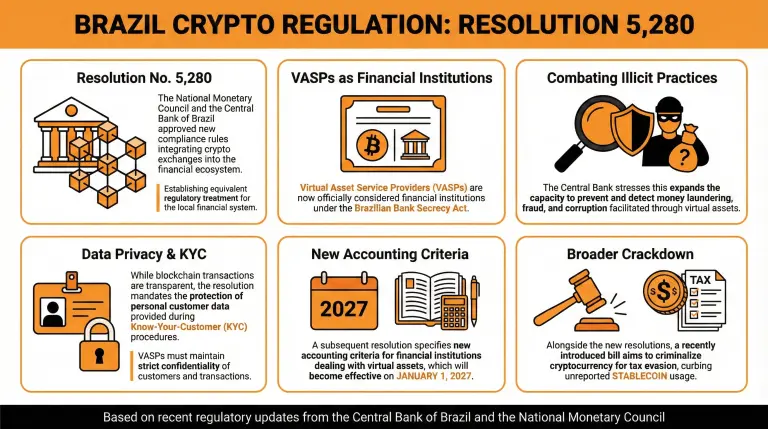
The Central Bank of Brazil stressed that this move “expands the capacity to prevent, detect, and combat illicit practices—such as money laundering, fraud, corruption, and other irregularities—that may be facilitated through the use of virtual assets.”
While blockchain transactions are transparent, given the nature of these structures, experts like Tiago Severo stressed that the identification and personal data of customers, provided when completing Know-Your-Customer (KYC) procedures, is what this resolution seeks to protect.
At the same time, it increases the responsibility of these institutions, which will have to take into account already established provisions regarding the confidentiality of their customers and their transactions.
In a subsequent resolution, the two institutions also approved a new resolution that specifies the accounting criteria that financial institutions dealing with virtual assets must follow.
The central bank states that regulatory clarity will contribute to investor confidence, assigning a clearer role to VASPs about the duties these institutions should fulfill.
The bank secrecy measure is already being applied, while the new accounting rules for financial institutions are set to become effective on January 1, 2027.
Recently, a bill criminalizing cryptocurrency for tax evasion was introduced into Congress, aiming to curb the usage of stablecoins for unreported payments and transactions.
FAQ
- What recent resolution has Brazil approved regarding crypto exchanges?
Brazil approved Resolution No. 5,280, integrating crypto exchanges into its financial ecosystem as virtual asset service providers.
- How does Resolution No. 5,280 affect virtual asset service providers (VASPs)?
VASPs will now be classified as financial institutions under the Brazilian Bank Secrecy Act, requiring compliance with new regulations.
- What is the goal of this regulatory change by the Central Bank of Brazil?
The aim is to enhance the detection and prevention of illicit practices, including money laundering and fraud, associated with virtual assets.
- When will the new accounting rules for financial institutions dealing with virtual assets take effect?
The new accounting criteria for financial institutions will become effective on January 1, 2027.
Disclaimer: The information on this page may come from third parties and does not represent the views or opinions of Gate. The content displayed on this page is for reference only and does not constitute any financial, investment, or legal advice. Gate does not guarantee the accuracy or completeness of the information and shall not be liable for any losses arising from the use of this information. Virtual asset investments carry high risks and are subject to significant price volatility. You may lose all of your invested principal. Please fully understand the relevant risks and make prudent decisions based on your own financial situation and risk tolerance. For details, please refer to
Disclaimer.
Related Articles
Canada Moves to Ban Crypto Donations in Elections in New Bill
Canada’s bill C-25 proposes bans of crypto donations and similar methods due to traceability and identity verification concerns.
Law applies to parties, candidates, and third parties, with strict penalties and enforcement measures.
Shift follows rising transparency concerns, moving from r
CryptoFrontNews1h ago
UNI and AAVE are the first to be hit! Analyst: The CLARITY Act could seriously damage the DeFi yield myth
《Digital Asset Market Clarity Act (CLARITY Act)》 focuses on stablecoin regulation. If it passes, it will have a major impact on DeFi protocols, especially by banning platforms from offering yield on stablecoins. This will cause returns to be re-concentrated in traditional financial institutions, shrinking the competitive space for crypto platforms. The report warns that multiple DeFi projects such as Uniswap and Aave may face stricter regulation, affecting trading volume and liquidity.
区块客3h ago
Coin Center Warns US Crypto Crackdown Possible Without Clear Rules
Peter Van Valkenburgh warns that without passing the CLARITY Act, future U.S. administrations may impose strict regulations on crypto. He emphasizes the need for statutory protections to prevent reliance on political climates, as current agreements stall in Congress.
CryptoBreaking3h ago
Pro-XRP Attorney and Ripple CEO Agree the U.S. Can’t Afford Another Gary Gensler Moment
The pro-XRP attorney John Deaton has concurred with recent remarks by Ripple CEO Brad Garlinghouse that the United States cannot afford another Gary Gensler experience. He was the former chair of the U.S. Securities and Exchange Commission (SEC).
In a tweet explaining his opinion, Deaton insisted t
CryptoPotato4h ago
Pierre Rochard’s warning about the Bitcoin gap in the Basel III revision
Pierre Rochard warns that the U.S. regulatory approach to Bitcoin in the Basel III revision lacks clarity. He emphasizes the need for transparent criteria and data for banks to manage Bitcoin risks, cautioning that ambiguity may hinder financial innovation and compliance.
TapChiBitcoin4h ago
The Clarity Act hangs in the balance: the SEC may hold crypto accountable, and Ripple and developers face immense pressure
The prospects of the "Clarity Act" are unclear, which may lead the SEC to reconsider cryptocurrencies as securities, increasing legal risks. Industry insiders warn that short-termism and conflicting interests may delay the passage of the bill, impacting the legal status of mainstream assets. Cryptocurrency lobbying groups are prepared to address regulatory risks, calling for unity to ensure the long-term safety of the industry.
GateNews7h ago


