The “Bye America” trading wave often reemerges when the market stops debating whether the U.S. is still the “safest house on the block” and begins debating the price to pay for staying in that house.
Over the past week, this debate has been clearly reflected in the currency markets through the weakening of the US dollar. The USD’s decline rarely stands alone as a story, but it often triggers a familiar chain of consequences: global investment portfolios reassess their exposure to US assets, hedging costs are recalculated, and risk budgets within portfolios are adjusted.
Bitcoin is somewhat benefiting from this wind. However, this development only makes sense if viewed beyond simple chart models and with a clear understanding of how foreign exchange (FX) volatility transmits into the crypto market.
Bitcoin does not trade directly against the US dollar but rather follows macroeconomic conditions shaped by factors influencing the USD—especially real yields, hedging costs, and how risk is allocated within investment portfolios.
When these factors align, Bitcoin can move as an alternative macro asset. When they are out of sync, Bitcoin often behaves like a high-beta asset sensitive to liquidity, prone to sell-offs when cash becomes scarce.
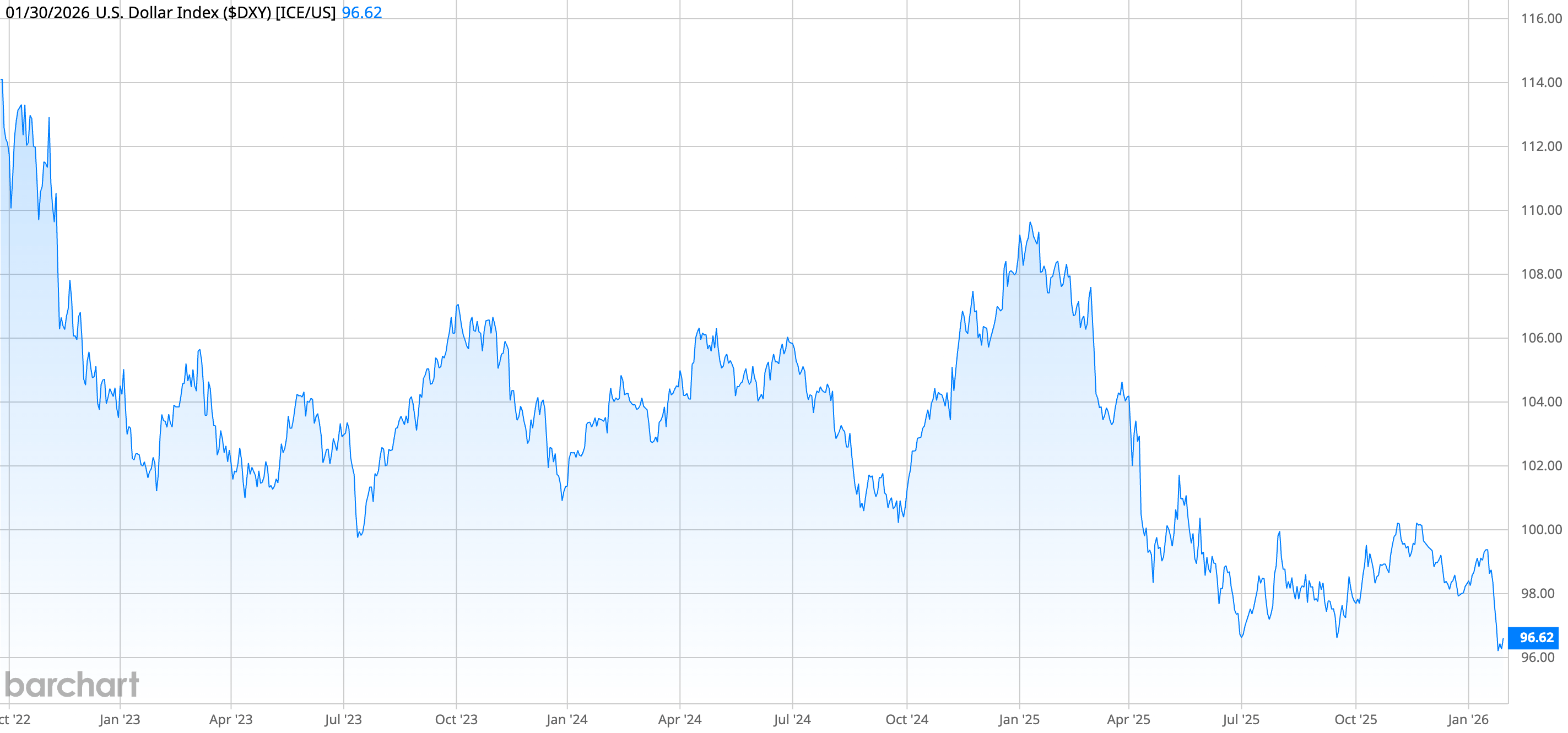 Chart showing the US Dollar Index (DXY) from September 26, 2022, to January 30, 2026 (Source: Barchart)## What Does “Bye America” Really Mean in the Market?
It sounds like a political slogan, but in the market, “Bye America” is essentially a story about portfolio accounting.
It’s a shorthand way of saying that global investors are becoming less comfortable holding risk related to the US at current prices, or are no longer willing to hold those assets without currency risk hedging—or both.
This can happen for multiple reasons simultaneously. The market might be repricing the Fed’s policy path, especially as growth cools and rate cuts become more likely. Fiscal risk could also be reassessed, focusing on budget deficits and future debt issuance.
Additionally, policy uncertainty often quickly reflects in the foreign exchange market, because FX is where global investors express discomfort without needing to sell off entire equity or bond holdings.
The key point is: although the headline sounds negative, the essence of this trade is mostly mechanical. Investors don’t need to emotionally “turn their back on America”; they only need to find that the expected yields after currency adjustments, hedging costs, and volatility are no longer attractive compared to other options.
Bitcoin can benefit from this rebalancing process, but also through these very mechanisms. It is added to the list when investors seek assets less tied to US policy outcomes, less dependent on US bond duration, or more broadly, less linked to US institutional risk.
Four Transmission Channels from FX to Bitcoin Demand
1. Global Financial Conditions
This is the most confusing channel. A weaker USD can loosen global financial conditions because most credit and trade are still priced in USD.
If USD weakness results from expectations of looser monetary policy, global risk appetite may improve, and Bitcoin often benefits along with other risk assets.
However, a weaker USD can also appear in tense environments. If the cause is instability, political risk, or sharp interest rate volatility, the same exchange rate movement might be accompanied by risk tightening within portfolios. In such cases, the USD chart may look “risk-on,” but the actual portfolio reaction could be to reduce risk exposure.
This explains why the relationship between the USD and Bitcoin is unstable, even if it seems very “logical” in hindsight.
2. Real Yields
Real yields condense many macro factors into a single number. When real yields fall, assets with longer durations tend to be “more affordable” because discount rates decrease and the opportunity cost of holding non-yielding assets drops.
Bitcoin often trades based on this mechanism, even though it is not a bond and does not generate cash flows. It belongs to the group of assets sensitive to liquidity and discount rates, so a declining real yield environment can encourage investors to pay higher prices for scarce assets.
This also explains why Bitcoin behaves differently from gold. Gold has a long history as a reserve and collateral asset. Bitcoin’s similar role is newer and more dependent on market structure.
When liquidity is abundant and macro variables are favorable, Bitcoin can be seen as an alternative to gold. But when liquidity tightens, it becomes more vulnerable to sell-offs as a risk asset.
3. Hedging Costs and Cross-Border Capital Flows
For non-US investors, owning US assets means a double bet: on the asset itself and on the USD. Hedging currency risk provides more stable returns but incurs costs.
These costs depend on interest rate differentials and USD supply-demand conditions in the swap market. When hedging becomes more expensive, investors must choose: accept currency volatility or reduce exposure to US assets.
This doesn’t require a shock to global reserve currency positions; just less attractive hedging at the margin can impact capital flows. When many investors adjust similarly, the valuation of US assets and capital flows into alternatives are affected.
Bitcoin doesn’t automatically receive this capital, but in a world where investors become more cautious about holding unhedged USD assets, non-sovereign assets like Bitcoin will be more seriously considered in portfolios, especially as small diversification alongside commodities or gold.
4. Intrinsic Leverage in the Crypto Market
This is often the decisive factor in whether a rally is sustainable. Bitcoin can rise driven by spot demand (spot-led) or by leverage in derivatives markets (leverage-led).
Spot-driven rallies tend to be slower but more durable because they rely on real buyers using actual money.
In contrast, leverage-driven rallies can be very strong initially but fragile, as they depend on traders continuously paying fees to maintain positions. When prices stagnate, liquidation pressures can quickly turn into a sell-off.
Therefore, the “plumbing” of the crypto market is just as important as macro stories. A macro shock that boosts spot demand can absorb volatility. But if the rally is mainly driven by futures leverage, the upward momentum can vanish in a single day.
When Does This Story Truly Matter for Bitcoin?
For the “Bye America” framework to genuinely support Bitcoin, initial evidence will likely be quite “boring”: it’s about persistence, not fireworks.
Macro factors favoring Bitcoin need to remain stable—this doesn’t require the USD to decline every day, but the overall picture must continue to tilt toward easier financial conditions, lower real yields, and volatility at manageable levels.
As long as this environment holds, investors can continue allocating capital, and Bitcoin can gradually rise even without dramatic breakout moments.
Meanwhile, demand must also come from underlying cash flows rather than excessive reliance on leverage. Capital inflows into ETFs could signal underlying demand, though daily data can be noisy.
Conversely, a failure scenario often involves a sharp reversal: the USD rebounds alongside rising real yields. This combination would tighten financial conditions and increase the cost of holding non-yielding scarce assets like Bitcoin.
More importantly, a sharp increase in volatility could force mechanistic risk-control funds to reduce positions broadly. During such times, Bitcoin won’t be “favored” and will be sold like other liquid assets—simply because risk limits are hit and cash becomes a priority.
Thus, the simplest way to view Bitcoin’s outlook in the coming weeks is to identify which channel is truly leading.
If the momentum comes from declining real yields and stable capital allocation, the rally could continue.
But if the main driver is crowded leverage based on bullish sentiment, it could vanish immediately when faced with a “hawkish” data point, a rate shock, or a spike in volatility forcing risk reduction.


