Global research and brokerage firm Bernstein, which manages over $790 billion in assets, has announced that the traditional four-year cryptocurrency cycle has ended. The firm has raised its 2026 Bitcoin price target to $150,000, projects a potential cycle peak of $200,000 in 2027, and has set a long-term target of $1 million by 2033. Analysts describe this as a “long-term bull market,” with the core logic being that institutional buying has created an entirely new market structure.
Institutional Buying Rewrites Bitcoin’s Rules of the Game

(Source: Sovryn)
Matthew Sigel, Head of Digital Assets Research at VanEck, cited Bernstein’s viewpoint, noting that after the recent market correction, “the Bitcoin cycle has broken its four-year pattern and is now in a longer bull market cycle, with more persistent institutional buying offsetting any panic selling by retail investors.” The supporting data for this conclusion is highly convincing. Although Bitcoin has dropped about 30% since early October, ETF outflows have only been around 5%, clearly highlighting the stark contrast between institutional investor confidence and retail behavior.
The traditional four-year cycle is rooted in Bitcoin’s halving mechanism, where mining rewards are halved every four years, supply shocks drive prices up, and a bear market correction follows. However, the entry of institutional investors has completely changed this logic. ETFs provide compliant channels, allowing pension funds, sovereign funds, and corporate treasury departments to steadily allocate to Bitcoin. This persistent buying is no longer driven by the halving cycle but by long-term asset allocation needs. Bernstein’s analysis shows that when institutional buying becomes the dominant force, market volatility decreases, bull market cycles lengthen, and the traditional four-year rhythm naturally becomes obsolete.
Fed Liquidity Injection as a Catalyst
Analysts David Brickell and Chris Mills from the London Crypto Club believe that the Fed’s liquidity injection on Wednesday could serve as a powerful catalyst, potentially driving Bitcoin “sharply higher.” They stated that the central bank is prepared to deliver a “dovish surprise.” They wrote, “As the Fed effectively turns on the printing press to monetize the deficit, we will enter a sustained rate-cutting cycle, and the balance sheet will also expand.”
This aligns perfectly with Bernstein’s $150,000 Bitcoin target from a macro narrative perspective. The M2 money supply has reached a record $22.3 trillion, and the reserve rebuild plan after the end of quantitative tightening may inject $35 billion in liquidity per month. Historical data shows that Bitcoin reacts more sensitively to liquidity cycles than to interest rate changes. After the Fed launched unlimited QE in March 2020, Bitcoin soared from $3,800 to $69,000, a direct result of excess liquidity. If liquidity continues to expand through 2026, the $150,000 target is entirely logical.
Technical Analysis Supports Long-Term Bull Market Thesis
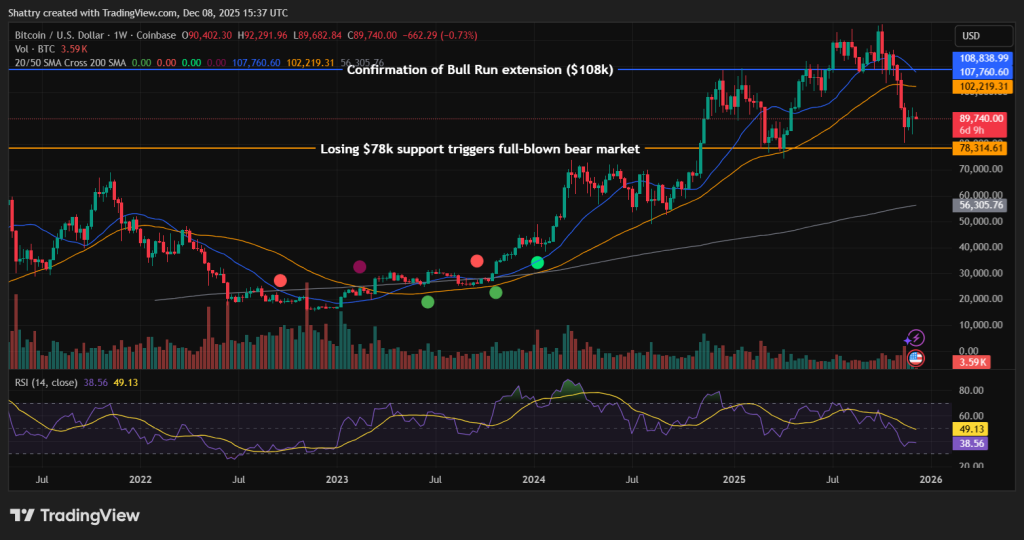
(Source: Trading View)
The weekly chart shows Bitcoin holding the critical $78,000 support level, which separates deeper bear market declines from the continuation of the macro uptrend. Prices have recently dropped sharply but have stabilized near the 20-week moving average, while the 50-week moving average continues to slope upward, indicating that despite the pullback, the long-term trend remains intact. The RSI momentum has cooled to the mid-40s, reflecting that the market has retreated from overbought conditions but has not reached the extreme oversold levels seen at major cycle bottoms.
As long as Bitcoin stays around the $78,000 area, this structure suggests it is in a consolidation phase within a larger bull market cycle. A rebound above $102,000 would indicate a resumption of the uptrend, while a break through the $108,000 resistance zone would confirm the price is reaching new highs. From a risk-reward perspective, the current position offers a good entry opportunity. If Bernstein’s forecast is realized, moving from $90,000 to $150,000 represents 66% upside potential.
Bernstein’s revolutionary forecast is not just a numbers game but a recognition of a fundamental shift in Bitcoin’s market structure. As institutions become the dominant force and Bitcoin evolves from a speculative tool to an allocation asset, traditional cycles naturally break down, and a long-term bull market becomes the new normal.
Disclaimer: The information on this page may come from third parties and does not represent the views or opinions of Gate. The content displayed on this page is for reference only and does not constitute any financial, investment, or legal advice. Gate does not guarantee the accuracy or completeness of the information and shall not be liable for any losses arising from the use of this information. Virtual asset investments carry high risks and are subject to significant price volatility. You may lose all of your invested principal. Please fully understand the relevant risks and make prudent decisions based on your own financial situation and risk tolerance. For details, please refer to
Disclaimer.
Related Articles
Wintermute: Energy is building in the crypto market, but the direction is unclear—there may be a sudden surge in trading activity.
Wintermute says the easing window for the situation is coming to an end. The cap on risk assets is lower than before, making it difficult for Bitcoin to stay above $700,000. If diplomatic progress goes smoothly and oil prices pull back, Bitcoin could rebound to $70,000–$74,000; if conditions deteriorate, it could fall to $60,000, or even to $50,000–$55,000. The extent of market volatility may exceed current pricing.
GateNews48m ago
Bitcoin Breaks Crucial Neckline Area of Bullish Pattern, Analysts Prepare for $50,000 BTC Prices
Bitcoin breaks crucial neckline area of bullish pattern.
This has sent analysts into a bearish frenzy, expecting lower prices.
The price of BTC is expected to hit targets between $48,000 and $55,000 next.
The crypto community continues to watch price charts closely to determine what
CryptoNewsLand1h ago
We Asked 2 AIs: What Must XRP Do to Escape the Ongoing Crisis?
Alongside the rest of the crypto market, Ripple’s cross-border token tried to break out in the middle of the business week, surging to a monthly peak of over $1.60. However, the subsequent rejection pushed it south to under $1.50 as of press time.
Even the most recent developments on the Ripple
CryptoPotato1h ago
Bearish sentiment builds in crypto as volatility and hedging rise
The crypto market exhibited signs of volatility on Tuesday, with bitcoin BTC$66,223.90 spiking to $68,300 shortly after midnight UTC before tumbling back to $66,500.
The initial spike was spurred by reports that U.S. President Donald Trump was willing to end the war in Iran without the Strait of
CoinDesk1h ago
Stablecoins grow faster than expected as more new applications emerge
Stablecoin is experiencing faster growth than expected, driven by new applications like AI payments. However, Standard Chartered maintains its forecast of a $2 trillion market cap by 2028.
TapChiBitcoin2h ago
PI Network (PI) Price Predictions for This Week
PI Network's price has corrected from $0.30 to $0.17, indicating a 40% drop. Currently, it hovers around $0.18, presenting a bearish outlook unless it surpasses $0.20. Volume remains low, suggesting indecision among sellers, while the RSI stays under 50, signaling further potential declines.
CryptoPotato2h ago


