At an important node in the global digital currency development, stablecoin giant Tether officially issues the offshore Chinese Yuan stablecoin CNHT0 and the US Dollar stablecoin USDT0 on the Conflux tree graph public chain. The CNHT0 and USDT0 launched on Conflux, where CNHT0 is the fully on-chain deployment version of Tether's offshore Chinese Yuan (CNHT).
Dual Currency Launch: Strategic Significance of Tether's Native Assets
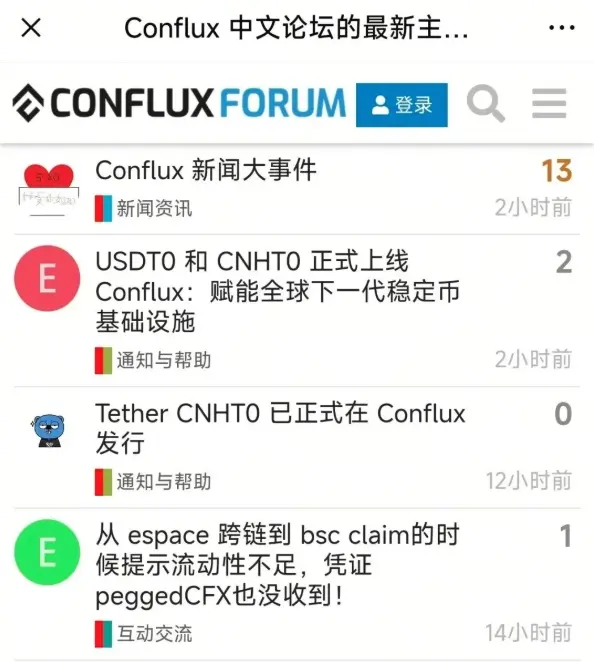
(Source: Conflux Chinese Forum)
The Conflux launch includes CNHT0 and USDT0, where CNHT0 is the full on-chain deployment version of Tether's offshore Renminbi (CNHT). Both stablecoins adopt LayerZero's OFT (on-chain fungible token) standard, allowing for the native flow of value backed by offshore Renminbi and USD across chains without the need for wrapped tokens or dispersed liquidity. The advantage of this technological architecture is that users can seamlessly transfer assets between different blockchains without going through a complex cross-chain bridging process.
Unlike the assets previously bridged through third parties, this time it is the native asset directly issued by Tether, which means higher security and lower transaction fees. For the Conflux ecosystem, this marks its official recognition by the leading stablecoin. Tether, as the world's largest stablecoin issuer managing a reserve of 181.2 billion USD and annual profits exceeding 10 billion USD, holds great symbolic significance in its choice.
CNHT0's strategic value as an offshore RMB stablecoin is particularly prominent. In the global financial system, while both offshore RMB (CNH) and onshore RMB (CNY) are renminbi, they differ in circulation scope and regulatory framework. Offshore RMB mainly circulates in international financial centers such as Hong Kong and Singapore, with fewer regulatory restrictions from mainland China, making it more suitable for international trade settlement and cross-border payments. Tokenizing offshore RMB can bring the liquidity of traditional foreign exchange markets into the blockchain ecosystem, providing a new settlement tool for cross-border commerce.
The Core Advantages of CNHT0 and USDT0
Native Issuance: Tether is issued directly rather than through a third-party bridge, ensuring better security and liquidity.
Full Chain Standard: Adopts LayerZero OFT standard, enabling native flow across multiple blockchains.
Dual Currency Hedging: Provides both USD and RMB pricing simultaneously to meet the needs of different users.
Compliance Endorsement: Tether's 1:1 reserve support and Conflux's regulatory recognition provide dual protection.
This dual-coin issuance strategy provides users with flexible asset allocation options. When the USD strengthens, users can hold USDT0; when there are expectations for the appreciation of the RMB, they can convert to CNHT0. This switching of coins would require complex foreign exchange trading processes in traditional finance, but can be completed instantly and at very low cost on-chain.
Conflux Tree Graph Public Chain: The Rise of China's Only Compliant Public Chain
Tether's choice of Conflux among many public chains is not accidental. As the only compliant public blockchain in China, Conflux has developed rapidly in recent years and has entered the first tier of public chains in the world. The Tree Graph public chain was designed by a scientific research team from Tsinghua University. The core members proposed a Tree Graph structure high-performance consensus algorithm, breaking the conventional thinking that “blocks must be linked in a chain.” This innovation has led to a breakthrough enhancement in performance for Conflux.
The Conflux tree graph public chain 3.0, officially launched in August this year, has improved its transaction processing capability to 15,000 TPS (transactions per second), achieving 75 times that of Ethereum, and reducing transaction confirmation time to within 26 seconds. This performance advantage allows Conflux to support large-scale commercial applications, especially in cross-border payment scenarios that are sensitive to transaction speed and cost. In traditional financial systems, cross-border transfers may take several days, while on Conflux, it can be completed in just a few seconds.
As of now, the Tree Graph public chain has processed a total of 170 million transactions, with over 25 million global users. Its consensus nodes peaked at 5,000, covering more than 40 countries across five continents. These figures prove that Conflux is not only a theoretical technological innovation but also a mature blockchain network that has been tested in practice. The scale of 25 million users ranks among the top in public chains, and the distribution of nodes covering more than 40 countries ensures the degree of decentralization and censorship resistance of the network.
Conflux holds a unique position in the Chinese blockchain ecosystem – it operates under regulatory approval and has supported multiple public infrastructure projects in China. This compliance is extremely rare in the global blockchain industry, as most public chains face regulatory uncertainty in China. Conflux's compliant status enables it to collaborate with government agencies, state-owned enterprises, and traditional financial institutions, an advantage that is difficult for other public chains to achieve.
Belt and Road Initiative Strategic Layout and Cross-Border Payment Applications
This cooperation is far from a simple technical deployment, but rather a high degree of alignment in strategic layout between both parties. In July this year, Conflux reached a strategic cooperation with AnchorX and Dongxin Ping to jointly promote the issuance of offshore RMB stablecoin and cross-border settlement applications in some “Belt and Road” co-construction countries. The three parties plan to conduct pilot projects in regions such as Central Asia and Southeast Asia, building a financial technology model that integrates “technology - compliance - security.”
The Belt and Road Initiative involves more than 140 countries and regions worldwide, with a trade scale reaching trillions of dollars. Payments and settlements in these cross-border trades still mainly rely on traditional banking systems and the SWIFT network, facing issues such as high costs, slow speeds, and significant exchange rate risks. The introduction of offshore RMB stablecoin provides innovative solutions to these pain points. Enterprises can use CNHT0 for instant settlement, significantly reducing transaction costs and time while avoiding exchange rate fluctuation risks.
Tether chose Conflux precisely because of its compliance advantages and technical strength in China and the broader Asian region. Tether has also deployed offshore RMB and USD stablecoins on Conflux, constructing a compliant digital asset bridge connecting the two major economies of China and the United States. This layout addresses the needs of cross-border trade and settlement, aiming to facilitate value transfer for institutional users in a compliant environment.
Tether's Strategic Transformation: From Stablecoin Giant to Digital Central Bank
As the world's largest stablecoin issuer, Tether has quietly transformed into a digital asset institution with characteristics of a central bank in recent years. As of 2025, Tether holds a reserve base of 181.2 billion USD, with annual profits exceeding 10 billion USD, a scale that can rival traditional central banks. This scale means that Tether is no longer just a technology company, but a systemically important financial institution.
Tether's business has long surpassed simple stablecoin issuance; it manages a diversified portfolio that includes short-term U.S. Treasury bonds, reverse repos, gold, and Bitcoin. In 2024, Tether officially expanded its business into four sectors: finance, data, energy, and education, with a portfolio covering over 120 companies. This diversification strategy has transformed Tether from a single-product company into a fintech group.
Deploying the offshore RMB stablecoin on Conflux is an important step in Tether's globalization strategy. Previously, Tether mainly focused on the US dollar stablecoin USDT, although it also issued euro and gold-backed stablecoins, their scale is far less than USDT. The launch of CNHT fills the market gap for RMB-denominated stablecoins, and the choice to deploy on Conflux, a compliant public chain in China, shows Tether's emphasis on the Asian market, especially the cross-border payment needs related to China.
For Conflux, this is not only a recognition of its technical strength but also an important indicator of its competitive advantage in the international digital currency arena. With the launch of the Tree Graph public chain 3.0 and the entry of Tether stablecoin, Conflux is already prepared to support larger-scale commercial applications. In the future, we can expect to see more cross-border payment, trade settlement, and financial innovation cases based on Conflux and CNHT0 in the countries along the “Belt and Road” initiative, which may reshape the global usage pattern of offshore RMB.
Potential Application Scenarios of Offshore RMB Stablecoins
Cross-border trade settlement: China and the countries along the Belt and Road can use CNHT0 for instant settlement of import and export trade.
Foreign Exchange Hedging Tools: Enterprises can utilize the conversion between CNHT0 and USDT0 for exchange rate risk management.
Digital Asset Deposit: Providing compliant participation channels in the cryptocurrency market for Chinese investors.
Remittance Service: Reduce the cost and time for overseas Chinese to remit money to the mainland.
A new chapter of digital currency is quietly being written on the tree diagram.


