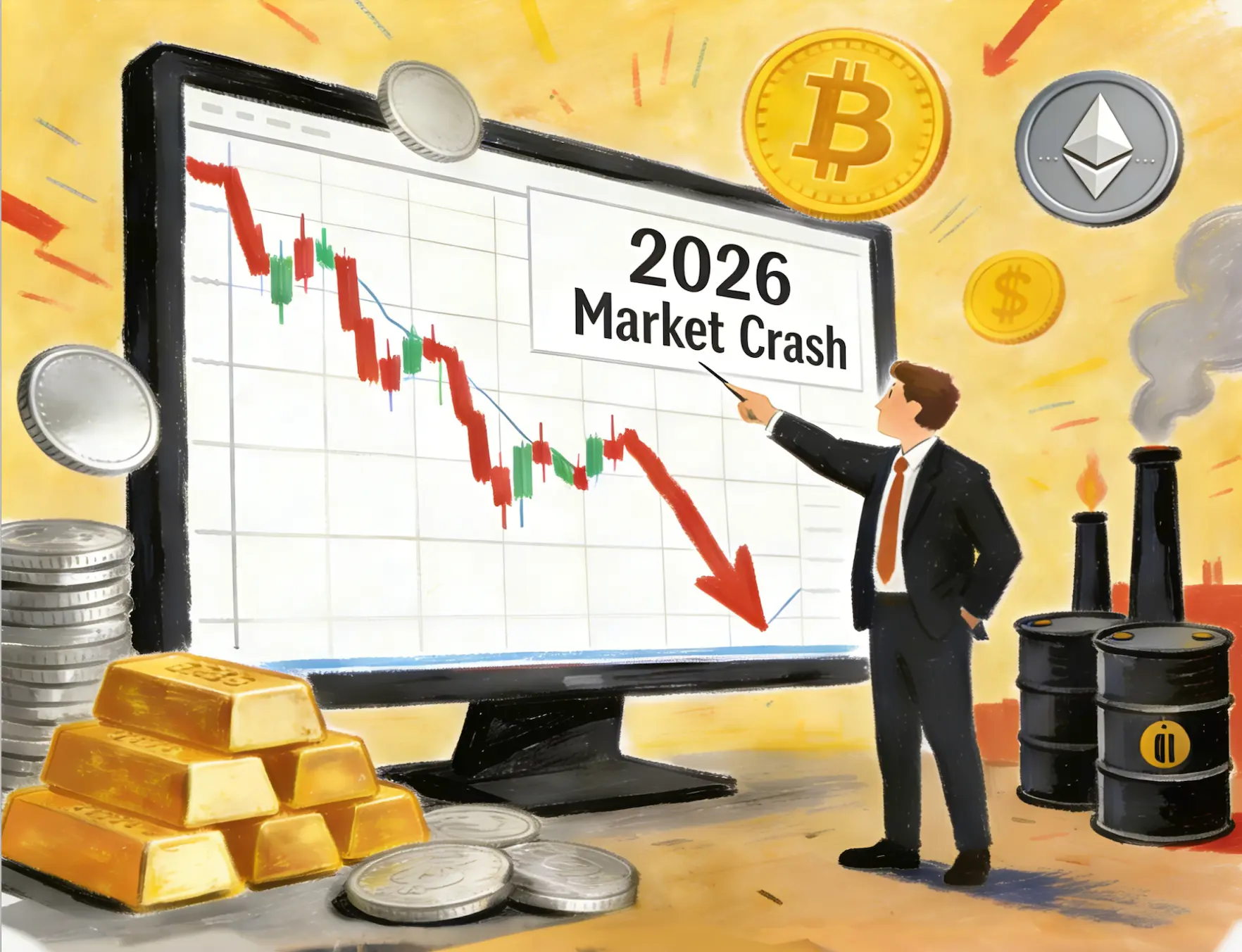
 Robert Kiyosaki, author of Rich Dad Poor Dad, has issued a warning that a historic global stock market crash could begin in 2026, linking the potential downturn to unresolved structural issues from the 2008 financial crisis and rising global debt levels.
The renowned investor specifically flagged risks in private credit markets, citing recent withdrawal restrictions at a BlackRock fund, and recommended gold, silver, Bitcoin, Ethereum, and oil as protective assets for investors navigating financial instability.
Kiyosaki’s 2026 Crash Warning and Historical Context
Prediction Timeline
Kiyosaki repeated his warning on social media platform X on March 9, 2026, stating that the crash he predicted in his 2013 book “Rich Dad’s Prophecy” may now be arriving. He wrote: “In Rich Dad’s Prophecy (2013), I warned the biggest stock market crash in history… was still coming. In 2026, I hope I am wrong. Yet I am afraid that crash is now arriving.”
The financial educator referenced his earlier prediction about the 2008 collapse, noting he warned about the failure of Lehman Brothers shortly before the investment bank went bankrupt during the Great Financial Crisis.
Unresolved Structural Issues
Kiyosaki argues that governments and central banks attempted to stabilize markets after the 2008 crisis through large stimulus programs and monetary expansion. However, he contends these actions delayed deeper structural problems rather than solving them. According to his analysis, the global financial system remains heavily dependent on debt and vulnerable credit markets, with unresolved weaknesses that could make the next downturn more severe than the 2008 crisis if pressures in credit markets trigger broader financial instability.
Private Credit Market Risks
BlackRock Fund Developments
Kiyosaki specifically warned about risks tied to private credit markets and their potential impact on the broader financial system. In March 2026, reports indicated BlackRock restricted withdrawals from a flagship private credit fund after a surge in redemption requests, highlighting stress in parts of the private credit market.
Kiyosaki claimed: “In 2026 the crash will be led by Blackrock’s private credit Ponzi scheme. I hope I am wrong… yet if and when Blackrock crashes, it’s going to be fast and destructive.” He warned that “baby boomers’ retirements will be wiped out all over the world because the world is loaded with debt it cannot pay back.”
Systemic Vulnerability
The comments connect the potential downturn to global debt levels and retirement exposure to financial markets. Rising debt levels and financial instability could eventually trigger a large market downturn, with large asset managers playing an increasingly significant role in global markets. Some analysts suggest that shifts in institutional investment strategies could amplify volatility during periods of financial stress.
Global Debt Concerns
U.S. National Debt
Concerns about global financial stability continue to grow amid rising sovereign debt levels. The United States now carries national debt exceeding $35 trillion, which has raised questions among economists about long-term fiscal sustainability and the resilience of the financial system to future shocks.
International Context
Kiyosaki’s warning extends beyond U.S. borders, suggesting that global debt levels pose a systemic risk to retirement savings worldwide. His comments reflect broader anxieties about the sustainability of current fiscal policies and their potential to trigger cascading market disruptions.
Recommended Assets for Protection
Precious Metals and Commodities
To protect wealth during potential economic turmoil, Kiyosaki continues to promote what he calls “real assets.” These include precious metals such as gold and silver, which have historically served as stores of value during periods of inflation and economic uncertainty. He also mentions oil as a key resource that could retain value during financial instability.
Digital Assets
Kiyosaki specifically encourages investors to accumulate Bitcoin and Ethereum, arguing that cryptocurrencies may offer protection if traditional financial markets experience severe volatility. His endorsement of digital assets aligns with his broader thesis that scarce, non-sovereign assets often perform well during periods of monetary expansion and systemic stress.
Track Record and Criticism
Mixed Prediction History
Despite his warnings, Kiyosaki’s predictions have produced mixed results over the years. He has previously forecast major market crashes in 2016 and 2020 that did not occur as expected. Because of this track record, many analysts view his forecasts with caution. While some investors appreciate his focus on financial preparedness, others note that market timing predictions can be difficult to verify.
Ongoing Debate
Kiyosaki’s warning has once again sparked debate about the resilience of today’s financial system and the role alternative assets may play in protecting investor wealth. Whether a major crash will occur in 2026 remains uncertain, but the discussion highlights growing concerns about global financial stability and the search for safe havens amid potential market turbulence.
FAQ: Robert Kiyosaki 2026 Crash Warning
Q: Why does Robert Kiyosaki believe a stock market crash could happen in 2026?
A: Kiyosaki argues that unresolved problems from the 2008 financial crisis, combined with rising global debt levels, could trigger a major downturn. He contends that government stimulus and monetary expansion delayed deeper structural issues rather than solving them.
Q: What financial sector does Kiyosaki warn could lead the next crash?
A: He specifically warns about risks in private credit markets, particularly involving large asset managers like BlackRock. Recent withdrawal restrictions at a BlackRock private credit fund highlight stress in this sector that could accelerate systemic instability.
Q: How could a potential market crash affect retirement savings?
A: Kiyosaki warns that global debt levels and market exposure could severely damage retirement funds, especially for baby boomers who have significant wealth tied to financial markets.
Q: Which assets does Kiyosaki suggest investors consider during financial instability?
A: He recommends gold, silver, Bitcoin, Ethereum, and energy investments such as partnerships in real oil wells as hedges against inflation, market volatility, and systemic financial risk.
Disclaimer: The information on this page may come from third parties and does not represent the views or opinions of Gate. The content displayed on this page is for reference only and does not constitute any financial, investment, or legal advice. Gate does not guarantee the accuracy or completeness of the information and shall not be liable for any losses arising from the use of this information. Virtual asset investments carry high risks and are subject to significant price volatility. You may lose all of your invested principal. Please fully understand the relevant risks and make prudent decisions based on your own financial situation and risk tolerance. For details, please refer to
Disclaimer.
Related Articles
Zonda Exchange Discloses 4,500 BTC Cold Wallet as Private Keys Remain Untransferred
Zonda, a Polish crypto exchange, revealed a cold wallet with 4,503 BTC amid a withdrawal crisis. CEO Przemysław Kral addressed fund misappropriation allegations and promised legal action against false claims, emphasizing that private keys were never transferred due to the former CEO's disappearance.
GateNews2m ago
Ben McKenzie Slams Bitcoin on Jon Stewart Show
Actor Ben McKenzie appeared on The Weekly Show with Jon Stewart on Aug. 14 in a segment titled "The Other Side of Bitcoin: Crypto Corruption," where he delivered a sharp critique of Bitcoin and the broader cryptocurrency industry. McKenzie, known for his film and television work, has become a
CryptoFrontier15m ago
BTC edges up 0.46% in 15 minutes: institutional fund outflows and macro risk-off sentiment in sync drove the move
From 15:00 to 15:15 (UTC) on 2026-04-16, BTC logged a +0.46% return within 15 minutes. The price fluctuated in a range of 73,939.7 to 74,440.0 USDT, with an amplitude of 0.68%. During this time window, market attention increased, short-term volatility intensified, and fund-flow characteristics changed noticeably.
The main driver of this deviation is the continued outflow of large amounts of capital from exchanges. According to on-chain data, in the past 24 hours the net flow was -14,408.84 BTC, mainly concentrated in large transfer ranges of more than $1 million (especially>$10M net outflow -12,987.03 BTC). This shows that institutions and large holders actively reduced their BTC holdings on exchanges, and short-term selling pressure was significantly lowered. Against the backdrop of persistently weak liquidity, with order book depth remaining at a low level for a long time, the price has become more sensitive to medium-sized buy orders—amplifying the impact of even modest inflows on spot market price action.
In addition, macro conditions changed in parallel and produced a synchronized effect: easing geopolitical tensions in the Middle East boosted overall market sentiment. International gold prices rose, global equity markets hit new highs, and the market re-evaluated the probability of the Federal Reserve cutting rates within the year, further increasing investor attention to safe-haven assets (including BTC). At the same time, on-chain data indicates that the “whale” trading activity during this phase is at an annual low (>$1M transfers fell to 1,485 transactions). With heavy market wait-and-see sentiment and limited short-term supply, BTC’s responsiveness to sudden buy-side capital was further enhanced.
Investors should be reminded that current market liquidity is still fragile. Insufficient order book depth increases the market’s sensitivity to large capital movements, and short-term volatility may intensify. Going forward, focus on further shifts in on-chain large-fund flows, changes in price action as it breaks through support or resistance regions, and the risks and opportunities brought by related macro policies and geopolitical developments. Please continue to track key data and stay alert to any sudden shocks during the period of abnormal moves.
GateNews1h ago
Bitcoin Transactions Face 70-Page Tax Filing Burden Annually
According to Nicholas Anthony of the Cato Institute's Center for Monetary and Financial Alternatives, spending Bitcoin on everyday purchases creates an unexpected tax compliance nightmare. The IRS treats Bitcoin as property, not currency, meaning every transaction—even a $5 coffee
CryptoFrontier1h ago
Bitcoin, Ethereum and Solana ETFs Record Positive Net Inflows on April 16
Gate News message, according to the April 16 update, Bitcoin ETFs recorded a 1-day net inflow of +2,855 BTC (+$209.95M) and a 7-day net inflow of +11,849 BTC (+$871.52M). Ethereum ETFs showed a 1-day net inflow of +15,477 ETH (+$35.44M) and a 7-day net inflow of +90,366 ETH (+$206.94M). Solana ETFs
GateNews1h ago
Bitcoin Breaks Below $74K as 24-Hour Decline Reaches 0.02%
Gate News message, April 16 — Bitcoin fell below the $74,000 level, currently trading at $73,906 with a 24-hour decline of 0.02%.
GateNews2h ago


