Bitcoin experienced another back-and-forth session on Feb. 19, struggling to maintain its value as it established a lower trading range.
Bitcoin Faces Volatility as Trading Ranges Shift Lower
Bitcoin ( BTC) endured another session of whipsaw price action Feb. 19, twice rebounding from sub-$66,000 lows to reclaim the $67,000 level. While the volatility mirrors the preceding 48 hours, technical analysts noted a downward shift in the asset’s trading range: the resistance ceiling has dropped from $69,000 to $67,000, while the support floor has slipped from $67,000 to just under $66,000.
As of Thursday afternoon, the cryptocurrency had recovered from an intraday low of $65,733 to trade near $66,500—a 0.9% decline over 24 hours. Since failing to hold the $70,000 threshold Monday, Bitcoin has shed approximately 5% of its value and remains down more than 25% over the last 30 days.
Despite the stagnant price action, bitcoin’s underlying network security continues to reach historic milestones. Reports indicate that the seven-day moving average hash rate has hit approximately 1 zettahash per second (ZH/s).
While a record-high hash rate is a bullish fundamental—signaling a network more resistant to attack—it is generally viewed as a medium-term indicator that does not immediately translate to price gains.
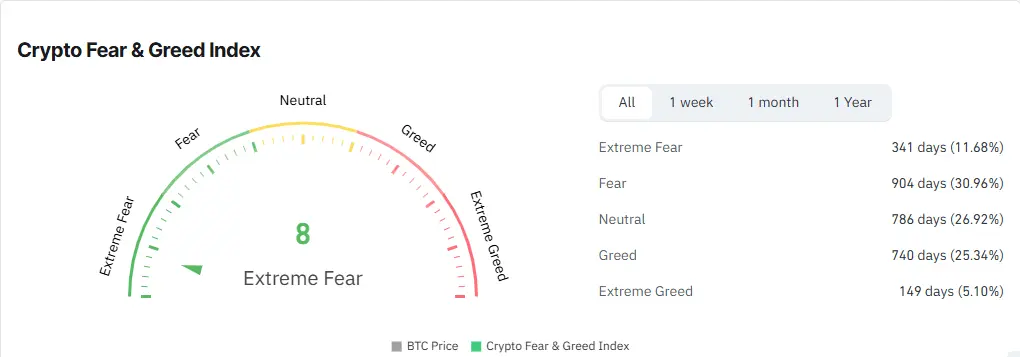
In the immediate term, market sentiment is dictated by “extreme fear.” This bearish outlook was reinforced by a second consecutive day of net outflows from spot Bitcoin exchange-traded funds (ETFs). Latest data shows a net exit of $133.3 million (approximately 1,980 BTC), a notable acceleration from the 1,520 BTC outflow recorded the previous day.
Geopolitical Tensions and Inflationary Risks
Bitcoin’s performance also appears tethered to broader macroeconomic jitters. The asset, which frequently correlates with the Nasdaq and high-growth tech stocks, was weighed down by escalating geopolitical friction in the Middle East.
Observers fear that a potential U.S. military strike on Iranian targets could lead Tehran to blockade the Strait of Hormuz, a critical chokepoint for global trade. Beyond the logistical chaos, such a conflict would likely trigger a spike in oil prices, reigniting inflationary pressures and complicating the outlook for interest rate cuts.
Amid the market turmoil, bitcoin is approaching a major psychological and mathematical milestone. The circulating supply is closing in on 20 million coins minted. According to Coingecko data from Feb. 19, the circulating supply stood at 19,991,937 BTC—leaving only 8,063 BTC before the network hits the 20 million mark.
With the hard cap set at 21 million, this milestone underscores the increasing scarcity of the asset as it moves into its final phases of issuance.
FAQ ❓
- Why did bitcoin drop below $66K this week? Volatility was driven by technical resistance slipping to $67K and ETF outflows accelerating.
- How is bitcoin’s network health despite price swings? The hash rate hit a record 1 ZH/s, signaling stronger security even as prices fell.
- What global risks are weighing on BTC right now? Geopolitical tensions in the Middle East and inflation fears are pressuring risk assets.
- Why is the 20M coin milestone important? It highlights Bitcoin’s scarcity, with fewer than 1M coins left before the 21M cap.
Disclaimer: The information on this page may come from third parties and does not represent the views or opinions of Gate. The content displayed on this page is for reference only and does not constitute any financial, investment, or legal advice. Gate does not guarantee the accuracy or completeness of the information and shall not be liable for any losses arising from the use of this information. Virtual asset investments carry high risks and are subject to significant price volatility. You may lose all of your invested principal. Please fully understand the relevant risks and make prudent decisions based on your own financial situation and risk tolerance. For details, please refer to
Disclaimer.
Related Articles
Willy Woo: Energy is the only path to forging hard currency, and Bitcoin is built on that.
Gate News message, April 7, a well-known Bitcoin analyst Willy Woo recently responded to a post questioning that “Bitcoin consumes too much energy.” He said there are only three ways to ensure the safety of a currency’s ledger: relying on physical atoms (like gold), depending on energy consumption (like Bitcoin), and building on social/political consensus (like fiat currency). Willy Woo emphasized that energy is the only path to forging an absolute hard currency, and physical atoms are not scarce.
GateNews21m ago
BTC 15-minute rise of 0.45%: driven by routine trading, with moderately resonating macro hedging sentiment
From 2026-04-07 15:15 to 15:30 (UTC), Bitcoin (BTC) recorded a +0.45% return. The price moved slightly upward within the USDT range of 67,886.0 to 68,199.5, with an amplitude of 0.46%. During this period, market attention increased somewhat, but overall volatility remained within the normal range, and no unusual market fluctuations appeared.
The main driving force behind this anomaly was routine trading activity in the spot market. On-chain data shows that the number of active addresses in the 15-minute window was about 66,000, slightly higher than the previous period. In the same period, spot trading volume increased by about 0.5 from the previous period over period
GateNews32m ago
Charles Schwab Wealth Management Warning: Allocating 1%-3% of an investment portfolio to BTC/ETH can significantly alter the risk profile.
Gate News message: On April 7, the U.S. financial giant Charles Schwab released a research bulletin warning that even if only 1%-3% of funds are allocated to Bitcoin or Ethereum within an investment portfolio, it may significantly change the portfolio’s overall risk characteristics. The research report notes that Bitcoin and Ethereum have both historically experienced drawdowns of more than 70%, far higher than the volatility levels of stocks or bonds; therefore, even small allocations can have a noticeable impact during periods of market volatility. Charles Schwab proposed two cryptocurrency allocation approaches: one is the traditional portfolio theory method, which allocates based on expected returns, volatility, and correlation; the other is a risk-based method, which determines the share of crypto assets according to the level of risk one is willing to take, shifting the focus from returns to risk tolerance.
GateNews48m ago


