Bitcoin traded flat near $66,000 on Feb. 18, showing little momentum despite sharp intraday swings. The day’s debate centered on comments from Cryptoquant’s CEO, Ki Young Ju, who questioned whether dormant coins — including Satoshi Nakamoto’s 1.1 million bitcoins — should ever be frozen at the protocol level.
Bitcoin Stagnates in Narrow Range
Bitcoin exhibited a characteristic lack of momentum on Wednesday, remaining largely range-bound even as the community descended into a fierce ideological civil war. Throughout the preceding 24-hour window, the top cryptocurrency oscillated between $65,840 and $68,000. While the price experienced several instances of high-velocity “whipsaw” movements—straying briefly before a rapid corrective snapback—it ultimately found its gravity within that narrow corridor.
As of 3 p.m. EST, bitcoin was again trading just below the $66,000 mark, logging a 2.6% decline over the day. This price action left the total market capitalization of the crypto-economy essentially drifting lower, alongside reflecting a “wait-and-see” approach from institutional desk traders.
The day’s primary narrative was dominated by Cryptoquant CEO Ki Young Ju, whose latest X article has sent shockwaves through the ecosystem. Ju has posed a pointed question to the community: Should it authorize a protocol-level “freeze” on dormant coins, particularly Satoshi Nakamoto’s storied 1.1 million BTC trove?
“Would you support freezing dormant coins, including Satoshi’s, to save BTC from quantum attacks? Or is it against Bitcoin’s core ethos? If this alone already divides us, the quantum debate must start now,” the Cryptoquant executive wrote.
Ju estimates that 6.89 million BTC are currently housed in legacy P2PK (pay-to-public-key) addresses. Because these older address types expose public keys directly on the blockchain, they are theoretically vulnerable to future quantum computing attacks that could derive private keys and drain the funds.
Critics, however, have decried the idea of such changes as a fundamental betrayal of bitcoin’s core value proposition. To freeze these coins, the network would require a drastic protocol upgrade, effectively breaking the rule of immutability. While there is a broad consensus regarding the long-term threat of quantum computing, the community remains bitterly divided over whether the cure is worse than the disease.
Geopolitical Winds: The ‘Risk-off’ Pivot
Despite the high-stakes debate over Satoshi’s coins, bitcoin’s price action on Feb. 18 appeared largely detached from internal politics, focusing instead on the escalating drums of war in the Middle East. Media reports suggest that U.S. and Israeli military strikes on Iran are imminent, a development that threatens to plunge the region into a state of total kinetic conflict.
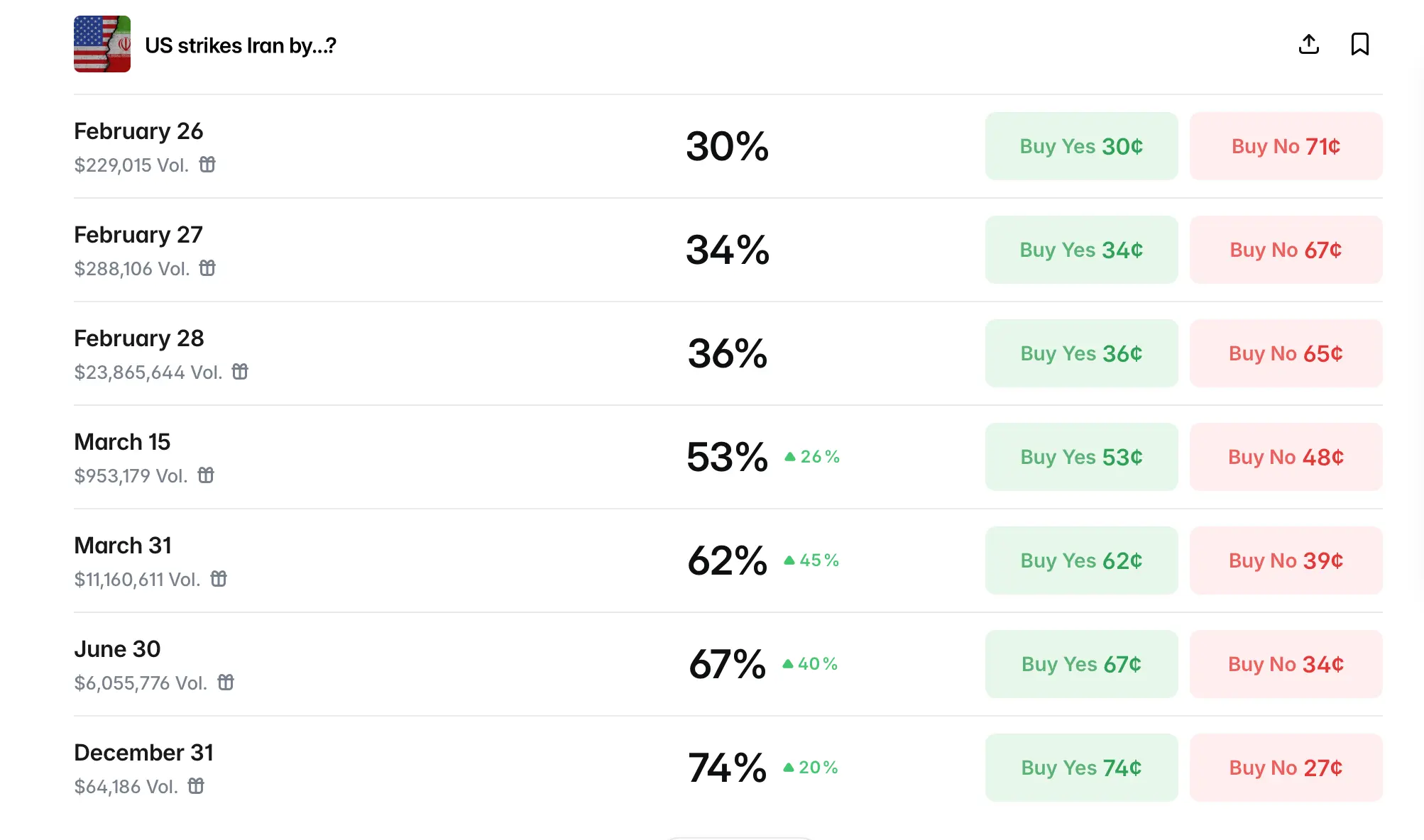 Polymarket odds on the escalation between the U.S. and Iran on Feb. 18, 2026, at 3 p.m. EST.
A wider conflict is expected to disrupt critical trade arteries and send crude oil prices into a vertical climb. For bitcoin, the impact remains a subject of intense speculation. While long touted as digital gold, recent price correlations suggest bitcoin has behaved more like a risk-on tech asset. This means, in the event of a regional conflagration, the initial reflex from investors may be a flight to traditional safe-haven assets, including U.S. Treasuries and gold.
Polymarket odds on the escalation between the U.S. and Iran on Feb. 18, 2026, at 3 p.m. EST.
A wider conflict is expected to disrupt critical trade arteries and send crude oil prices into a vertical climb. For bitcoin, the impact remains a subject of intense speculation. While long touted as digital gold, recent price correlations suggest bitcoin has behaved more like a risk-on tech asset. This means, in the event of a regional conflagration, the initial reflex from investors may be a flight to traditional safe-haven assets, including U.S. Treasuries and gold.
This will potentially put further downward pressure on bitcoin as liquidity tightens across global markets.
FAQ ❓
- Where is bitcoin trading now? It hovered between $67K and $68K, showing little momentum.
- What sparked the community debate? Cryptoquant’s CEO proposed freezing dormant coins, including Satoshi’s stash.
- Why is the proposal controversial? Critics say freezing coins breaks bitcoin’s immutability despite quantum risks.
- How do geopolitics affect bitcoin? Escalating Middle East tensions, specifically between Iran and the U.S., have pushed investors toward gold and Treasuries, pressuring BTC.
Disclaimer: The information on this page may come from third parties and does not represent the views or opinions of Gate. The content displayed on this page is for reference only and does not constitute any financial, investment, or legal advice. Gate does not guarantee the accuracy or completeness of the information and shall not be liable for any losses arising from the use of this information. Virtual asset investments carry high risks and are subject to significant price volatility. You may lose all of your invested principal. Please fully understand the relevant risks and make prudent decisions based on your own financial situation and risk tolerance. For details, please refer to
Disclaimer.
Related Articles
Bitcoin Tests Long-Term Holder Resilience Near Key Support Levels
Bitcoin is testing a crucial support level at $67,675, just $1,000 away, amidst a -44.8% drawdown. The outcome may dictate future price movements, with a potential correction to $54,000-$58,000 if breached. Historical patterns reveal Bitcoin's cyclical volatility.
BlockChainReporter51m ago
Crypto-rewards fintech company GoSats completes $5 million Series A funding, led by Konvoy
Gate News message: On April 7, the crypto rewards fintech company GoSats announced the completion of a $5 million Series A round of financing, led by Konvoy, with participation from Y Combinator, Taisu Ventures, and others. GoSats' business model links Bitcoin and gold rewards to everyday spending, helping businesses acquire customers and boost user loyalty. The funds from this round will be used to develop innovative fintech products and to build AI-powered personalized services.
GateNews53m ago
Bitcoin is negatively correlated with the global easing breadth index; this week, ETFs recorded their largest net inflow since February
The negative correlation between Bitcoin and global central bank monetary policy suggests that institutional capital has already positioned itself ahead of a potential easing cycle. In the recent spot ETF net inflows have hit a new high, but the market remains choppy and unstable, with weak demand. Corporate allocation has slowed, volatility in the options market has increased, and traders are more inclined to add downside protection.
GateNews1h ago
U.S.-listed company Hyperscale Data increases its Bitcoin holdings to 639.2135 BTC
Hyperscale Data announced that its Bitcoin holdings increased to 639.2135 BTC, with a total market value of approximately $44.1 million. Its subsidiary Sentinum holds 591.3761 BTC, ACG acquired 47.1935 BTC, and the overall asset value exceeds $100 million.
GateNews1h ago
Why Michael Saylor's bitcoin buys aren’t moving the needle anymore
Strategy (MSTR) purchased 4,871 BTC for $330 million, yet large buys often don't influence Bitcoin's market, with prices sometimes dropping. MSTR's impact is minimal compared to long-term holders and broader market dynamics, which show significant capital outflows.
CoinDesk1h ago
Peter Schiff: If Bitcoin falls to $10k by the end of 2026, it’s still the best-performing asset over the next decade
Gate News message, April 7, gold supporter Peter Schiff posted, saying that assuming Bitcoin drops to $10k by the end of 2026, it will still be the best-performing asset of the next decade. Schiff said he is sure Michael Saylor will rely on this to keep pushing up the price of Bitcoin and issue more shares to buy Bitcoin. But a 92% drop will make it the worst-performing investment for most long-term holders.
GateNews1h ago


