Sustained price pressure and weather-related outages reduced mining power, forcing a rare and large network adjustment.
Bitcoin’s mining network went through a major reset over the weekend after a steep fall in computing power. Slower block production over several weeks forced the system to make a rare and large adjustment. Experts cited market pressure and weather-related disruptions as the reasons for such a large move.
Bitcoin Network Responds to Sudden Loss of Computing Power
Bitcoin mining difficulty fell 11.16% on Saturday, dropping to 125.86 trillion at block height 935,424. Data from Mempool shows the adjustment came after average block times stretched to about 11.4 minutes, well above the network’s 10-minute target.
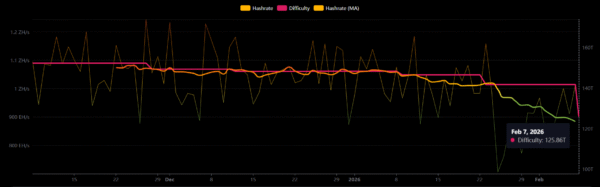 _Image Source: _Mempool
According to Bitcoin developer Mononaut, the adjustment represents the biggest difficulty drop since China forced miners to shut down operations in July 2021. Few adjustments of this size have ever occurred, placing the move among the ten largest declines in the network’s history.
Bitcoin just experienced an 11.16% drop in difficulty – the largest negative adjustment since the July 2021 china mining ban crash, and the 10th largest negative % adjustment of all time. https://t.co/AVUGsv8mlB pic.twitter.com/Fauykg0d3l
— mononaut (@mononautical) February 7, 2026
As many miners shut down their machines, the network’s computing power declined, causing blocks to be produced more slowly. Over the past month, about one-fifth of the network’s mining power disappeared, with much of that loss happening in just the past week.
Since China’s mining ban, Bitcoin has seen very few large difficulty drops. The largest prior incident occurred in June 2025, when extreme heat forced many miners to scale back operations. Another smaller difficulty cut occurred in early February 2025.
Price Slump and U.S. Weather Events Cut Bitcoin Mining Activity
Experts suggest the recent price weakness remain a factor behind the hashrate retreat. Bitcoin has dipped from its October peak of above $126,000, falling more than 45%.
Bitcoin prices came under pressure as government bond yields rose and investors pulled money from exchange-traded funds. Further, the broader shift away from risk assets also weighed on demand. Data from SoSoValue shows U.S. spot bitcoin ETFs becoming net sellers in 2026.
At the same time, a winter storm in the United States knocked a large share of mining power offline. At one point, as much as 40% of global hashrate was unavailable. Miners across several power regions reduced activity to ease stress on local grids and protect household electricity supply.
In contrast, lower mining difficulty offers short-term relief. With fewer machines online, miners still operating face less competition and can earn more per unit of computing power if prices remain stable.
Still, the OG coin is trading near $69,475 and price charts point to continued weakness across both short and long-term periods. This downside signals weak market confidence and limits the relief miners expect.
Disclaimer: The information on this page may come from third parties and does not represent the views or opinions of Gate. The content displayed on this page is for reference only and does not constitute any financial, investment, or legal advice. Gate does not guarantee the accuracy or completeness of the information and shall not be liable for any losses arising from the use of this information. Virtual asset investments carry high risks and are subject to significant price volatility. You may lose all of your invested principal. Please fully understand the relevant risks and make prudent decisions based on your own financial situation and risk tolerance. For details, please refer to
Disclaimer.
Related Articles
Michael Saylor “Laser Eyes” post surpasses 1 million views, billionaires follow up by buying crypto
MicroStrategy Executive Chairman Saylor has restarted the laser eyes symbol, expressing his bullish conviction in Bitcoin, and contrasting it with the current market’s fear sentiment. MicroStrategy holds 761,068 Bitcoins and plans to increase that to 1,000,000 by 2026. Real estate billionaire Grant Cardone has also announced additional Bitcoin purchases, strengthening market confidence and signaling a long-term hold.
MarketWhisper6m ago
Square enables “Bitcoin payments” with zero fees and no minimums for million-dollar U.S. small and mid-sized businesses, with Jack Dorsey pushing BTC into everyday use
Square announces that it will automatically enable Bitcoin receiving functionality for eligible U.S. sellers. Transactions are converted to U.S. dollars in real time, and fees are waived through the end of 2026. This move simplifies the process for merchants to use cryptocurrency and increases the viability of Bitcoin as a daily payment tool. Industry experts believe this could become foundational infrastructure for the financial system.
動區BlockTempo14m ago
Oil prices rise above $105: Is Bitcoin at risk of dropping again?
Oil Prices Break Above 105 USD: Is Bitcoin at Risk of Dropping Again?
The rising momentum of oil prices to a 3-year high is drawing special attention from digital asset investors, because history shows that whenever energy becomes more expensive, Bitcoin often does not react positively. The 105 USD per barrel mark for WTI oil on the day
TapChiBitcoin20m ago
Square Enables Bitcoin Payments for 4 Million US Small Businesses with Instant Dollar Conversion
Square, the payments subsidiary of Block, began automatically enabling Bitcoin payments for eligible US small businesses on March 31, 2026, shifting from an opt-in to an opt-out model that integrates cryptocurrency acceptance directly into existing payment systems for approximately 4 million merchants.
CryptopulseElite34m ago
Cuba’s central bank approves 10 companies to use cryptocurrencies for international payments
Cuba’s central bank has for the first time approved 10 companies to use cryptocurrencies for international payments, including 9 small and micro enterprises and 1 joint venture, with a license validity period of 1 year. This marks the first time that Cuban companies have been granted permission to directly operate international payments, which must be handled through approved virtual asset service providers and with transaction information reported on a regular basis.
GateNews40m ago


