- Payments platform Payy Link has launched Payy Network, which it claims to be Ethereum’s first and only privacy-enabled, EVM Layer-2.
- **With a Privacy Layer, stealth transactions and native zero-knowledge proofs, the new network targets users to whom privacy is critical. **
Ethereum has been on a campaign to go back to its original mission, with decentralization and privacy featuring prominently on its priorities list, as we have reported. The network is now getting a big boost on the privacy front, with Payy Link launching “Ethereum’s first and only privacy-enabled, EVM Layer-2.”
In its documents, the company further described Payy Network as “the first EVM compatible stablecoin chain with privacy at every layer.”
Ethereum is for privacy. https://t.co/xnj0sWTC5K
— Ethereum (@ethereum) February 4, 2026
Payy believes that privacy can’t be an afterthought: it must be custom-built into the architecture of a network in a holistic and complete approach. On the new network, transfers of any ERC-20 tokens will be private by default and no smart contract changes are required.
Additionally, it supports all wallets on the Ethereum Virtual Machine (EVM) natively. This is an important feature as it guarantees that developers can build on Payy Network using their existing tooling, with privacy layered in without any changes to the EVM protocol.
It states:
In the past, privacy always had tradeoffs: bad UX, fragmented liquidity, limited compatibility. With Payy, privacy is invisible.
With the Payy Network, all transfers will happen directly inside the pool, with smart contract interactions then withdrawing from the pool to fresh addresses. The private transaction data then goes to off-chain Privacy Vaults, which developers can configure using RPC URL query parameters. It also comes with native zero-knowledge verification.
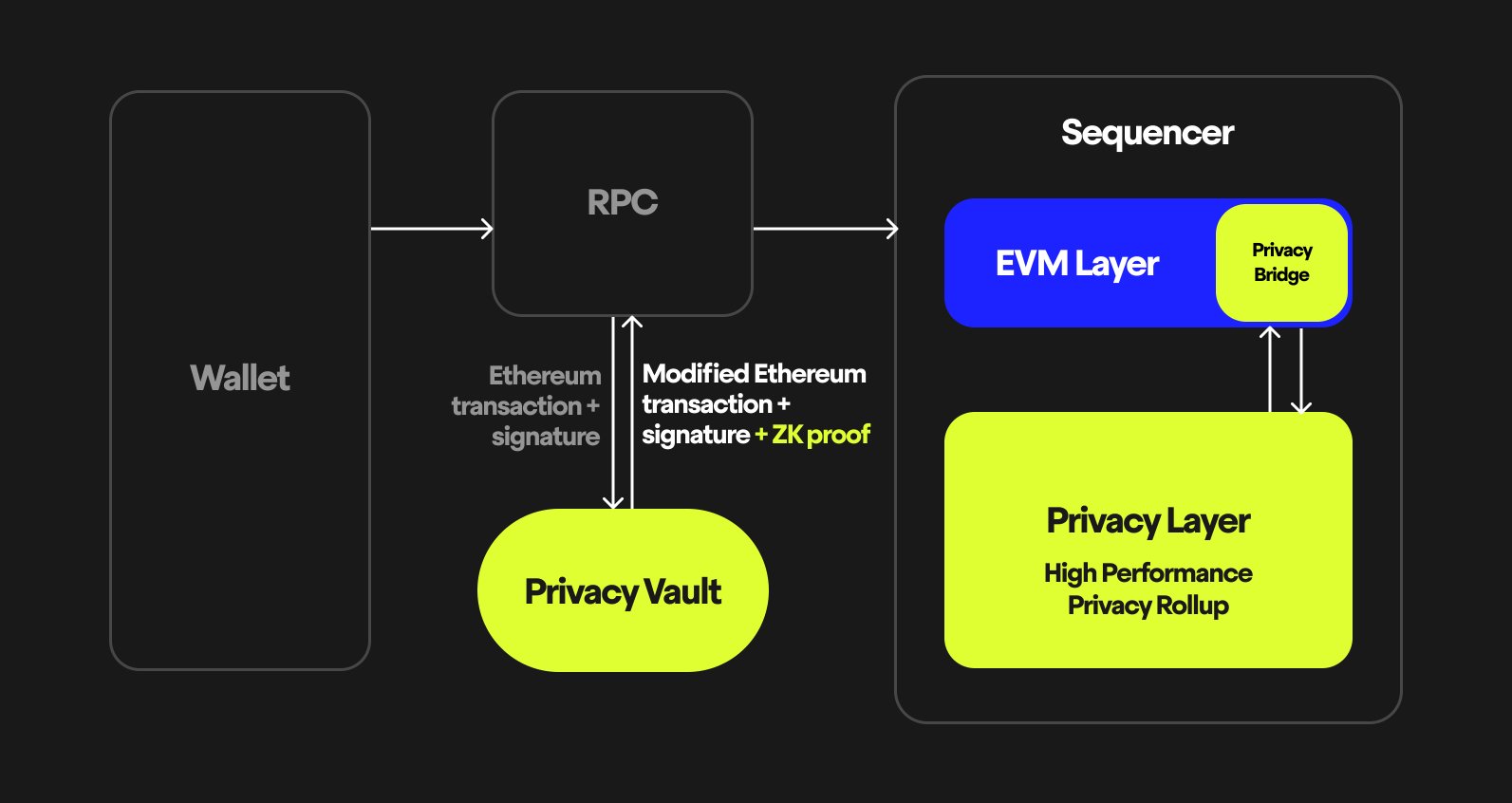
Image courtesy of Payy Link.
Native Ethereum Privacy on Payy Network
Payy Network offers three levels of privacy. The first is offered through the Privacy Layer, where payments are natively private even before they hit the EVM. Stealth Transactions then mint a new address for each new transaction, with the transaction conducted on the EVM layer, before the original tokens are then returned to the Privacy Layer. Moving funds in and out of this layer requires no gas fees, but minting the new address requires gas fees.
Then, there is native zero-knowledge technology, which users can tap depending on the privacy applications. Being native allows Payy Network’s ZK technology to cut down the cost that would otherwise be required; ZK tech on other networks consumes up to 10% of the available blockspace.
Essentially, Payy Network’s ZK proofs conduct their verification off-chain, allowing developers to build applications such as off-chain orderbooks like Hyperliquid, which has been predicted to hit $200 billion in market cap, as we reported.
They can also build dark liquidity pools and private real-world asset contracts.
The network will be powered by PUSD, a stablecoin backed by US dollars and available both as a native token and an ERC-20 token. Being a stablecoin, it guarantees that the fee for each transaction remains consistent.
Payy Link says the Payy Network is for crypto natives and funds to trade privately, and fintechs and tradfi that require extreme privacy for their transactions.
Disclaimer: The information on this page may come from third parties and does not represent the views or opinions of Gate. The content displayed on this page is for reference only and does not constitute any financial, investment, or legal advice. Gate does not guarantee the accuracy or completeness of the information and shall not be liable for any losses arising from the use of this information. Virtual asset investments carry high risks and are subject to significant price volatility. You may lose all of your invested principal. Please fully understand the relevant risks and make prudent decisions based on your own financial situation and risk tolerance. For details, please refer to
Disclaimer.
Related Articles
Ethereum is approaching a key level, but it’s hiding strong signals! Active addresses are nearing their all-time high, while funds continue to leave trading platforms
In April 2026, the price of Ethereum fell under the influence of geopolitical pressure, but on-chain data performed well and network activity was high. User preference for self-custody increased, and the DEX market share rose. Analysts say the market has not seen panic selling; whether the price will reverse in the future still depends on the external environment.
GateNews9m ago
Has the logic for the next bull market changed? Clem Chambers warns: the crypto market will move on from the “coin-flipping era”
Clem Chambers指出 that in the future, the crypto market will no longer rely solely on token hype, but will shift toward real applications and long-term value creation. The market is moving toward tokenized assets and stablecoins, with attention on the ability of blockchain technology to deliver real-world implementation. Although speculation will still dominate in the short term, projects that truly have use value will become the core driving force for the future.
GateNews11m ago
Australia’s new crypto regulations are now in effect! Mandatory license oversight is on the way, and crypto exchanges face a life-or-death split
In 2026, Australia will pass new regulations for crypto assets, bringing digital asset platforms under financial oversight, requiring them to apply for financial services licenses and comply with ASIC supervision. This marks a transition toward standardized management in the crypto industry, improving investor protection, but it also increases operating costs for smaller platforms and could lead to changes in the competitive landscape of the market.
GateNews22m ago
Aave Launches V4 on Ethereum Mainnet With New Hub-and-Spoke Lending Design
Aave has launched V4 on Ethereum mainnet, introducing a hub-and-spoke architecture for shared liquidity. This redesign aims to improve efficiency by separating liquidity from risk, starting with a cautious rollout of limited hubs and assets.
CryptoNewsFlash36m ago
Frictionless launch of privacy features for the privacy-preserving project zERC20
Gate News update. On April 2, the privacy-preserving project zERC20 launched its frictionless privacy feature. For new wallets connecting to zERC20, this will eliminate the initial gas fees. The new features include: receiving zAssets without gas fees, with transaction fees automatically deducted from your assets; and one-tap conversion of some zAssets into their native form
GateNews45m ago
Ethereum daily active addresses reach 788,000, and network activity is approaching its all-time high
Gate News message: On April 2, according to data tracked by Santiment, on-chain network activity for Ethereum has recently risen significantly. The data shows that the number of Ethereum daily active addresses has reached 788,000, the number of new daily wallet addresses has reached 255,000, and overall activity is already approaching the all-time high record.
GateNews1h ago


