As the S&P 500 climbs on strong earnings, Bitcoin crashes to a 14-month low at $60,000. We analyze the causes of this historic split, review critical on-chain capitulation metrics, and provide an outlook for what comes next for crypto and traditional markets in 2026.
The financial markets of early 2026 are telling two starkly different stories. On one side, the S&P 500 index demonstrates resilience, buoyed by robust corporate earnings and investor confidence in traditional growth sectors like AI. On the other, the cryptocurrency market is in turmoil, with Bitcoin price plunging at the critical $60,000 support level to lows not seen in over a year. This dramatic divergence highlights a shifting risk appetite, where capital is fleeing speculative digital assets for the tangible profits of established equities. This analysis delves into the root causes of the crash, examines the “extreme fear” gripping crypto, and explores whether this is a temporary dislocation or a sign of a deeper market transformation.
The Great Split: Analyzing the Market Divergence
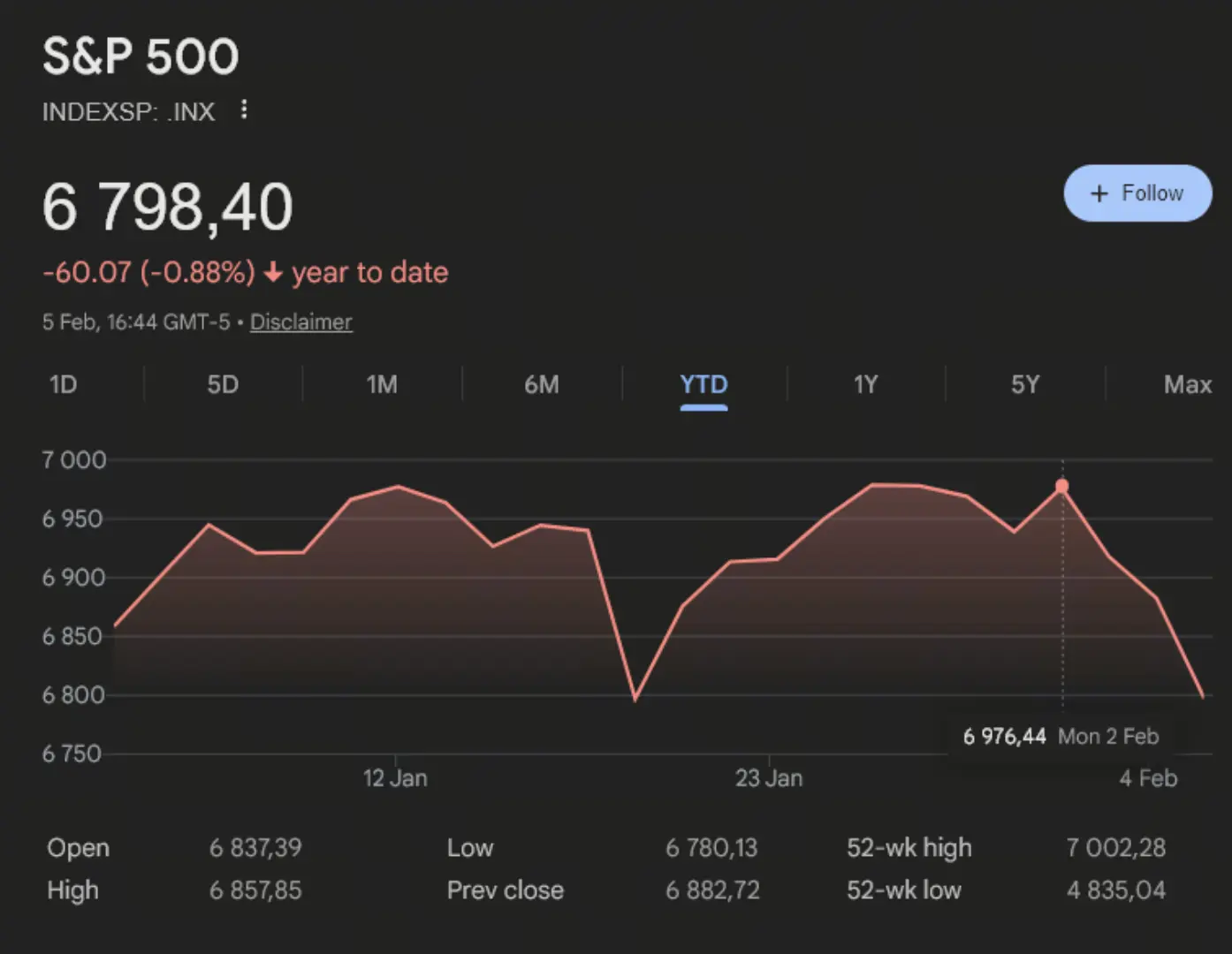
The first week of February 2026 has laid bare a growing chasm between two major asset classes. While U.S. stock markets, including the Nasdaq, showed pre-market stability or modest gains, the digital asset space entered a deep freeze. Bitcoin, the market bellwether, led the decline, crashing close to the psychologically significant $60,000 barrier and erasing gains from the past 15 months. The sell-off was broad-based, dragging down major cryptocurrencies like Ethereum and altcoins even more severely.
(Source: Google)
This divergence is not merely about price action; it reflects a fundamental shift in where investors perceive safety and opportunity. The traditional equity rally is anchored in verifiable fundamentals—specifically, stronger-than-expected corporate earnings. Analysis suggests earnings growth accounts for a dominant share of current S&P 500 returns, moving the market away from speculative valuation expansion. In contrast, the crypto market is struggling with fading momentum, regulatory overhangs, and a lack of immediate, earnings-driven narratives to sustain bullish sentiment in a risk-averse climate.
The split is visually evident across exchanges and related securities. As crypto assets tumbled, shares of companies tied to the digital asset ecosystem, such as large Bitcoin holders like Strive, crypto exchanges, and mining firms, fell in tandem. This created a self-reinforcing cycle of negativity, starkly contrasting with the stability in broader tech ETFs. The message from the market is clear: for now, capital rotation is favoring assets with transparent, quarterly profit reports over those driven by decentralized network adoption and speculative fervor.
Unpacking the Crypto Crash: Leverage, Liquidations, and Fear
The severity of Bitcoin’s drop points to specific internal mechanisms within crypto markets that amplified the downturn. A primary catalyst was a massive deleveraging event across derivatives markets. As prices began to fall, they triggered a cascade of forced liquidations for over-leveraged traders. Data shows that in a 24-hour period, more than $800 million in leveraged crypto positions were wiped out, with the majority being bullish “long” bets. This mechanical selling pressure ruthlessly pushed prices lower.
The intensity of the sell-off is captured in the market’s “fear gauge.” The Crypto Fear and Greed Index plummeted to as low as 11, firmly in the “Extreme Fear” territory. This sentiment indicator reflects a panicked and pessimistic investor base. On-chain data from analytics firm Glassnode confirms this panic, identifying the event as the second-largest capitulation event among Bitcoin investors in the past two years. Capitulation occurs when investors surrender and sell their holdings at a loss, often marking a peak in panic and a potential precursor to a market bottom.
Furthermore, evidence suggests the selling pressure was institutionally led. Analysts noted that the “Coinbase Gap,” a metric comparing prices on the institutional-heavy Coinbase Pro to retail-centric exchanges, turned deeply negative. This signals that large, professional players were offloading Bitcoin more aggressively than the retail crowd, adding substantial weight to the downturn. This combination of derivative blow-ups, peak fear, and institutional selling created a perfect storm that equities, with their different structure and participant base, largely avoided.
A Closer Look at Institutional Moves and The DAT Phenomenon
The market turmoil brings into sharp focus the behavior of institutional players, both traditional and crypto-native. Interestingly, while some were selling, the framework for broader, albeit indirect, institutional exposure continues to evolve. A notable example is the quiet accumulation of Bitcoin exposure by traditional finance giants through unconventional means.
Vanguard Group, the world’s second-largest asset manager with over $12 trillion in assets, has historically been publicly skeptical of cryptocurrencies. However, through its passive index funds, it has inadvertently built a multi-million dollar position in Bitcoin. This occurred because Vanguard’s Total Stock Market Index fund automatically holds shares of public companies within its benchmark. One such company is Strive, which rebranded itself as a “Bitcoin Treasury Company” in late 2025. After acquiring Semler Scientific in early 2026, Strive now holds over 13,000 BTC, making it a top-ten corporate Bitcoin holder globally. Consequently, Vanguard’s index funds, and by extension millions of its passive investors, now have indirect exposure to Bitcoin’s price movements through their ownership of Strive shares.
This touches on the broader trend of Digital Asset Treasuries (DATs)—public companies that hold significant cryptocurrency, primarily Bitcoin, on their balance sheets. The outlook for these entities in 2026 is a point of significant debate among analysts:
- The “Great Cleansing” Thesis: Some institutions, like Galaxy Digital, predict a shakeout. They argue that many smaller DATs that traded at a premium during bullish times may now face pressure if their stock price falls below the value of their Bitcoin holdings (Net Asset Value - NAV). This could force asset sales or even lead to company failures.
- The “Red Herring” Thesis: Others, like Grayscale, maintain that while DATs generate media buzz, they are not a core driver of the underlying crypto market’s pricing and will not be a decisive factor in 2026’s trajectory.
The performance of DAT stocks during the recent crash, which saw them fall sharply, lends initial credence to the “cleansing” viewpoint and demonstrates their high correlation to—and vulnerability from—volatile crypto prices.
Strategic Outlook and Navigating the Current Market
Navigating this divided market requires a clear-headed assessment of both landscapes. For traditional equities, the path seems tied to the continuity of corporate earnings growth and a stable macroeconomic backdrop. The rally’s sustainability will be tested against future economic data and Federal Reserve policy signals. The current environment of contained inflation and solid GDP growth provides a supportive, if cautious, foundation for continued equity strength.
For cryptocurrencies, the immediate future hinges on finding a stable price floor and rebuilding investor confidence. Technical and on-chain analysts are closely watching several key levels and metrics:
Key Support Levels and On-Chain Data:
- Realized Price Clusters: On-chain data points to a significant volume of Bitcoin acquired in the $70,000 to $80,000 range, which was expected to provide support. The breach of this zone is bearish. The next high-conviction support cluster is identified between $66,900 and $70,600.
- Long-Term Holder (LTH) Stress: A critical metric for identifying market bottoms is the percentage of long-term holders in an unrealized loss. Historical peaks of this metric (e.g., 85% in 2022) have coincided with major bear market exhaustion. Current levels are estimated around 37%, suggesting that the most resilient investors are not yet under severe enough pressure to signal a definitive bottom.
- Exchange-Traded Product (ETP) Flows: After massive success, U.S. spot Bitcoin ETPs like BlackRock’s IBIT have recently seen net outflows. A reversal to sustained inflows would be a strong signal of returning institutional confidence.
Given the “extreme fear” sentiment, contrarian investors see potential for a sharp, short-term relief bounce, as markets often move contrary to peak crowd emotion. However, establishing a longer-term bullish trend would require not just a technical rebound, but a resumption of positive capital flows into ETPs and a resolution of the macro uncertainties currently favoring traditional assets.
In this complex environment, a prudent strategy involves rigorous risk management. For crypto investors, this means assessing exposure size, considering dollar-cost averaging into weakness only if one’s conviction in the long-term thesis remains strong, and avoiding the use of high leverage that led to the catastrophic liquidations seen in this crash. For traditional investors, the rally in equities, while grounded in earnings, invites selectivity, as record highs always carry the risk of a correction.
The great market divergence of early 2026 underscores a period of recalibration. Capital is scrutinizing asset classes with a finer lens, prioritizing tangible profits and relative stability in uncertain times. While this has punished cryptocurrencies severely, it also lays the groundwork for the sector’s next phase—one that may demand more robust fundamentals and clearer regulatory pathways to once again attract the sustained institutional capital that ETFs initially promised. The journey toward that next phase begins with navigating the current volatility and identifying the true signals of recovery amidst the noise of fear.


