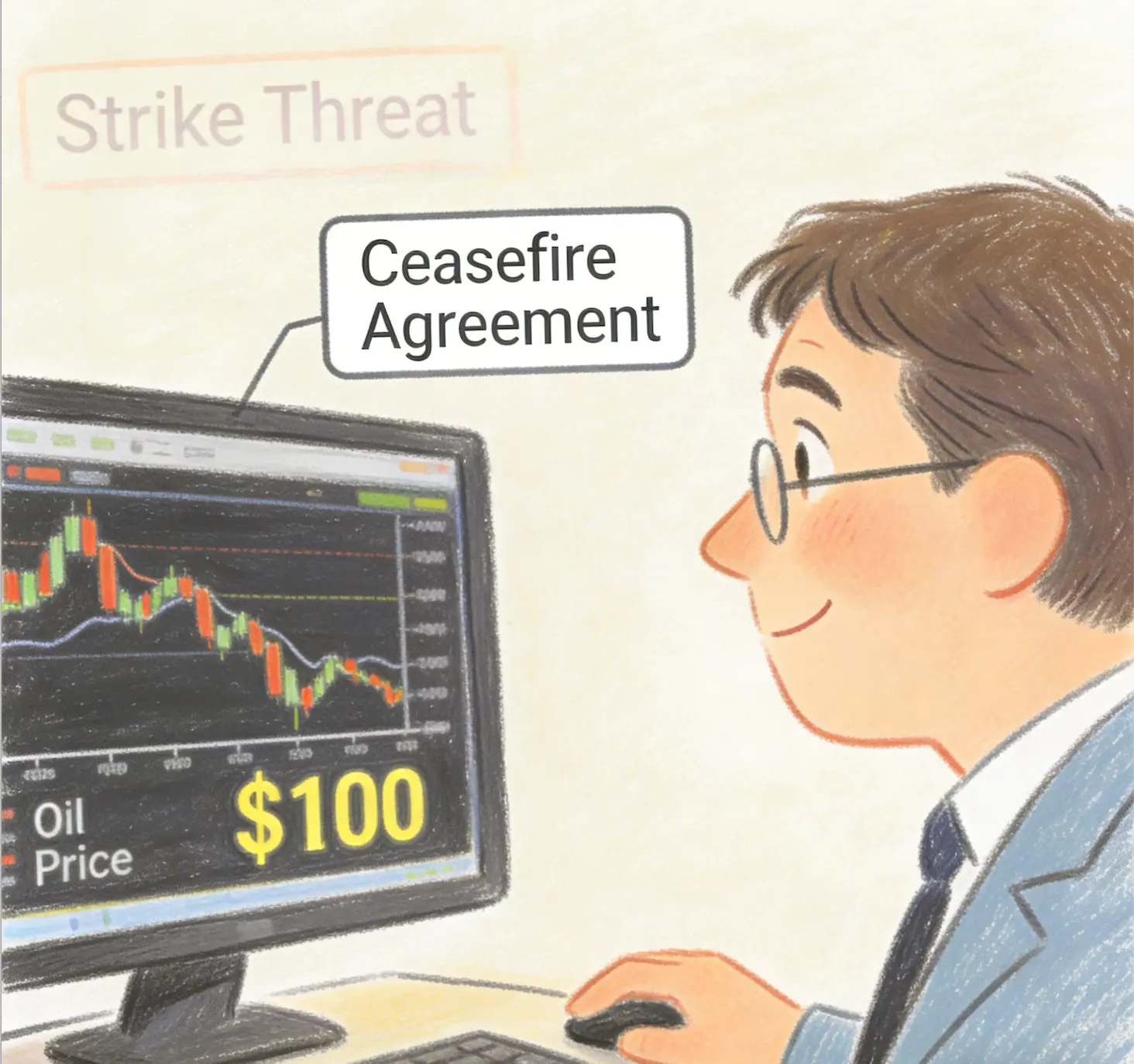
 President Donald Trump announced on April 7, 2026 that he had agreed to a two‑week ceasefire with Iran, suspending planned military strikes just hours before his self‑imposed deadline, triggering a more than 14% plunge in crude oil prices.
Brent crude fell $14.84 to $94.43 a barrel and West Texas Intermediate (WTI) slid $16.13 to $96.82, as markets priced in reduced geopolitical risk after Trump said Iran had presented a “workable” 10‑point peace plan and agreed to allow safe passage through the Strait of Hormuz.
Ceasefire Terms and Oil Market Reaction
Trump announced the suspension of strikes on Truth Social, stating the pause was conditional on Iran’s “COMPLETE, IMMEDIATE, and SAFE OPENING” of the Strait of Hormuz, through which approximately 20% of the world’s oil transits. The president credited conversations with Pakistani Prime Minister Shehbaz Sharif and Army Chief Asim Munir as decisive. Iran’s Supreme National Security Council confirmed acceptance, with Foreign Minister Abbas Araqchi stating that safe transit would be possible for two weeks under Iranian military coordination. However, the council warned that “our hands remain upon the trigger,” stressing the ceasefire does not mean the war has ended.
The oil price drop erased a portion of the steepest monthly rise in history – March saw crude gain more than 50% as the conflict escalated. Despite the decline, prices remain well above pre‑war levels near $70 per barrel. IG analyst Tony Sycamore said the truce “is a good start and could pave the way to a more permanent reopening – but lots of ifs still to work out.” MST Marquee analyst Saul Kavonic warned that even with a peace deal, “Iran may be emboldened to threaten the Strait of Hormuz more frequently in the future, and the market will price in heightened risk.”
Technical Outlook for WTI Crude
From a technical perspective, WTI broke below the 200‑hour Simple Moving Average (SMA) and the lower end of a two‑week ascending channel, signaling bearish momentum. The Relative Strength Index (RSI) near 18 reflects stretched downside conditions, which helped prices find some support at $86.00 and stage a modest recovery. However, the Moving Average Convergence Divergence (MACD) indicator remains below zero with a negative histogram, suggesting persistent selling pressure.
Immediate resistance is seen at the $91.50–$92.00 area, with stronger resistance at the 200‑period SMA near $98. A move above $98 would be needed to challenge the former channel region toward $96–$100 and weaken the bearish bias. On the downside, support lies at the psychological $90.00 level, with a break lower opening the way toward $88.50 and then $86.00.
Military Threats and Feasibility Concerns
Trump had threatened to destroy “every bridge” and power station in Iran within four hours, and warned that “a whole civilization will die” if no deal was reached. However, military experts and former defence officials told the BBC that such threats are not feasible. Iran is approximately one‑third the size of the continental United States, and identifying thousands of civilian infrastructure targets across the country in such a short time span would be a “Herculean task,” according to a former senior US defence official.
A large‑scale attack on Iran’s power sector is more feasible, as most power plants and refineries are concentrated in three coastal provinces on the Persian Gulf. Striking those could cut the regime’s access to oil revenue and the Strait of Hormuz, said Miad Maleki, a former senior US Treasury official. However, some civilian infrastructure has already been hit: US‑Israeli airstrikes targeted a bridge in Qom and military infrastructure on Kharg Island, which handles roughly 90% of Iran’s oil exports.
International Criticism and Legal Concerns
Pope Leo XIV called Trump’s threats “truly unacceptable” and said such attacks would violate international law. French Foreign Minister Jean‑Noël Barrot stated that targeting civilian and energy infrastructure could constitute a war crime. A spokesman for UN Secretary‑General Antonio Guterres said he was “deeply troubled” by the threats, adding that no military objective justifies targeting civilian infrastructure.
Trump has said he is “not at all” concerned about committing war crimes. Tehran’s UN representative, Amir‑Saeid Iravani, said the threats “constitute incitement to war crimes and potentially genocide” and that Iran would take “immediate and proportionate reciprocal measures” if devastating strikes were launched.
Negotiations and Unresolved Issues
US and Iranian negotiators are scheduled to meet in Islamabad beginning April 10 for two weeks of talks. Trump said his special envoy Steve Witkoff, son‑in‑law Jared Kushner, and Vice President JD Vance were leading the talks, though a US official said Vance would be brought in only if a deal is imminent. The ceasefire leaves nearly every core dispute unresolved, including Iran’s nuclear program, control of the strait, and the demand for full US military withdrawal from the region – the latter deeply contentious for Gulf Arab states.
A US official who spoke on condition of anonymity said Witkoff and Kushner are leading day‑to‑day efforts. “The Vice‑President may be tagged in more directly if there’s sufficient progress made by Witkoff and Jared,” the official said.
FAQ
How much did oil prices fall after the ceasefire announcement?
Brent crude dropped 13.6% to $94.43 per barrel, and WTI fell 14.3% to $96.82. The March oil price rise had been the steepest monthly increase in history, exceeding 50%.
Why did Trump agree to the ceasefire despite his previous threats?
Trump cited conversations with Pakistani Prime Minister Shehbaz Sharif and Army Chief Asim Munir, and said Iran had presented a “workable” 10‑point peace plan. He stated that US military objectives had already been met and exceeded.
What are the main obstacles to a lasting peace?
The ceasefire leaves core disputes unresolved, including Iran’s demand for full sanctions relief, US acceptance of Iran’s nuclear enrichment rights, and complete withdrawal of US combat forces from the region. Iran’s Revolutionary Guard has operated independently, making compliance uncertain.
Disclaimer: The information on this page may come from third parties and does not represent the views or opinions of Gate. The content displayed on this page is for reference only and does not constitute any financial, investment, or legal advice. Gate does not guarantee the accuracy or completeness of the information and shall not be liable for any losses arising from the use of this information. Virtual asset investments carry high risks and are subject to significant price volatility. You may lose all of your invested principal. Please fully understand the relevant risks and make prudent decisions based on your own financial situation and risk tolerance. For details, please refer to
Disclaimer.


