An onchain analyst argues that Bitcoin developers are more actively addressing quantum computing risks than headlines suggest, with discussions accelerating in 2025 and highlighted by the first Quantum Bitcoin Summit in San Francisco.
Data Shows a Shift in Focus
Onchain analyst Willy Woo has entered the debate regarding bitcoin’s readiness for the looming quantum threat, claiming that significantly more work is happening behind the scenes than headlines suggest. While admitting that the initial response from bitcoin developers was slow, Woo insists the pace has accelerated, particularly during the second half of 2025.
“ Bitcoin dev response to quantum risks started in Jan. 2025 and accelerated midyear; we also saw the first Quantum Bitcoin Summit in July in SF,” Woo noted.
In a post on X, Woo shared archives from the bitcoin developers mailing list to support his argument. The data reveals that the share of messages discussing quantum resistance has consistently remained above 10% since June 2025, with October and November being the only exceptions.
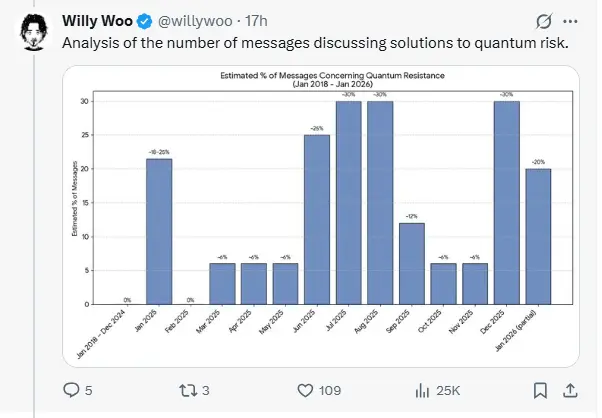
This defense comes amid growing alarm regarding the vulnerability of bitcoin addresses to quantum computing. Some analysts suggest these fears are already weighing on the market, contributing to bitcoin’s inability to break above the $100,000 mark for several weeks. Crypto advocate Nic Carter suggested that bitcoin’s recent price stagnation reflects a market waking up to long-term quantum risks. While developers may view the threat as distant, Carter argues institutional investors now see it as a legitimate “headwind.”
Read more: Is Quantum Computing Casting a Shadow Over Bitcoin’s Price?
This sentiment is gaining traction in traditional finance. Christopher Wood, a strategist at Jefferies, recently removed bitcoin from a recommended pension portfolio, citing the “existential technological threat” of quantum computing. On the other hand, Sergio Ermotti, the CEO of the financial services giant UBS, stated that bitcoin must overcome the quantum threat to maintain its long-term credibility as a store of value.
To counter the narrative of inaction, Woo’s analysis highlighted an “explosion” of technical discussions in 2025, following a period of near-total silence between 2018 and 2024.
The primary focus of these discussions—often exceeding 100 messages per thread—revolves around the vulnerability of ECDSA/Schnorr signatures to Shor’s algorithm. Key points of the current developer consensus include implementing voluntary transitions rather than forced protocol changes. There is an agreement to prioritize the maturity of the National Institute of Standards and Technology (NIST) post-quantum cryptography standards before integration.
Woo characterized the current atmosphere not as one of panic, but as “proactive engineering for a distant-but-real threat.”
FAQ ❓
- What is the quantum threat to bitcoin? Quantum computing could break Bitcoin’s cryptographic signatures, risking address security.
- How are developers responding? Bitcoin devs accelerated work in 2025, with discussions topping 10% of mailing list activity.
- Why is the market concerned? Analysts say quantum fears are weighing on Bitcoin’s price, stalling it below $100,000.
- What solutions are being explored? Developers favor voluntary transitions and NIST post‑quantum standards before protocol integration.
Disclaimer: The information on this page may come from third parties and does not represent the views or opinions of Gate. The content displayed on this page is for reference only and does not constitute any financial, investment, or legal advice. Gate does not guarantee the accuracy or completeness of the information and shall not be liable for any losses arising from the use of this information. Virtual asset investments carry high risks and are subject to significant price volatility. You may lose all of your invested principal. Please fully understand the relevant risks and make prudent decisions based on your own financial situation and risk tolerance. For details, please refer to
Disclaimer.
Related Articles
Bhutan Sells $18.46M Bitcoin as Price Nears $74k Resistance
The Royal Government of Bhutan transferred approximately 250 BTC worth $18.46 million in the past 24 hours, according to on-chain data from Arkham, continuing a broader pattern of reduced Bitcoin holdings. The transfers included 162 BTC and 69.7 BTC sent to new wallet addresses within a short
CryptoFrontier2m ago
Bitcoin's BIP-361 Quantum Fix Splits Community Over Address Freezing
A proposed Bitcoin improvement to address quantum vulnerability has divided the cryptocurrency community over whether to freeze legacy addresses, including those attributed to Satoshi Nakamoto. The BIP-361 proposal, which went live on April 14, has sparked debate between prominent figures including
CryptoFrontier1h ago
Zonda Exchange Discloses 4,500 BTC Cold Wallet as Private Keys Remain Untransferred
Zonda, a Polish crypto exchange, revealed a cold wallet with 4,503 BTC amid a withdrawal crisis. CEO Przemysław Kral addressed fund misappropriation allegations and promised legal action against false claims, emphasizing that private keys were never transferred due to the former CEO's disappearance.
GateNews1h ago
Ben McKenzie Slams Bitcoin on Jon Stewart Show
Actor Ben McKenzie appeared on The Weekly Show with Jon Stewart on Aug. 14 in a segment titled "The Other Side of Bitcoin: Crypto Corruption," where he delivered a sharp critique of Bitcoin and the broader cryptocurrency industry. McKenzie, known for his film and television work, has become a
CryptoFrontier1h ago
BTC edges up 0.46% in 15 minutes: institutional fund outflows and macro risk-off sentiment in sync drove the move
From 15:00 to 15:15 (UTC) on 2026-04-16, BTC logged a +0.46% return within 15 minutes. The price fluctuated in a range of 73,939.7 to 74,440.0 USDT, with an amplitude of 0.68%. During this time window, market attention increased, short-term volatility intensified, and fund-flow characteristics changed noticeably.
The main driver of this deviation is the continued outflow of large amounts of capital from exchanges. According to on-chain data, in the past 24 hours the net flow was -14,408.84 BTC, mainly concentrated in large transfer ranges of more than $1 million (especially>$10M net outflow -12,987.03 BTC). This shows that institutions and large holders actively reduced their BTC holdings on exchanges, and short-term selling pressure was significantly lowered. Against the backdrop of persistently weak liquidity, with order book depth remaining at a low level for a long time, the price has become more sensitive to medium-sized buy orders—amplifying the impact of even modest inflows on spot market price action.
In addition, macro conditions changed in parallel and produced a synchronized effect: easing geopolitical tensions in the Middle East boosted overall market sentiment. International gold prices rose, global equity markets hit new highs, and the market re-evaluated the probability of the Federal Reserve cutting rates within the year, further increasing investor attention to safe-haven assets (including BTC). At the same time, on-chain data indicates that the “whale” trading activity during this phase is at an annual low (>$1M transfers fell to 1,485 transactions). With heavy market wait-and-see sentiment and limited short-term supply, BTC’s responsiveness to sudden buy-side capital was further enhanced.
Investors should be reminded that current market liquidity is still fragile. Insufficient order book depth increases the market’s sensitivity to large capital movements, and short-term volatility may intensify. Going forward, focus on further shifts in on-chain large-fund flows, changes in price action as it breaks through support or resistance regions, and the risks and opportunities brought by related macro policies and geopolitical developments. Please continue to track key data and stay alert to any sudden shocks during the period of abnormal moves.
GateNews2h ago
Bitcoin Transactions Face 70-Page Tax Filing Burden Annually
According to Nicholas Anthony of the Cato Institute's Center for Monetary and Financial Alternatives, spending Bitcoin on everyday purchases creates an unexpected tax compliance nightmare. The IRS treats Bitcoin as property, not currency, meaning every transaction—even a $5 coffee
CryptoFrontier3h ago


