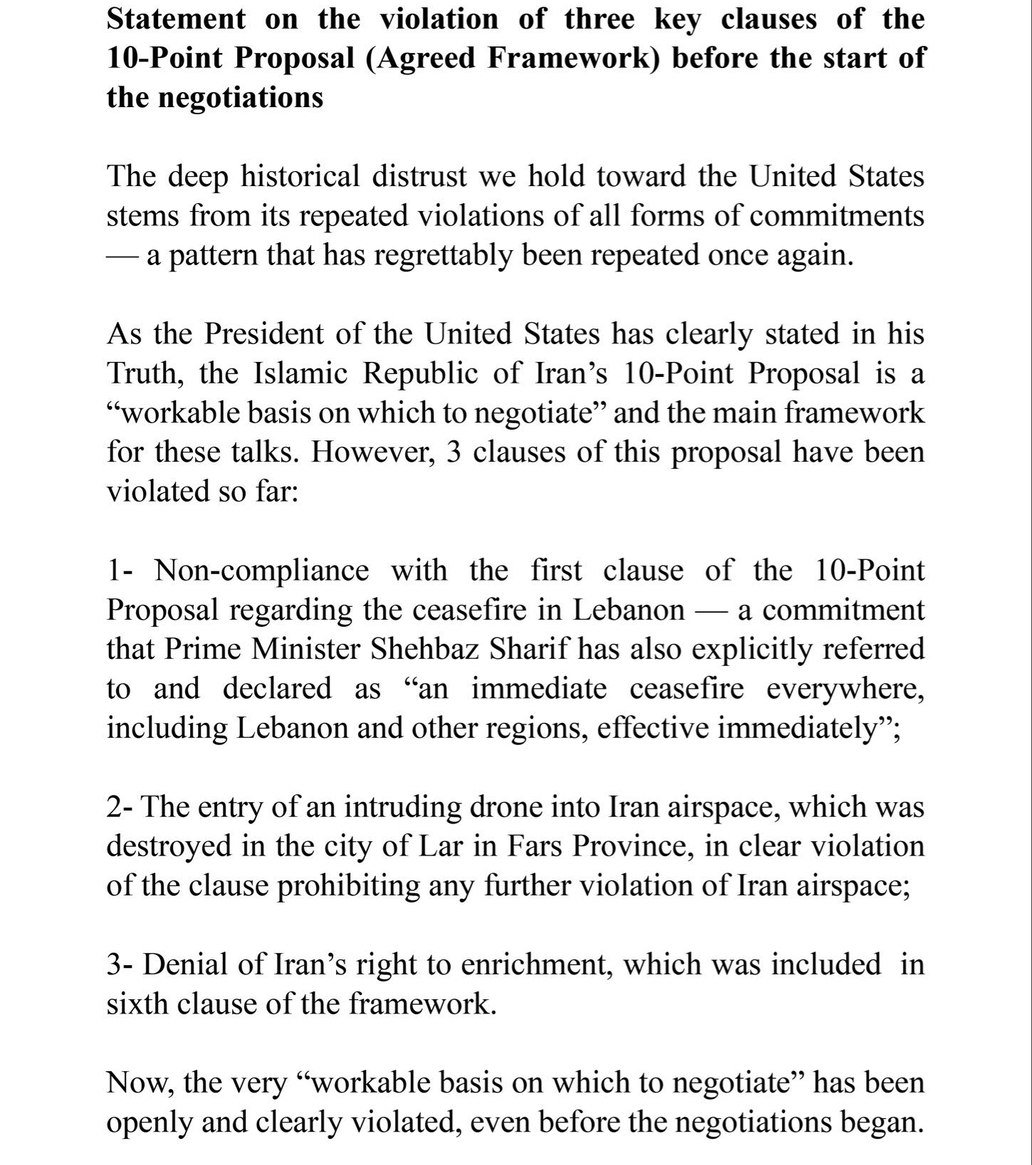
Iranian Parliament Speaker Mohammad Bagher Ghalibaf issued a tough statement, accusing the United States and Israel of openly violating three clauses in Iran’s “10-point proposal,” which was set as the basis for the ceasefire talks. Ghalibaf said bluntly that the basis for the talks was already undermined before the meeting, making the soon-to-be-held bilateral talks “highly unreasonable.”
(Backgrounder: The U.S.-Iran ceasefire is on the verge of collapse! Trump says “the ceasefire doesn’t include Lebanon”; Iran hits back hard: If they keep fighting, we’ll block the Strait of Hormuz)
(Additional background: The U.S.-Iran ceasefire agreement could be torn up! Iran warns Israel: If it continues to bombard Lebanon, it will “fully withdraw from the ceasefire agreement.” Bitcoin falls below $71k on the spot)
The fragile, two-week ceasefire agreement between the United States and Iran is teetering on the brink of collapse. The peace talks that both sides are scheduled to hold on April 10 in Islamabad, Pakistan, have not yet begun, yet Iran’s officials fired first. Mohammad Bagher Ghalibaf, speaker of the Iranian parliament, issued a new tough statement, sharply criticizing the United States and Israel for trying to pressure and sabotage the agreement before the negotiations even start.
Iran lists three charges of violating the agreement: airspace infringement and denial of nuclear rights
In the statement, Ghalibaf clearly pointed out that the actions of the United States and Israel have in practice violated three core clauses in Iran’s “10-point proposal” submitted through Pakistan:
- Violation of the Lebanon ceasefire clause: Israel has completely failed to comply with the requirement to halt fighting on the Lebanon front and continues to carry out intense military strikes against the region.
- Drone airspace intrusion: An unidentified drone entered Iranian airspace and was shot down near Lar, Fars Province (Fars), which Tehran sees as a clear provocation of the clause on “no further infringement of Iranian airspace.”
- Denial of uranium enrichment rights: In response to the proposal’s Clause 6 requiring “recognition of Iran’s nuclear enrichment activities,” U.S. officials publicly denied Iran’s right to uranium enrichment.
In light of the situation above, Ghalibaf, who will personally lead the Iranian delegation to Islamabad, made a stern statement: “The ‘feasible basis’ for the negotiations was publicly and clearly violated even before the talks began. Under these circumstances, a bilateral ceasefire or talks are not reasonable.”
The “10-point proposal” sets an extremely high bar; Friday’s talks are a geopolitical focal point
The 10-point proposal, which Iran’s Supreme National Security Council regards as a “major victory,” and which U.S. President Donald Trump calls a “feasible basis for negotiations,” contains extremely high political and strategic thresholds. In addition to requiring the U.S. to guarantee it will no longer invade, lift all first- and second-tier sanctions, and withdraw U.S. forces from the Middle East, it also requires recognition of Iran’s control over the global oil chokepoint “Strait of Hormuz” and the right to coordinate passage.
At present, the U.S. side is expected to send a delegation led by Vice President JD Vance to attend Friday’s meeting. However, amid trust between both sides having dropped to an ice point and the negotiating premises being repeatedly undermined before the talks, whether this historic face-to-face meeting can take place as scheduled and achieve meaningful progress still carries enormous uncertainty.

Disclaimer: The information on this page may come from third parties and does not represent the views or opinions of Gate. The content displayed on this page is for reference only and does not constitute any financial, investment, or legal advice. Gate does not guarantee the accuracy or completeness of the information and shall not be liable for any losses arising from the use of this information. Virtual asset investments carry high risks and are subject to significant price volatility. You may lose all of your invested principal. Please fully understand the relevant risks and make prudent decisions based on your own financial situation and risk tolerance. For details, please refer to
Disclaimer.


