The leading prediction market on Polymarket, has already surpassed $55 million in cumulative trading volume for the previous event bet: “Will Jesus return again before 2027?” The current odds for No are 96%.
(Background: Polymarket announced its return to the U.S.—approved by the CFTC—operating as an “Designated Contract Market,” running an intermediary-style trading platform)
(Additional context: Deep analysis of the on-chain prediction market Polymarket—how it became a global barometer of major events, and the technical & regulatory challenges it faces?)
In prediction markets where data-driven decision-making rules, there is a wager on a proposition that no one has been able to verify in the past two thousand years: whether Jesus Christ will return. On Polymarket, the contract named “Will Jesus Christ return before 2027?” has rules so simple they’re almost absurd:
If the Second Coming of Jesus Christ happens before the end of 2026, the market settles as Yes; otherwise it settles as No.
The settlement basis in the official rules says the source is “consensus from credible sources,” but what counts as a credible source? Is it authoritative? The rules do not provide further clarification.
User Ornery-Colt raised a settlement question: “If someone claims to be Jesus returned, does that count as Yes? Or do we need recognition from the big church or the small church?” Smoggy-Mixer then followed up: “What if the one who comes is a Jewish messiah, not Jesus?”
Currently, the probability for Yes is about 4%, and for No about 96%.
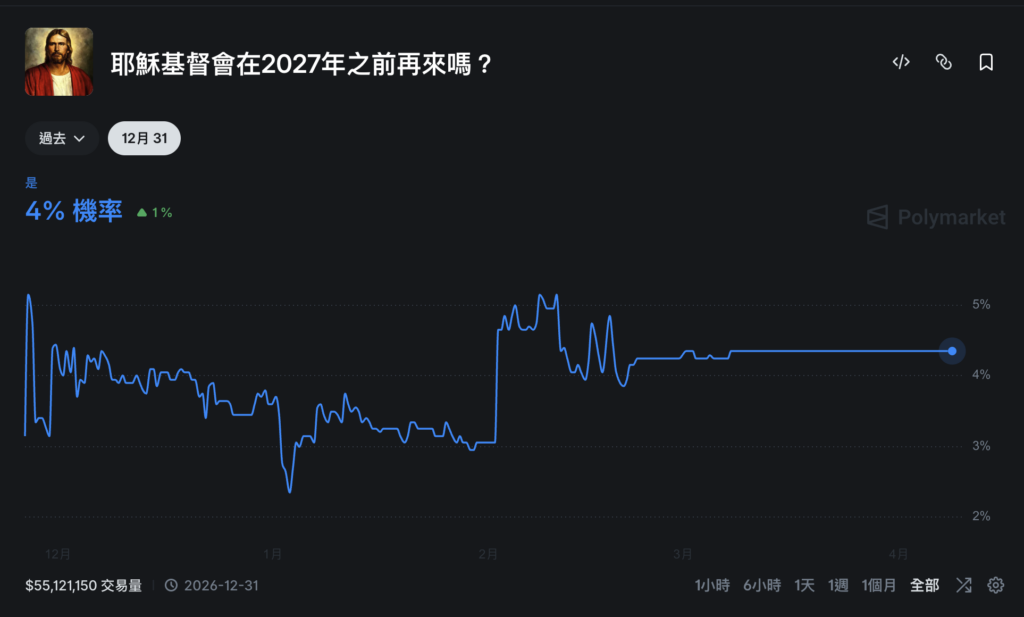
Based on official data, you can see the largest holders for both YES and NO positions—both are at 500k dollars.

It’s not faith—it’s the annualized return rate?
I’m not a Christian, and I also think it’s strange that this event could even be valid on its own. But I believe there are plenty of people betting on No; assuming you buy a No contract with the current price of 0.96 dollars, and you get 1 dollar back at year-end settlement, the annualized return rate is about 5.5%.
One commenter said, “This isn’t a prediction market; it’s a fixed-income product wearing a theological costume.” A community user named Bare-Digit wrote, “If I had $20 million, I would go all-in on No without hesitation—guaranteed profit of $200k. Completely free money.”
However, some users warn, “People who think this is free betting will end up losing money. This is a very scammy process.” His concerns aren’t without reason: the opportunity cost during the funds’ lock-up period, platform risk, and the ambiguous settlement terms of the contract are all hidden costs behind the scenes; after all, controversies over event outcomes aren’t uncommon on Polymarket.

Disclaimer: The information on this page may come from third parties and does not represent the views or opinions of Gate. The content displayed on this page is for reference only and does not constitute any financial, investment, or legal advice. Gate does not guarantee the accuracy or completeness of the information and shall not be liable for any losses arising from the use of this information. Virtual asset investments carry high risks and are subject to significant price volatility. You may lose all of your invested principal. Please fully understand the relevant risks and make prudent decisions based on your own financial situation and risk tolerance. For details, please refer to
Disclaimer.


