Brent crude oil futures rose more than 60% in March, marking the strongest single-month gain since records began in 1988; on Tuesday, the May contract’s settlement price rose by about 5% to $118.35 per barrel. After the U.S. and its allies conducted joint airstrikes on Iran on February 28, Iran blocked the Strait of Hormuz, cutting off roughly one-fifth of the world’s oil and natural gas transit routes. The International Energy Agency (IEA) characterized the disruption as the largest supply shock in the history of the global oil market.
The Historical Depth of the Energy Shock: Why 1988 Is the Key Comparison Benchmark
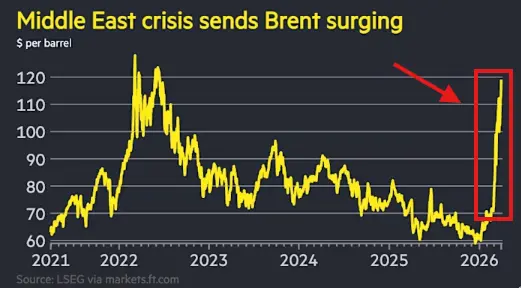
(Source: LSEG)
The daily volume of crude oil transiting the Strait of Hormuz accounts for about 17% to 20% of global supply, making it the world’s most critical oil transit waterway. After the blockade, the global oil futures market quickly began pricing in the risk of prolonged supply shortages, pushing the March gain to more than 60%—a figure unseen in the oil market history since 1988.
The special feature of this surge lies in its persistence: this is not a short-lived, pulse-like increase triggered by a geopolitical event, but a structural rise supported by a real supply gap, lasting the entire month alongside the blockade of the strait—highly similar in nature to the supply crises triggered by Middle East wars before 1988.
Consumers Hit First: Gasoline Prices Climb to Multi-Year Highs
The energy price shock has moved from the futures market to global end consumers:
United States: Since last December, gasoline prices have risen by $1.25 per gallon to $4 per gallon, the highest level since 2022
United Kingdom: Gasoline has reached 152.8 pence per liter, up about 20 pence from the start of the conflict
Global industrial energy use: JPMorgan Chase’s global chief economist Bruce Kasman warned that long-term supply disruptions could leave industrial energy users facing supply constraints
Kasman said: “If the strait closes again for one month, oil prices will rise to $150 per barrel, and industrial energy users will face supply constraints—this is something that can be expected.”
Outlook: the $150 to $200 Scenarios and Three Geopolitical Paths to Resolution
Kasman’s $150 warning is not the most pessimistic expectation in the market. According to Bloomberg, U.S. officials and Wall Street analysts have begun discussing the possibility of crude reaching $200 per barrel, provided that the Strait of Hormuz remains closed and diplomatic proposals fail to make progress.
However, the geopolitical landscape is also evolving in parallel. President Trump has hinted that the U.S. could end its military action against Iran within two to three weeks; the Wall Street Journal reported that even if the Strait of Hormuz remains largely closed, Trump is willing to end the military action; at the same time, the UAE is preparing to help the U.S. use force to reopen the waterway.
Which of the three parallel paths—diplomatic negotiations to resolve the issue, unilateral military withdrawal, and a multinational coalition using force to reopen—ultimately happens first will be the key variable determining the subsequent direction of the global oil market.
Frequently Asked Questions
Why did the March gain in Brent crude set a historical record since 1988?
The main reason is that Iran blocked the Strait of Hormuz after the Feb. 28 U.S.-led airstrikes with U.S. and its allies, cutting off roughly 17% to 20% of the world’s oil transit routes. The IEA characterized the disruption as the largest supply shock the global oil market has ever seen, and the month-long blockade pushed futures pricing to a month-on-month gain of more than 60%.
Why do analysts warn that oil prices could reach $200?
JPMorgan Chase’s chief economist Bruce Kasman warned that if the strait is closed for another month, oil prices could reach $150 per barrel. Bloomberg further cited U.S. officials and Wall Street analysts, noting that in extreme scenarios the possibility of $200 per barrel is also being discussed, assuming the blockade continues and a diplomatic solution is not achieved.
What possible paths exist to end the oil crisis?
There are currently three paths: reaching a ceasefire agreement through diplomatic negotiations, with Iran lifting the blockade; Trump accepting the reality that the strait would remain largely closed after the end of military action; or the UAE, working with the U.S., using force to compel the reopening of the Strait of Hormuz. The priority and progress of each path will be key observation indicators for the subsequent direction of oil prices.
Disclaimer: The information on this page may come from third parties and does not represent the views or opinions of Gate. The content displayed on this page is for reference only and does not constitute any financial, investment, or legal advice. Gate does not guarantee the accuracy or completeness of the information and shall not be liable for any losses arising from the use of this information. Virtual asset investments carry high risks and are subject to significant price volatility. You may lose all of your invested principal. Please fully understand the relevant risks and make prudent decisions based on your own financial situation and risk tolerance. For details, please refer to
Disclaimer.


