
DeFiLlama data shows that prediction market Polymarket recorded $550,000 in daily revenue on April 1, ranking seventh among all crypto agreements. The timing is exactly the third day after the platform officially began charging a Taker (order-taking) fee on almost all market categories starting March 30. The new fee schedule produced a significant revenue impact in a short period of time.
Financial Impact of the Fee Reform: Top 10 in Crypto Agreements in Three Days
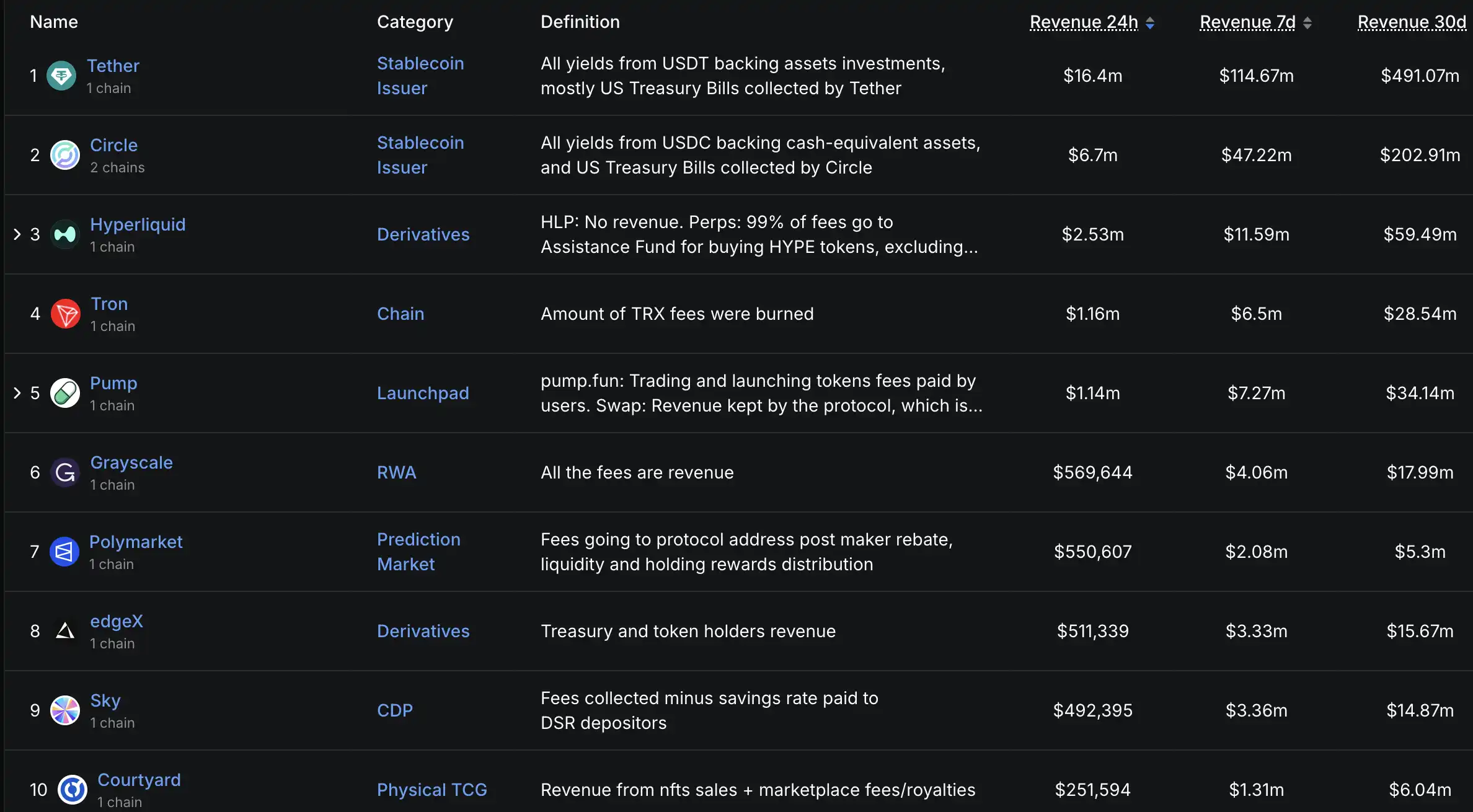 (Source: DefiLlama)
Polymarket’s new fee schedule uses a variable fee structure based on market probabilities, with different pricing standards set across various categories. The overall logic is: when the probability is close to 50%, the fee reaches its peak; the more certain the outcome becomes, the closer the fee gets to zero—so markets with high uncertainty contribute more revenue to the platform.
DeFiLlama data shows that on the third day after the new fee schedule was implemented, Polymarket’s daily revenue reached $550,000, rising to seventh place among revenue across the entire crypto ecosystem agreement—this ranking means its day-to-day profitability has surpassed that of most well-known DeFi agreements. For a prediction market platform that was originally built on non-financial betting, this achievement signals that its business model has entered an entirely new scale tier.
This result also validates Polymarket’s fee adjustment logic: amid continued growth in market trading volume, introducing a fee mechanism did not significantly suppress user participation, and the platform’s bargaining power was confirmed early on.
P2P.me Scandal: Why the Integrity Rules Landed Right on Time
In the same time window as Polymarket’s fee adjustment, a startup event involving insider betting provided real-world evidence for the integrity rules Polymarket updated earlier.
A stablecoin startup P2P.me, supported by Coinbase Ventures and Multicoin Capital, publicly apologized on Saturday on the X platform, admitting that it used the account name “P2P Team” to place bets via Polymarket on MetaDAO’s financing activities for the company itself. The bets were whether the financing would reach predetermined milestones.
Key facts of the incident are as follows:
· The betting took place 10 days before the public fundraising formally began, using the real company name for the account, and the information can be publicly verified
· Total profits were less than $15,000, but the company’s apology statement acknowledged that “even small gains may have a huge impact”
· Some of P2P.me’s major supporters were not aware in advance; they learned after the news came out in reports
· MetaDAO co-founder Prohp3t said that if they had known in advance, they would have advised P2P.me to stay away from Polymarket
· MetaDAO has provided refunds to investors who want to exit before the fundraising ends; it has already received $20,000 in applications (from $5.7 million in committed funding)
In its apology statement, P2P.me said: “This caused confusion and damaged trust. We should have let the work outcomes, the product, and the mission speak for themselves. This is our mistake.”
Notably, Polymarket had just completed an integrity rules update on March 24, clearly prohibiting people with “authority or influence sufficient to affect the outcome of the target event” from placing bets in relevant markets. The timing of the P2P.me incident made the necessity of the new rules feel especially concrete.
Frequently Asked Questions
What is the specific structure of Polymarket’s new fee schedule?
Polymarket’s new fee schedule uses a variable structure: the peak fee rate for crypto-related contracts is as high as 1.8%, the peak fee rate for celebrities and some economics-focused predictions is around 1.5%, and lower tiered fee rates apply to categories including sports, finance, politics, culture, weather, and general. The fee reaches its peak when market probability is close to 50%, and the more certain the result is, the lower the fee becomes.
Did P2P.me violate the rules by betting on its own funding on Polymarket?
Polymarket’s integrity rules updated on March 24 clearly prohibit relevant bets by people who can influence the outcome. Although P2P.me’s actions were carried out with transparent accounts, they still sparked widespread questions. The company chose to publicly apologize and acknowledge that even small profits damage market trust.
How does Polymarket currently rank in daily revenue among crypto agreements?
According to DeFiLlama data for April 1, 2026, Polymarket’s daily revenue reached $550,000, ranking seventh among all crypto agreements. This ranking occurred on the third day after the new fee schedule was implemented, indicating the immediate uplift effect of the fee adjustment on the platform’s revenue.
Disclaimer: The information on this page may come from third parties and does not represent the views or opinions of Gate. The content displayed on this page is for reference only and does not constitute any financial, investment, or legal advice. Gate does not guarantee the accuracy or completeness of the information and shall not be liable for any losses arising from the use of this information. Virtual asset investments carry high risks and are subject to significant price volatility. You may lose all of your invested principal. Please fully understand the relevant risks and make prudent decisions based on your own financial situation and risk tolerance. For details, please refer to
Disclaimer.


