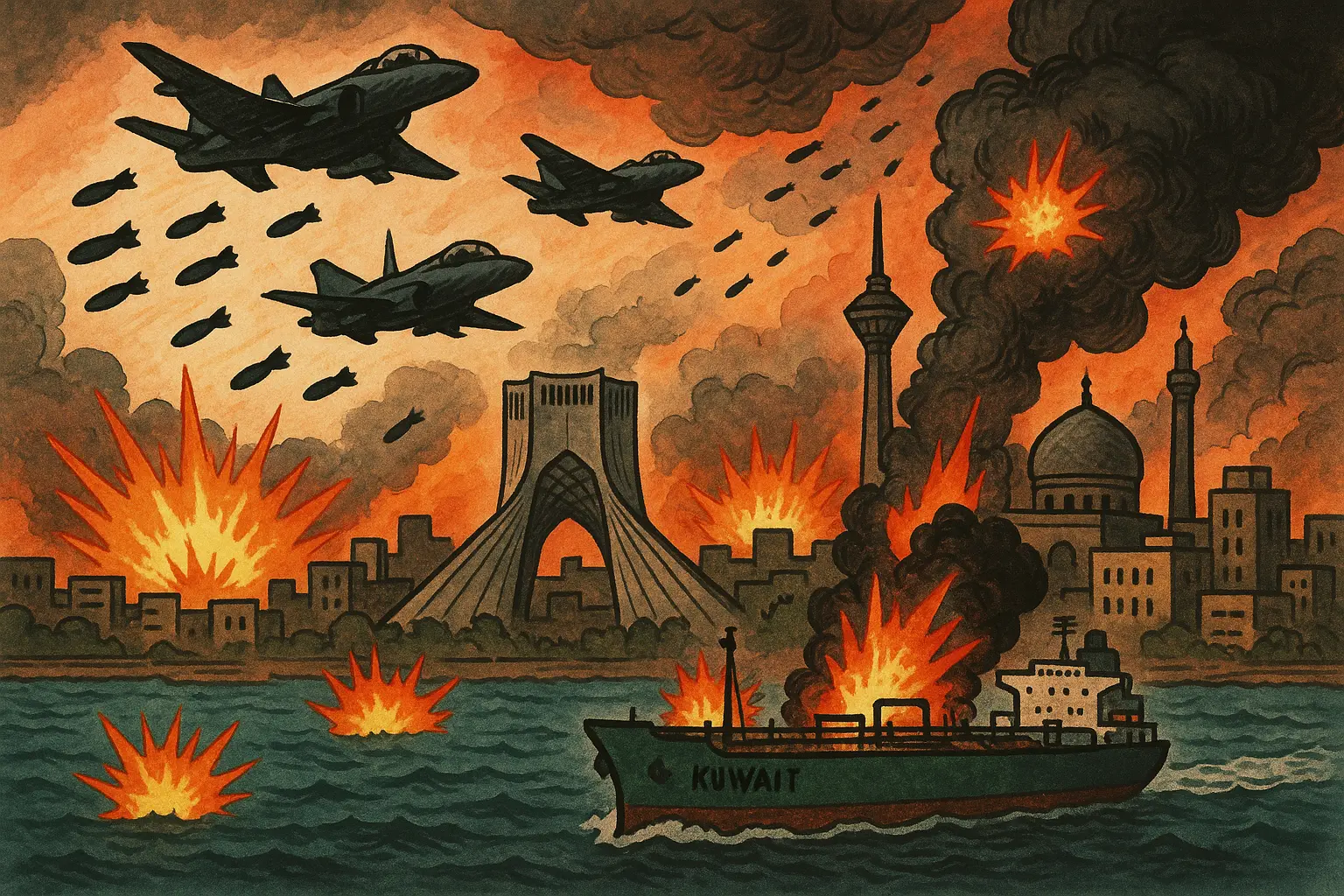
The U.S.-Israeli coalition continues military action against Iran. In the past 24 hours, the Israeli military carried out 170 strikes on Tehran, targeting drone-engine manufacturing facilities and the Western military headquarters. A Kuwait oil tanker in the Persian Gulf was hit by an Iranian drone, sparking a fire. Fueled by the escalation of the conflict, U.S. West Texas Intermediate (WTI) crude surged more than 3% to nearly $106 per barrel, while Brent crude rose more than 2% to $115 per barrel.
Conflict spreading: synchronized escalation in multiple places
The rate at which the Iranian front is spreading has exceeded prior expectations. Israel’s airstrikes on Tehran are moving deeper into Iran’s industrial production capacity and command core. With 170 attack targets struck within 24 hours, the air campaign appears to have entered a dense, intensive offensive tempo.
In the Persian Gulf, a drone strike on the Kuwaiti tanker further raised market expectations of heightened disruptions to energy supply. In southern Lebanon as well, there was an attack on peacekeeping forces; three Indonesian soldiers were killed. France then immediately called for an emergency meeting of the United Nations Security Council, signaling that the conflict has triggered a broad international response.
Iran’s parliament approved charging tolls for ships passing through the Strait of Hormuz and banned ships associated with the United States and Israel from passing through. This formally sets control over the strait’s passage rights as a tool of diplomatic confrontation, further intensifying market concerns about global oil supply.
Oil breaks through $100; global financial markets feel the knock-on pressure
This is WTI crude’s first time breaking $100 per barrel since July 2022. Gold has remained steady at around $4,500 per ounce, and demand for traditional safe-haven assets has heated up in tandem. Key market data are as follows:
WTI crude oil: Surged more than 3%, approaching $106 per barrel (a four-year high)
Brent crude oil: Up more than 2%, breaking above $115 per barrel
U.S. stocks: Nasdaq down 0.75%, S&P 500 down 0.4%, Dow up slightly 0.11%; overall, the market opened higher and then traded lower
U.S. Treasury yields: After Fed Chair Jerome Powell’s Harvard speech, the 10-year yield fell back to 4.35%, and the probability of rate hikes in 2026 dropped to 5%
Bitcoin: Briefly dipped to $66,500 after Trump’s remarks, then edged back up above $67,000; overall, it has been moving sideways in a $65,000 to $70,000 range
Powell said the Fed is inclined to view short-term energy shocks as temporary, with no urgency to adjust rates. That slightly eased market concerns about earlier-than-expected rate hikes and drove a decline in sovereign bond yields.
Expert assessment: threat to power plants and the feasibility of operations on Khark Island
Trump’s remarks threatening attacks on civilian energy infrastructure have drawn broad legal and military scrutiny. Laurent Lambert, vice professor at the Doha Institute, clearly warned that intentionally attacking civilian infrastructure is very likely to violate international law and constitutes a war crime. David Michel, a scholar at the Center for Strategic and International Studies (CSIS), noted that attacks on desalination facilities are a highly provocative escalation. The International Monetary Fund (IMF) simultaneously warned that the Iran-U.S. war is causing global prices to keep rising while the economy slows.
Regarding assessments of operations on Khark Island, Alessio Patalano, a scholar at King’s College London (KCL), warned that stationing troops on the island would make U.S. forces a fixed target for Iranian missiles. Sidharth Kaushal, a researcher at the Royal United Services Institute (RUSI), analyzed that before landing on the island, mines must be cleared first and coastal air-defense systems must be disabled. Khark Island handles about 90% of Iran’s oil exports. If it is occupied or destroyed, the impact on energy markets would far exceed current oil-price levels.
Frequently asked questions
How does the Iran-U.S. war push oil prices above $100 per barrel?
The Strait of Hormuz carries about 20% of global oil trade. Iran’s parliament approved tolls and banned U.S.- and Israeli-linked ships from passing through, plus the direct impact of a drone strike on a Kuwaiti oil tanker, which sharply boosted market expectations of disruptions to global oil supply—pushing WTI crude to break $100 per barrel for the first time since July 2022.
To what extent are Bitcoin and cryptocurrencies affected by the Iran-U.S. war?
In the backdrop of rising tensions between the U.S. and Iran, Bitcoin has continued to trade in a $65,000 to $70,000 range, unable to effectively escape constraints from macro pressures. Soaring oil prices reinforce inflation expectations and compress the Fed’s space to cut rates, putting overall valuations of high-risk assets under pressure. A safer-haven sentiment is more inclined to flow into gold rather than crypto assets—this structural reason is why Bitcoin has been unable to rebound effectively in the near term.
Does Trump’s threat to attack Iranian power plants violate international law?
Multiple legal and military experts point out that deliberately targeting civilian infrastructure (such as power plants) under the framework of the Additional Protocol to the Geneva Conventions may constitute a war crime. At present, this threat has not been carried out, but Laurent Lambert’s assessment suggests that if the threat comes true, it could trigger serious consequences under international humanitarian law and set off diplomatic ripple effects.
Disclaimer: The information on this page may come from third parties and does not represent the views or opinions of Gate. The content displayed on this page is for reference only and does not constitute any financial, investment, or legal advice. Gate does not guarantee the accuracy or completeness of the information and shall not be liable for any losses arising from the use of this information. Virtual asset investments carry high risks and are subject to significant price volatility. You may lose all of your invested principal. Please fully understand the relevant risks and make prudent decisions based on your own financial situation and risk tolerance. For details, please refer to
Disclaimer.


