
Key Takeaways
-
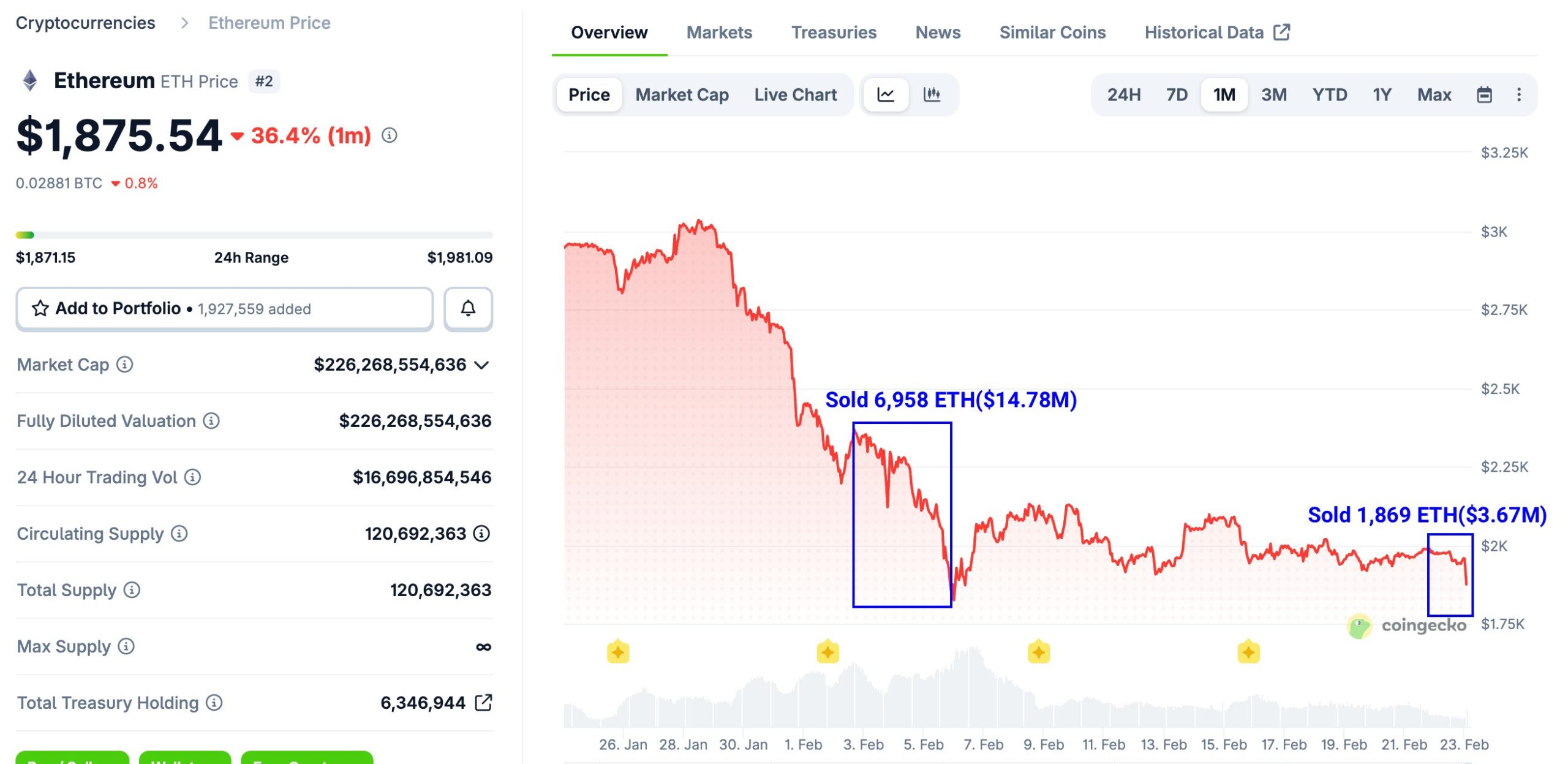
Vitalik Buterin sold 1,869 ETH (~$3.67 million) in the last 48 hours, picking up pace after recent Aave withdrawals.
-
_During this period, ETH fell 5.7% from $1,988 to $1,875, echoing a prior larger sale where ETH dropped 22.7% ($2,360 → $1,825). _
-
Sales continue funding Ethereum ecosystem projects, privacy tools, and open-source work—Buterin retains over 240,000 ETH; moves use privacy tools like CoW Protocol.
Ethereum co-founder Vitalik Buterin has accelerated his ETH sales in recent days, sparking renewed speculation in the crypto community about potential market impact amid ongoing price weakness.
According to on-chain tracking from Lookonchain (posted February 23, 2026), vitalik.eth sold 1,869 ETH—valued at approximately $3.67 million—over the past two days. During this period, Ethereum’s price declined from $1,988 to $1,875, a drop of 5.7%.
This comes as part of a broader selling pattern in February 2026. Earlier reports indicate Buterin has offloaded thousands of ETH since early February, with cumulative sales exceeding $15–18 million at average prices around $2,000–$2,100 per ETH. For context, a prior batch of 6,958 ETH (worth ~$14.78 million) coincided with a steeper ETH decline from $2,360 to $1,825—a 22.7% fall—highlighting how high-profile movements can amplify volatility in thin markets.
Source: @lookonchain (X)
Recent Activity and Broader Context
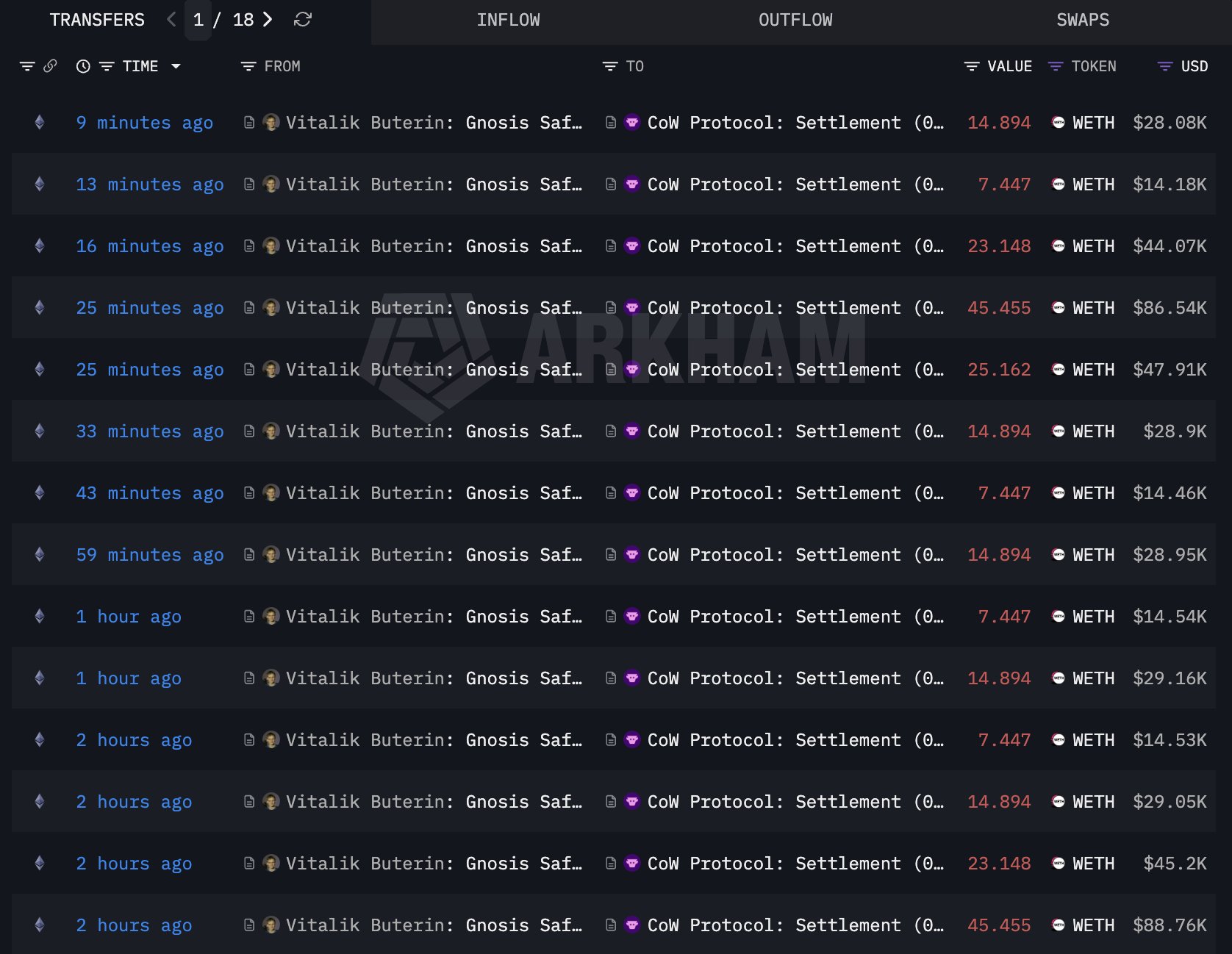
The latest acceleration in activity comes after Buterin withdrew 3,500 ETH (approximately $6.95 million) from Aave on February 22. Following the withdrawal, part of those holdings were gradually sold.
Over the past two days alone, he has offloaded 1,869 ETH worth around $3.67 million. During the same period, ETH’s price declined from $1,988 to $1,875, marking a 5.7% drop.
Source: @lookonchain (X)
Notably, some of these transactions were routed through privacy-focused trading platforms such as CoW Protocol, a move that can help reduce immediate market impact and slippage. In addition, portions of the ETH were swapped into stable assets, including GHO — Aave’s overcollateralized stablecoin — and USDC, suggesting a shift toward more defensive positioning amid short-term volatility.
Context on Buterin’s Holdings and Strategy
Buterin’s known ETH balance remains substantial. Recent estimates from Arkham (as of 23 February 2026) place his holdings above 224,000 ETH, currently valued around $418 million.

Source: Arkham
These transactions are typically not interpreted as bearish signals on Ethereum itself. Buterin has consistently framed such sales as strategic liquidity management to support long-term goals, including advancements in zero-knowledge proofs, decentralization, and emerging areas like AI-blockchain intersections. His recent X posts (from February 19–21, 2026) focus on governance innovations, protocol hardening, scaling upgrades (e.g., ePBS, gas repricings), and UX/security improvements—rather than market commentary.
Market Context
As of February 23, 2026, ETH trades near $1,860–$1,875 (with intraday lows around $1,856–$1,862 per snapshots), reflecting broader sentiment challenges including ETF outflows and macro headwinds. While Buterin’s volumes are noteworthy for visibility, they remain a tiny fraction of daily ETH liquidity (billions in USD traded).

Source: Coinmarketcap
These actions fit Buterin’s consistent pattern: strategic liquidity management to fund Ethereum’s long-term development without sudden disruption. While they add short-term sentiment pressure in a downtrending market, they do not indicate diminished confidence in the protocol.
Disclaimer: The views and analysis presented in this article are for informational purposes only and reflect the author’s perspective, not financial advice. Technical patterns and indicators discussed are subject to market volatility and may or may not yield the anticipated results. Investors are advised to exercise caution, conduct independent research, and make decisions aligned with their individual risk tolerance.
About Author: Nilesh Hembade is the Founder and Lead Author of Coinsprobe, with over 5 years of experience in the cryptocurrency and blockchain industry. Since launching Coinsprobe in 2023, he has been providing daily, research-driven insights through in-depth market analysis, on-chain data, and technical research.
Disclaimer: The information on this page may come from third parties and does not represent the views or opinions of Gate. The content displayed on this page is for reference only and does not constitute any financial, investment, or legal advice. Gate does not guarantee the accuracy or completeness of the information and shall not be liable for any losses arising from the use of this information. Virtual asset investments carry high risks and are subject to significant price volatility. You may lose all of your invested principal. Please fully understand the relevant risks and make prudent decisions based on your own financial situation and risk tolerance. For details, please refer to
Disclaimer.
Related Articles
ETH drops 0.76% in 15 minutes: Dual pressure from whales’ proactive deleveraging and ETF fund outflows
Between 07:15 and 07:30 (UTC) on 2026-04-19, the ETH spot price fluctuated in the 2298.13 to 2322.69 USDT range, with an amplitude of 1.06% and a return of -0.76%. During this period, market attention increased; the sharp drop in price triggered widespread user focus, along with a clear surge in trading volume within a short time, indicating a sudden escalation in liquidity pressure.
The main driver behind this deviation is that on-chain whale accounts actively sold ETH to repay DeFi platform borrowings in order to avoid forced liquidation. Based on on-chain tracking and fund-flow monitoring, from April 18 to 19, more than 42,000 ETH per-transaction large transfers were rapidly sent into a certain mainstream exchange, and at the same time there was a sharp spike in net inflows to the exchange. This concentrated sell pressure directly weakened spot market prices. Under proactive deleveraging behavior, selling pressure was released in the short term, creating a sudden market shock.
In addition, during the period of price deviation, the ETH derivatives market saw a significant rise in passive liquidation volume, especially as leveraged long positions encountered strong liquidations during the price decline, further increasing supply pressure in the spot market. Meanwhile, ETH spot ETF funds continued to see net outflows; in mid-April, there were multiple days with single-day outflows exceeding $40-50M, with the largest single day reaching $200M. This reflects a warming of short-term institutional risk-avoidance sentiment, which led to a deeper shift downward in buy-side liquidity depth. The launch of a new public chain ecosystem also attracted some ETH liquidity migration, further weakening the capital protection layer of the mainnet. Multiple structural feedback effects amplified the downside move.
At present, leverage risk in the ETH market remains prominent. Some whales still have large borrowings outstanding; if the price continues to move downward, potential liquidation risks may flare up again. ETF fund flows, on-chain large transfers, and capital-attraction moves tied to the new-chain ecosystem all need close monitoring. With increased short-term volatility risk, it is recommended to watch key support zones, exchange net inflow indicators, and DeFi on-chain liquidation dynamics in order to promptly grasp the latest market signals.
GateNews7m ago
ETH breaks below 2300 USDT
Gate News bot message, Gate market data shows that ETH has broken below 2300 USDT, with the current price at 2298.67 USDT.
CryptoRadar17m ago
ETH drops 0.58% in 15 minutes: derivatives liquidity contraction and proactive position reduction dominate short-term pullback
From 2026-04-19 04:30 to 2026-04-19 04:45 (UTC), within ETH’s 15-minute candlestick chart, the return recorded -0.58%, and the price range was 2321.62 to 2342.04 USDT, with an amplitude of 0.87%. The short-term selloff occurred against a backdrop of increased overall market volatility and a broad decline in the prices of major crypto assets; overall market risk appetite clearly fell, and traders’ wait-and-see sentiment strengthened.
The main driver behind this abnormal move is a sharp contraction in liquidity in the derivatives market and leveraged funds proactively reducing positions. Data shows that over the past 24 hours, the ETH/USD perpetual contract trading volume dropped 67.16% to approximately 74.87 million, open interest edged down 3.33% to 329 million, and liquidation amounts did not expand unusually. This structure indicates that the market lacks the risk of passive cascades; more funds chose to proactively step aside and wait on the sidelines, intensifying short-term selling pressure.
In addition, the long/short structure in which shorts held the upper hand (long/short ratio 47.48%:52.52%) and sentiment synchronization with the panic range reinforced the downward price trend. During the same period, major coins such as BTC and SOL also fell 2%-3.4% in tandem, further showing that this pullback was driven by system-wide risk sentiment. On-chain funds did not show any large abnormal transfers or large-scale liquidations of DeFi protocols; spot and on-chain liquidity remained generally stable, and no sudden system risk resonance was observed.
Current volatility-related risks still need close monitoring, especially as overall risk appetite continues to contract—ETH’s short-term price may face further downside probing. Watch subsequent changes in derivatives trading volume and open interest, extreme shifts in the long/short ratio and funding rate, and promptly monitor on-chain fund flows, large transfers, and any signs of amplified platform net outflows. For more market anomalies and deeper analysis, please continue to follow our upcoming market updates.
GateNews2h ago
Spark Protocol's January delisting of rsETH proves prudent as Aave faces ETH liquidity crisis
Spark Protocol's strategy of delisting low-usage assets and tightening collateral has faced initial backlash but proved wise during market turmoil. While maintaining higher interest rate caps, SparkLend ensures liquidity, unlike Aave, which now faces significant risks.
GateNews3h ago
Ethereum Processes 200M Transactions in Q1 2026, Up 43% QoQ
Ethereum experienced its highest quarterly transaction volume in Q1 2026 with over 200 million transactions, marking 43% growth from the previous quarter. Layer 2 solutions and stablecoin usage drove this surge, indicating a utility-focused adoption trend.
GateNews17h ago


