
Crypto feels heavy again.
After months of distribution and fading rallies, the market resembles prior bear cycles. Bitcoin is down roughly 30% over the past 12 months. Cardano (ADA) is down closer to 60% over the same stretch. Liquidity is weak. ETF flows have cooled. Retail enthusiasm has faded.
This environment looks more like 2018 or 2022 than 2021.
So the question becomes uncomfortable but practical: does it make sense to rotate from ADA into Bitcoin at this stage of the cycle?
Let’s look at history.
- Bitcoin Leads, Altcoins Follow
- Cardano’s Recent Underperformance
- Bear Market Risk: ADA vs BTC
- So… Does the Switch Make Sense?
Bitcoin Leads, Altcoins Follow
In previous cycles, Bitcoin moved first.
After the brutal 2018 bear market, Bitcoin bottomed near $3,200 in December 2018. By mid-2019, BTC had already rallied above $13,000 — a 4x move — while most altcoins lagged significantly behind. Many never recovered meaningfully until much later.
The same pattern repeated after the 2022 crash. Bitcoin bottomed around $15,500 in late 2022. By early 2023 and into 2024, BTC reclaimed $30,000, then pushed toward new highs. The early stage of that move was Bitcoin-dominant. Altcoin dominance remained muted for months.
Capital flows into Bitcoin first during recovery phases. It is the most liquid, the most trusted, and the primary institutional on-ramp. Only after BTC stabilizes and gains confidence does capital rotate into higher-risk altcoins.
If a new bull phase begins in late 2026 or 2027, odds favor Bitcoin leading again.
To be clear – that does not guarantee it. But historically, it has been the pattern.
Cardano’s Recent Underperformance
Cardano’s last cycle was painful for long-term holders.
During the 2020–2021 bull run, ADA pumped aggressively, peaking above $3. But in the 2023–2025 recovery phase, it struggled to regain momentum compared to major competitors.
Ethereum pushed to new cycle highs. Solana broke past previous all-time highs and became one of the strongest performers of the cycle. XRP also hit new all-time high in the summer of 2025.
ADA, by contrast, never reclaimed its former highs. It failed to generate sustained upside momentum when liquidity returned to the market.
For holders who stayed through 2024 and into 2025 and 2026, that relative weakness has been frustrating.
When an asset fails to outperform during favorable conditions, investors start asking hard questions about opportunity cost.
Read also: Big XRP and ADA Market Caps Just Found a Tax-Free Liquidity Shortcut on Base
Bear Market Risk: ADA vs BTC
Another factor is downside protection.
If the bear market extends through 2026, risk assets may face additional pressure. Historically, Bitcoin falls less than mid-cap altcoins during deep corrections.
The data supports this dynamic. Over the past 12 months, ADA is down around 60%. Bitcoin is down roughly 30%. In downturns, capital tends to consolidate into the most liquid and established asset.
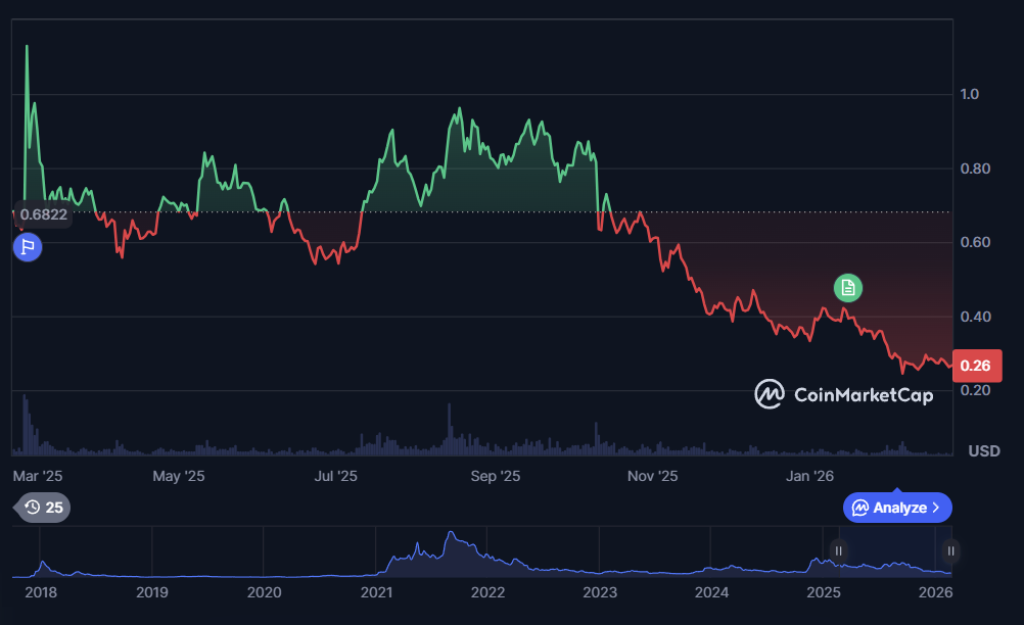
Source: CoinMarketCap/ADA’s 1-year price action
Bitcoin has stronger institutional support, deeper liquidity, and broader global recognition. That often cushions drawdowns relative to altcoins.
If macro conditions worsen, ADA could decline faster than BTC. The volatility gap cuts both ways: it creates upside potential in bull phases, but it magnifies pain in bear phases.
So… Does the Switch Make Sense?
This is not a blanket call to sell ADA. Cardano still has a loyal community, ongoing development, and long-term ambitions.
But from a cycle-rotation perspective, shifting some capital into Bitcoin during late bear phases has historical backing.
If a new bull market begins, Bitcoin likely moves first. If the bear deepens, Bitcoin may hold value better.
That is the trade-off.
ADA offers higher theoretical upside. Bitcoin offers stronger relative safety and first-mover momentum when cycles turn.
The smarter move may not be all-in on one side. It may be about understanding cycle dynamics, relative strength, and risk tolerance.
In bear markets, capital preservation matters. In early bull markets, leadership is important as well. Historically, Bitcoin has delivered both.
Disclaimer: The information on this page may come from third parties and does not represent the views or opinions of Gate. The content displayed on this page is for reference only and does not constitute any financial, investment, or legal advice. Gate does not guarantee the accuracy or completeness of the information and shall not be liable for any losses arising from the use of this information. Virtual asset investments carry high risks and are subject to significant price volatility. You may lose all of your invested principal. Please fully understand the relevant risks and make prudent decisions based on your own financial situation and risk tolerance. For details, please refer to
Disclaimer.
Related Articles
Bitcoin Breaks $72K as $280M Bear Liquidations Test Fragile Truce
Bitcoin extended a sharp intraday move higher on Tuesday, rising about 6% within four hours as risk appetite improved in tandem with a broader rally in global equities after news of a two-week ceasefire between the United States and Iran. The swift price surge coincided with a wave of liquidations i
CryptoBreaking47m ago
BTC drops 0.62% over 15 minutes: exchange net inflows intensify and short-term arbitrage converges to trigger volatility
From 18:00 to 18:15 on April 9, 2026 (UTC), the BTC price return recorded -0.62%, closing in the range of 71857.8 to 72375.1 USDT, with a trading range of 0.72%. Market attention was notably elevated, volatility intensified, and capital moved quickly within a short period. Overall market sentiment has become more cautious, and investors’ willingness to trade in the short term has increased.
The main driving force behind this abnormal move is an increase in net inflows to BTC exchanges during the anomaly window; the 10-minute net flow reached 755.92 BTC, indicating that some investors chose to transfer funds to exchanges to seek arbitrage opportunities in the midst of the volatility issue
GateNews2h ago
BTC 15-minute pump 0.55%: Large on-chain funds inflows and options positioning resonate to lift spot prices
2026-04-09 17:00 to 2026-04-09 17:15 (UTC), the BTC spot market saw a rapid spike with a +0.55% return. The price range was 72,063.9 to 72,518.5 USDT, and the full-period amplitude reached 0.63%. This upswing coincided with rising market attention; volatility clearly intensified, drawing funds into short-term trading in a mix of cautious sentiment and localized increased volume.
The main driving force behind this move was concentrated inflows to exchanges from on-chain large transfers, which pushed up spot market buy orders in a short time. Data shows that, in the past 24 hours, on-chain BTC transfers
GateNews3h ago
Mainstream CEX and DEX funding-rate displays suggest an increasingly bearish market sentiment
On April 10, the Bitcoin price broke through $72k again. According to Coinglass data, the funding rates on major trading platforms show that the market’s bearish sentiment is strengthening. Funding rates are used to balance the contract price with the asset price; a rate below 0.005% indicates that the market is broadly bearish.
GateNews3h ago
Over the past 1 hour, forced liquidations across the entire market totaled $101 million, including $80.39 million in BTC liquidations.
Gate News message, on April 9, CoinGlass data shows that over the past 1 hour, liquidations across the entire network totaled $101 million, including $97.07 million from short liquidations and $3.54 million from long liquidations. In addition, the liquidation amount for BTC reached $80.39 million, while the liquidation amount for ETH reached $11.79 million.
GateNews4h ago


