Multiple analysts believe the ongoing Bitcoin downtrend merely represents a bull market correction, but what does market data say?
Bitcoin has now fallen for five straight months and trades 46% below its all-time high of $126,000. However, despite this downtrend, analysts still refuse to call it a full bear market. They believe Bitcoin is simply going through a correction within a larger bull cycle, not entering another crypto winter.
Nonetheless, XWIN Research, a Japanese research firm, disagrees. The firm argues that Bitcoin has already entered the early stage of a bear market. According to XWIN, many investors fail to see it because today’s price levels remain higher than what they saw in previous bear markets.
Key Points
- Bitcoin has fallen 46% from its $126,000 peak and now trades around $67,900 after five straight months of decline.
- XWIN Research says Bitcoin has entered an early winter phase, with the Fear & Greed Index at 14 and structural selling pressure visible in capital flow data.
- In 2024, $10 billion in inflows expanded the market cap, but in 2025, over $300 billion in inflows coincided with a market cap decline.
- Net realized losses recently hit $13.6 billion, matching extremes seen during the 2022 bear market, though past bottoms formed about five months after peak losses.
- Bitcoin has declined 41% over four consecutive losing months, a pattern last seen in 2018, with a similar drawdown previously recorded during the 2022 bear market.
Investors Fail to Recognize the Bear Market
The firm presented reasons why many participants resist this idea. First, investors still remember the pain of 2022, and they do not want to relive it. In addition, Bitcoin trades at much higher nominal prices than it did during the last winter, which makes the situation feel different
Further, the launch of spot ETFs, stronger institutional adoption, and improved infrastructure also give many people confidence that history will not repeat itself. For instance, industry leaders like Strategy’s Michael Saylor had suggested that the bull market would extend to this year.
Why Bitcoin May Have Already Entered a Bear Market
Still, XWIN Research stressed that price alone does not define winter. Notably, supply and demand changes, capital flows, and sentiment provide the real data. Right now, the Fear & Greed Index stands at 14, a level classified as Extreme Fear. The firm noted that similar sentiment drops appeared in past cycles before prices adjusted downward.
Capital flow data also points to winter conditions. In 2024, $10 billion in inflows helped expand Bitcoin’s market cap. However, in 2025, more than $300 billion flowed into the market, but the market cap declined
XWIN Research sees this as a sign of ongoing selling pressure. On-chain profit data also shows falling realized gains despite high price levels, which indicates weakening internal strength.
Based on this data, XWIN Research believes Bitcoin may already be entering winter, even if higher prices and stronger infrastructure delay broader recognition. The firm said it would reconsider this view if ETF inflows stabilize and if on-chain distribution slows clearly.
How History Defines Bitcoin Winter
Meanwhile, the chart that accompanied XWIN’s report presented two definitions of Bitcoin winter. Under a broad definition, winter stretched from the November 2021 peak to the November 2022 bottom. During that one-year period, Bitcoin declined from its all-time high and dragged the entire crypto market into a bearish trend.
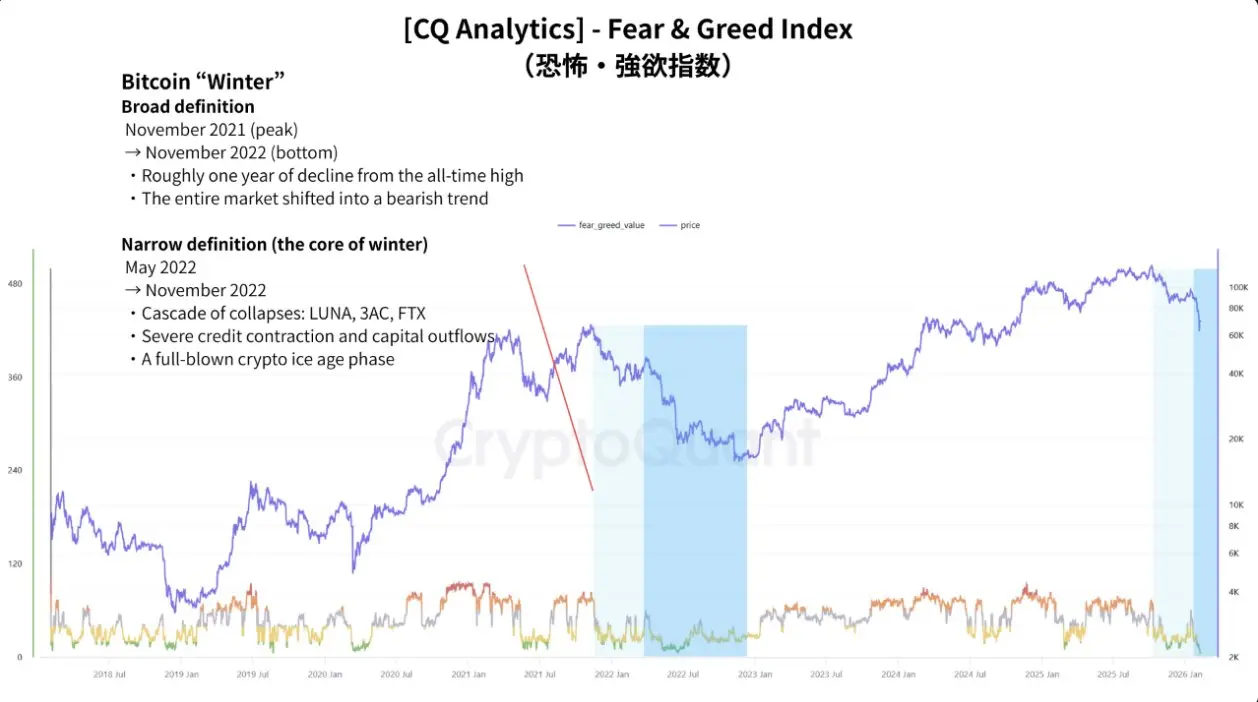 Bitcoin Bear Market Ideas | XWIN ResearchHowever, under a narrower definition, the core winter phase ran from May 2022 to November 2022. This period included the collapse of LUNA, the failure of Three Arrows Capital (3AC), and the bankruptcy of FTX
Analysts Split on What Comes Next
However, not everyone agrees that a bear market has already begun. Investor and commentator Mr. Crypto Whale shared what he calls his 2026 Bull Run Roadmap
Notably, he believes the current downtrend this month is a bear trap and will lead to a Bitcoin breakout in March. He predicts an altcoin season in April and a new all-time high around $215,000 in May. After that, he sees a bull trap in June, a liquidation cascade in July, and the official start of a bear market in August.
Meanwhile, Bitcoinsensus reported that Bitcoin’s net realized losses have reached levels similar to the worst moments of the 2022 bear market. Just three days ago, realized losses hit $13.6 billion
However, Bitcoinsensus reminded investors that in 2022, realized losses peaked about five months before the actual market bottom formed, which shows that bottoms take time to develop.
CryptoQuant author Woo Minkyu also warned three months ago that Bitcoin had already entered a bear market, citing the Bitcoin Cycle Momentum Indicator (BCMI), while it still traded above $86,000. Today, Bitcoin trades at $67,900
A Downtrend That Mirrors Past Bear Markets
Also, Bitcoin’s recent performance looks increasingly similar to past bear markets. The asset has recorded four consecutive months of losses and remains on track to log a fifth. Over this period, Bitcoin has dropped 41%.
The last time Bitcoin posted four straight months of declines was during the 2018 bear market, not even during 2022. The last time it suffered a 41% drawdown occurred during the 2022 bear market.
Disclaimer: The information on this page may come from third parties and does not represent the views or opinions of Gate. The content displayed on this page is for reference only and does not constitute any financial, investment, or legal advice. Gate does not guarantee the accuracy or completeness of the information and shall not be liable for any losses arising from the use of this information. Virtual asset investments carry high risks and are subject to significant price volatility. You may lose all of your invested principal. Please fully understand the relevant risks and make prudent decisions based on your own financial situation and risk tolerance. For details, please refer to
Disclaimer.
Related Articles
A certain South Korean CEX postponed its IPO until after 2028, due to internal preparations and regulatory factors
A South Korean cryptocurrency exchange announced that it will postpone its IPO until after 2028 due to the need to improve internal controls and accounting policies, and it is still in the preparation stage. Although it is expected to generate $43 billion in revenue in 2025, internal and regulatory issues have impacted the IPO process.
GateNews41m ago
BTC briefly fell below 68,000 USDT, and the 24H price increase narrowed to 0.03%
Gate News message, April 1, market conditions show that BTC briefly fell below 68000 USDT, currently at 67999.9 USDT, with the 24H gain narrowing to 0.03%.
GateNews1h ago
Bitcoin Hovering at $68K as Traders Predict Near-Term Decline
Bitcoin has each week stretched the same narrative: a narrowing price range after a dip to $60,000 in early February, with bulls and bears locked in a quiet tug-of-war. The last few days have seen BTC flicker between its daily highs and lows in a compact corridor, leaving traders debating whether th
CryptoBreaking1h ago
Nakamoto BTC Sale Signals Sectorwide DAT Contagion, Analyst Says
Bitcoin treasury holders have faced a renewed wave of scrutiny as market stress spread through the sector. Nakamoto (NAKA), a prominent crypto treasury company, disclosed March sales that locked in losses, a signal that broader capital discipline could intensify in the coming weeks. The
CryptoBreaking3h ago
RWA Trading Boom Fuels Bitcoin and Tron While APEMARS Leads Best 100x Crypto to Buy Today Trends At $0.00017238
The crypto market is entering a new phase where institutional-grade innovation is beginning to merge with retail accessibility. Bitcoin continues to hold strong near the $67K range while Tron expands its ecosystem through AI integration and steady network growth. These developments reflect a
CaptainAltcoin3h ago
Bitcoin Transaction Fees Hit Lowest Level Since 2017: But It’s Not Due to Weak Demand
The average transaction fee on the Bitcoin network has fallen below $0.40 for the first time since 2017, according to on-chain data shared by analyst Darkfost.
The drop is markedly different from other times in the past when low costs were triggered by low usage, as it has come while daily transact
CryptoPotato3h ago


