
Pi Network has fallen from a high of $3 to around $0.14. X users accuse the team of years of promises without a mainnet, merely performing mobile mining demonstrations, labeling it as the longest-running scam disguising itself as Web3. The project is about to unlock 250 million tokens, with an average of 8.3 million per day, releasing 23.6 million on February 13. The RSI is at 35, approaching oversold levels, hinting at a possible rebound.
Years of Promises of No Mainnet as a Hollow Check
According to X user pinetworkmembers, this decline is not a “healthy correction,” but rather the market pricing in the biggest issue behind this controversial project: “This is not a healthy correction but the market ultimately reflecting the obvious truth: after years of promises, there is still no usable mainnet, aside from ‘keeping the app open,’ with no real utility, and a large-scale mobile mining show.”
This criticism directly targets Pi Network’s core problem: the huge gap between promises and reality. Since its launch in 2019, Pi Network has promised to launch a fully functional mainnet allowing users to freely trade and use PI tokens. Yet, nearly 7 years later, the mainnet remains “closed” or “semi-open,” with most features unusable. Users can only tap the app daily to “mine,” but these tokens cannot be converted or used for actual transactions over the long term.
The critique that it “has no real utility besides keeping the app open” is extremely sharp. It implies Pi Network’s only function is to have users log in daily and click to maintain the illusion of “active users,” but behind the scenes, there are no substantial blockchain applications or economic activities. This model is very similar to Ponzi or pyramid schemes: attracting new users to sustain the system, but not creating real value.
The “large-scale mobile mining show” is even more telling. The so-called “mining” requires no computational power or electricity; it’s simply clicking daily to prove account activity. This “mining” is not true proof-of-work or proof-of-stake; it’s more like a points distribution mechanism. Packaging it as “mining” borrows the concept from Bitcoin mining, but is fundamentally different. This misleading promotion is what critics find most objectionable.
Three Major Evidence of Pi Network Being Accused of a Scam
Broken Promises: Mainnet features promised for 7 years have never been truly realized
No Real Utility: Aside from daily “mining” clicks, no substantial applications
Development Features: Requires inviting others to increase mining efficiency, similar to referral schemes
They claim that PI was initially promoted as “revolutionary,” but ultimately turned into “the longest scam disguised as Web3, targeting hopeful retirees and late-night browsers.” This characterization is very harsh, directly classifying Pi Network as a scam rather than a failed innovation attempt. The description “targeting retirees and late-night browsers” suggests the project’s target audience is those unfamiliar with crypto, easily attracted by “free mining.”
Unlocking 250 Million and the February 13 Selling Peak
 (Source: PiScan)
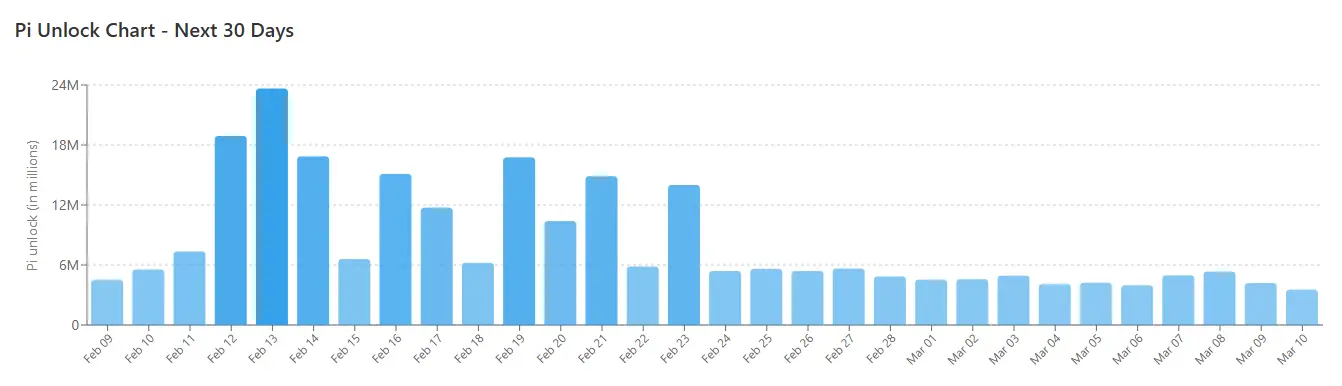
What lies ahead for Pi Network? Several concerning factors, including upcoming token unlocks, suggest PI’s price could further decline in the short term. Data shows nearly 250 million tokens will be released in the next 30 days, averaging over 8.3 million per day. February 13 is expected to be the highest trading volume day, with 23.6 million PI released. While this development doesn’t necessarily cause a sharp drop in price, it increases selling pressure and is considered bearish.
The 250 million tokens unlocked over 30 days represent an extreme level in Pi Network’s history. Compared to the current circulating supply of about 2.8 billion, this is an 8.9% increase in supply in one month. Without corresponding demand growth, this supply shock will likely continue to depress the price. Even more concerning, on February 13 alone, 23.6 million tokens will be released. If these tokens flood the market in a short period, it could trigger a 10-20% single-day crash.
Historical data confirms these concerns. Past large unlocks have led to significant price drops. Pre-unlock speculative selling, concentrated liquidation on the unlock day, and continued selling afterward created three downward waves. February 13 may repeat this pattern, with PI testing or even breaking below the $0.13 low.
The daily unlock rate of 8.3 million is also startling. If sustained through 2026, it could add over 3 billion tokens annually—doubling the current circulating supply. Such a flood of supply is almost impossible for the market to absorb, and PI’s price could continue to decline or even crash under this pressure.
RSI at 35 Oversold and Moderator Appreciation Day Controversy
On the other hand, Pi Network’s Relative Strength Index (RSI) also indicates a potential rebound. This technical indicator measures recent price change speed and magnitude, helping traders identify potential reversals. RSI values range from 0 to 100; below 30 suggests PI is oversold and may rebound soon. According to RSI Hunter data, the current RSI is about 35, approaching but not yet in oversold territory.
An RSI of 35 shows PI is nearing conditions for a technical rebound but has not reached extreme oversold levels. Historically, when PI’s RSI drops below 30, short-term rebounds often occur, though these are usually brief and limited in scope during strong downtrends. If RSI continues downward to 25 or below, the rebound could be stronger. However, with the upcoming large unlock on February 13, any bounce could be interrupted by new selling pressure.
This project has faced criticism before. Earlier this month, Pi Network’s core team held a so-called “Moderator Appreciation Day.” The event aimed to recognize moderators and praise their contributions to community building and support. However, the announcement sparked strong backlash, with many members feeling the project should focus on more urgent issues like accelerating verification and related tasks.
This backlash reveals the community’s anger and disappointment. As users wait years without usable tokens, with prices down 95%, and massive unlocks imminent, the team spends time and resources on a PR event honoring moderators. This misplaced priority is seen as “unprofessional” or even “diverting attention.” The community wants tangible progress on mainnet features, faster KYC processes, and tokenomics improvements, not superficial gratitude activities.
They believe Pi Network users (called pioneers) should admit the experiment has failed and shift focus to more valuable pursuits. “May those still stuck where they are rest in peace. Honestly, go touch some grass.” This extreme pessimism reflects some community members’ deep disappointment, feeling that continuing to invest time and energy is pointless and that it’s better to give up early.
Disclaimer: The information on this page may come from third parties and does not represent the views or opinions of Gate. The content displayed on this page is for reference only and does not constitute any financial, investment, or legal advice. Gate does not guarantee the accuracy or completeness of the information and shall not be liable for any losses arising from the use of this information. Virtual asset investments carry high risks and are subject to significant price volatility. You may lose all of your invested principal. Please fully understand the relevant risks and make prudent decisions based on your own financial situation and risk tolerance. For details, please refer to
Disclaimer.
Related Articles
Pi Network’s First Big Post–Pi Day Announcement Leaves Pioneers Unimpressed
It has been two weeks since the conclusion of the much-anticipated Pi Day (March 14), in which the Core Team behind Pi Network announced some major updates and progress on key infrastructure developments.
One of those garnered the community’s attention, as many of them have been waiting for a
CryptoPotato16m ago
Pi Network Launches Second Phase Migration: Referral Rewards Unlocked, Mainnet Progress Accelerated
Pi Network will advance the mainnet's second phase migration after Pi Day in 2026, with over 119,000 users participating. This upgrade allows users who have completed KYC verification to transfer referral rewards, accelerating identity verification. The system calculates mining and referral data one by one to ensure fair distribution. Users must enable two-factor authentication to transfer assets. The platform is also expanding application scenarios, shifting its focus from user growth to ecosystem development.
GateNews3h ago
Pi Network's second migration accelerates + exchange reserves hit new highs, exposing the logic behind the pressure on PI prices.
The Pi Network ecosystem has entered a critical stage of advancement, with over 119,000 users completing the second migration, marking progress in the mainnet expansion. Despite increased user activity, the number of PI on trading platforms has risen, and holders tend to circulate in the market, causing price pressure. The current price is about $0.18, down 94% from its peak. Future trends will depend on application implementation and real demand.
GateNews4h ago
Pi Network completes second migration, PI reserves increase by 79.5% raising market awareness.
Pi Network announced on March 27 that more than 119,000 users have completed the second migration, successfully transferring mining rewards to the mainnet. On-chain data shows that Pi’s reserves on centralized exchanges reached 472 million coins, up 79.5%, and potential supply pressure may affect the token’s price movement. Pi Network also launched the Pi Launchpad and the Pi App Studio, marking the development of its ecosystem.
MarketWhisper5h ago
Is Pi Coin repeating the same model that led to the previous 76% surge?
The price of Pi Coin (PI) is currently hovering around 0.188 USD after several sessions of sideways accumulation in a compressed range. However, the 8-hour chart is reflecting a similar cash flow structure to the period before the market experienced a strong increase of 76% earlier this month.
In the period from February 28 to March 4, gi
TapChiBitcoin6h ago
Pi DEX integrates DeFi, establishing a dual-track asset trading mechanism for Pi coins.
Pi Network expands token trading channels through Pi DEX (decentralized exchange), strengthening the liquidity and market demand for Pi coins. Pi DEX pairs Pi coins with all other tokens, offering users a dual-track asset acquisition mechanism, including participation in practical applications and market trading. The platform's launch marks Pi Network's transition toward a mature blockchain network, but market evaluations remain cautious. In the future, Pi Network plans to further expand support for financial applications.
MarketWhisper10h ago


