
Strategy, due to adopting fair value accounting, recognized a net loss of $12.4 billion in Q4, with 700,000 coins held turning into paper losses.
Fair value accounting reveals staggering losses, with Q4 net loss reaching $12.4 billion
The cryptocurrency market experienced intense volatility by the end of 2025, with the market rally once dubbed the “Trump rally” rapidly fading. According to Strategy (formerly MicroStrategy), which announced its Q4 fiscal year 2025 financial report on 2/5, the company recorded a net loss of up to $12.4 billion for the quarter. This heavy financial blow mainly stems from Bitcoin ($BTC) prices falling sharply after reaching over 126,000 in October 2025, down to about 89,000 by the end of last year.
Because the company has fully adopted digital asset fair value accounting standards, any fluctuations in the crypto market are directly reflected in earnings reports. The financial report shows that the company’s Q4 operating loss was as high as $17.4 billion, almost entirely due to unrealized impairments of digital assets. Compared to a loss of only $670 million in the same period in 2024, this loss has exploded, with diluted loss per share reaching $42.93. Although core software business performance remained relatively stable, with quarterly revenue slightly up 1.9% to $123 million, this modest growth is insignificant compared to the hundreds of billions in asset devaluation.
Further reading
Bitcoin plunges to $60,000! The “Trump rally” is completely reversed, with the 200-day moving average as a potential support
Bitcoin falls below average cost basis, 700,000 coins turn into “negative assets”
As Bitcoin prices further crashed into the $64,000 range, Strategy’s large Bitcoin holdings have fallen into a serious “underwater” predicament. As of February 1, 2026, the company held a total of 713,502 Bitcoins, with an accumulated cost basis of $54.26 billion.
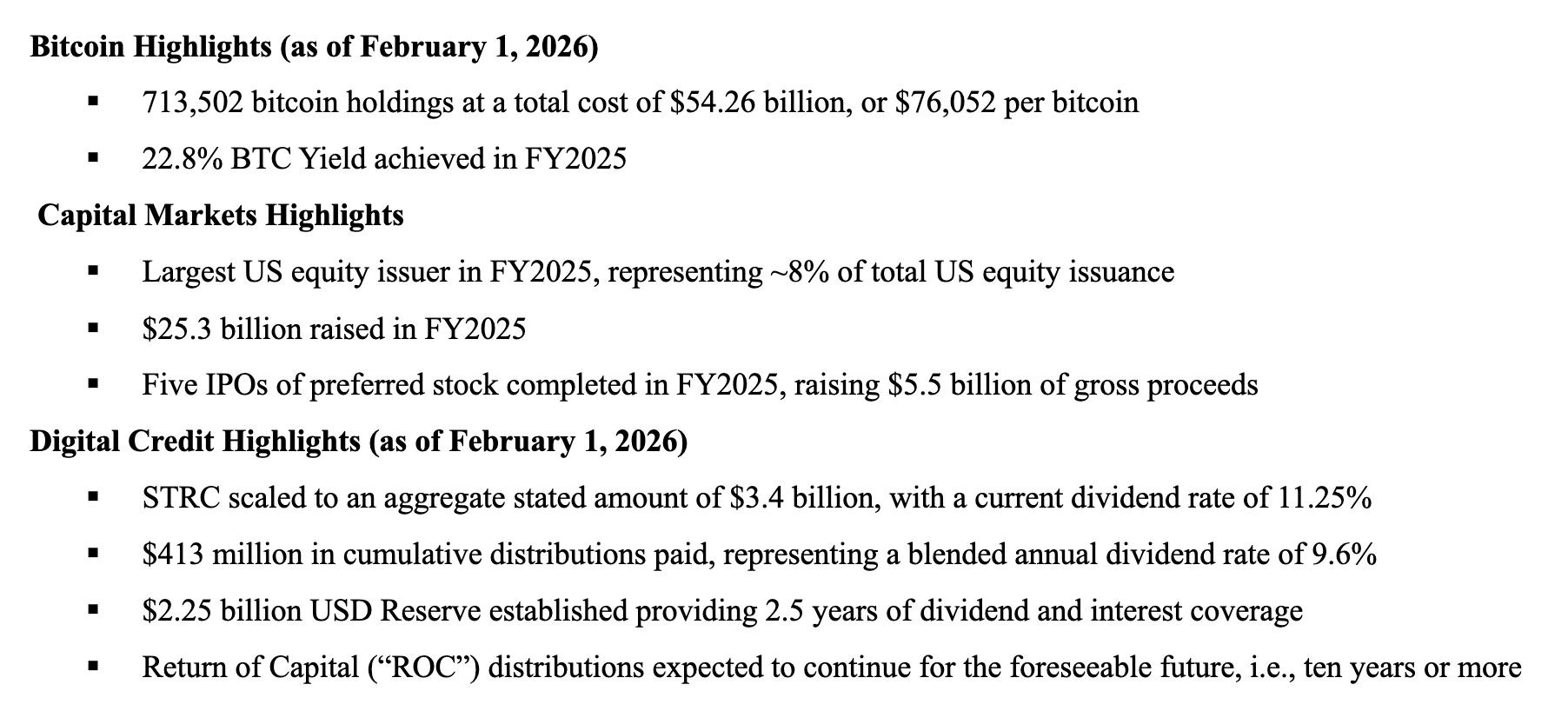
Image source: Strategy
According to disclosed data, the average acquisition cost per Bitcoin is approximately $76,052. This means that at current market prices, Strategy’s Bitcoin holdings face an unrealized paper loss of about $7.5 billion to $9 billion. This decline is considered the most severe since the flash crash in October 2025, with asset prices dropping over 12% in a single day. Despite this, in January 2026, the company added 41,002 Bitcoins to its holdings in an attempt to maintain its Bitcoin Per Share growth strategy, but the continuous market downturn has clearly exceeded many investors’ expectations. Critics like economist Peter Schiff have pointed out that such leveraged Bitcoin bets will expose shareholders to unbearable risks during a bear market.

Image source: X/@PeterSchiff Peter Schiff criticizes Strategy’s leveraged Bitcoin strategy
Stock price crashes to a one-and-a-half-year low, crypto concept stocks suffer collectively
Amid poor financial results and Bitcoin’s downward trend, Strategy’s stock (NASDAQ: MSTR) was bloodied on Thursday, plummeting 17% in a single day to around 106, erasing all gains since 2025. The stock has now hit its lowest point in 18 months, down over 70% from the peak of 457 reached in 2025.
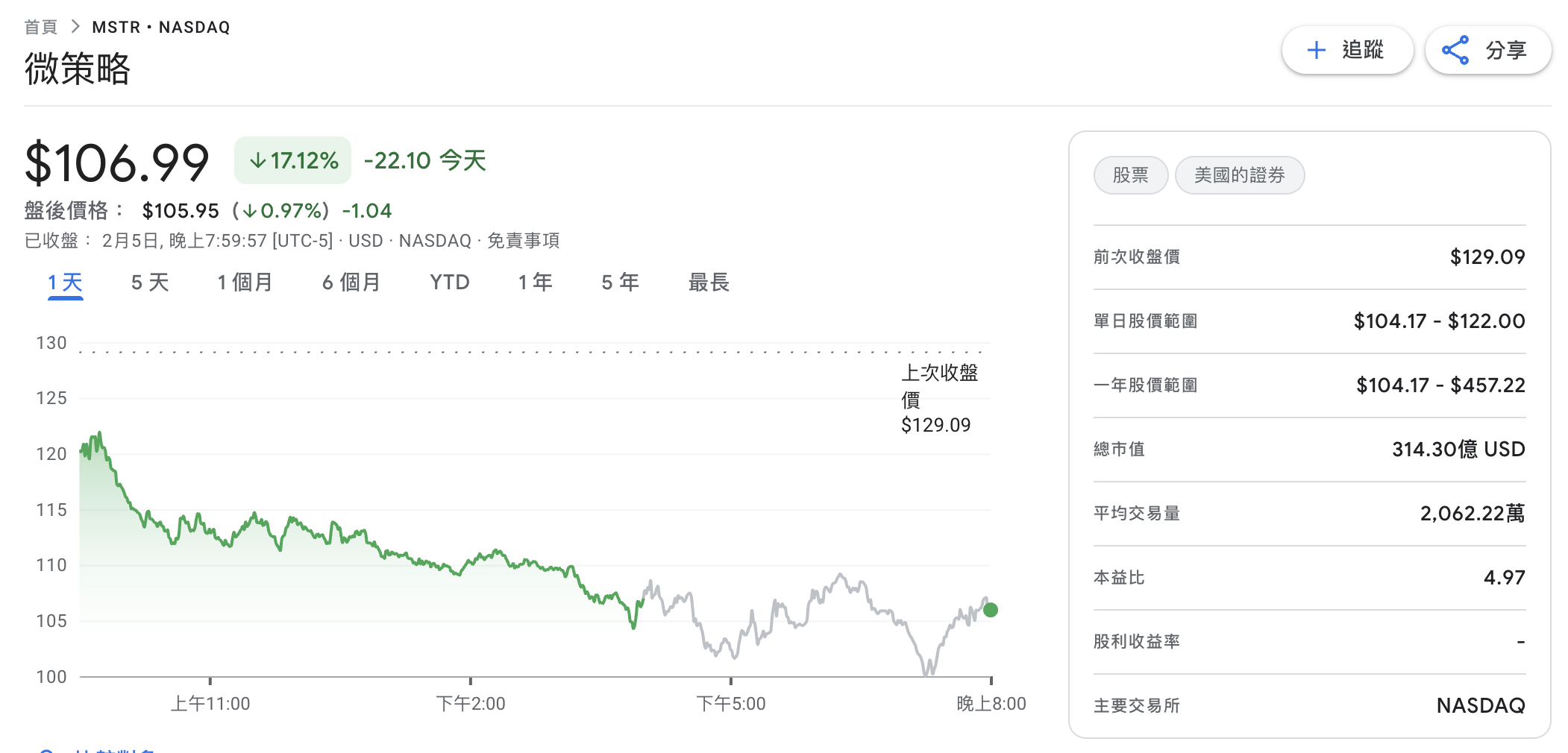
Image source: Google Finance Strategy’s stock price drops 17% in one day to around 106
Market sentiment worsened not only for this company but across the entire Digital Asset Treasury (DAT) sector. According to Reuters, the market value of digital asset treasuries has evaporated over $25 billion so far. Among them, Bitmine, which has accumulated large amounts of Ethereum ($ETH), suffered the most, with unrealized losses swelling to $8.1 billion, mainly due to ETH falling below $2,000. Most DAT companies have stopped increasing their holdings, and some miners’ holders have begun selling reserves to sustain operations. Strategy’s previous “premium” over Bitcoin value has nearly disappeared; its market cap relative to its Bitcoin holdings now shows a premium ratio (mNAV) of only about 1.1x, indicating growing skepticism among institutional and retail investors about its leverage model.
Establishing a $2.2 billion cash defense tower, management claims financial resilience remains
In response to doubts about its debt and interest payment capacity, Strategy’s management demonstrated a strong defensive stance during the earnings call.
CFO Andrew Kang emphasized that the company has built a “digital fortress,” currently holding about $2.25 billion in cash reserves, enough to cover the next 2.5 to 3 years of preferred stock dividends and debt interest payments. These funds mainly come from proceeds of previous ATM sales of Class A shares. Additionally, the company’s digital credit product STRC has issued $3.4 billion, with a dividend rate adjusted to 11.25%, still viewed as a financing tool capable of maintaining price stability.
CEO Phong Le stated that the company has no major debt maturities before 2027, so there is no forced sale pressure on Bitcoin. In the most extreme scenario testing, Le candidly said that unless Bitcoin drops to an astonishing $8,000, the company would not face substantial difficulties in meeting its debt obligations. Although market forecasts show the probability of the company selling Bitcoin within this year rising from 10% to 32%, founder Michael Saylor still issued a “HODL” slogan on social platforms, reaffirming his long-term commitment to holding Bitcoin indefinitely.

Image source: X/@saylor Michael Saylor posts “HODL” slogan on social media
Disclaimer: The information on this page may come from third parties and does not represent the views or opinions of Gate. The content displayed on this page is for reference only and does not constitute any financial, investment, or legal advice. Gate does not guarantee the accuracy or completeness of the information and shall not be liable for any losses arising from the use of this information. Virtual asset investments carry high risks and are subject to significant price volatility. You may lose all of your invested principal. Please fully understand the relevant risks and make prudent decisions based on your own financial situation and risk tolerance. For details, please refer to
Disclaimer.
Related Articles
Google also issued a warning: there is a risk to the $100 billion worth of assets in Ethereum, and five major quantum attack vectors have been exposed.
Google releases a white paper warning that quantum computers may break Ethereum, putting hundreds of billions of dollars in assets at risk. The report points out that there are multiple vulnerabilities in systems such as giant whale wallets, DeFi management keys, and staking systems, and that a high level of alertness is needed. The Ethereum Foundation has already launched research into post-quantum cryptography and plans to carry out a system upgrade before 2029.
CryptoCity1h ago
Yesterday, spot Ethereum ETFs saw net outflows of $7.02 million
On April 1, the U.S. spot Ethereum ETF saw a net outflow of $7.02 million, with BlackRock and Fidelity being the main outflow sources, while Grayscale ETHE and other parts of the products pulled in inflows against the trend.
GateNews2h ago
Meiji Big Brother holds 6,000 ETH in a 25x long position; the liquidation price is only $13 away.
Gate News, April 2, according to on-chain analysts monitoring, Brother Maji (address 0x020...872) currently holds 6,000 ETH on a 25x long position, with an entry price of $2,084.5 and a liquidation price of $2,040.5—only $13 away from the liquidation price. Previously, he had closed 1,700 ETH, incurring a loss of $48,000.
GateNews2h ago
ETH 15-minute decline of 0.94%: whale investors proactively reduced positions and inflows into exchanges converged to trigger spot selling pressure
2026-04-02 03:30 to 2026-04-02 03:45 (UTC), ETH experienced a short-term decline in yield of -0.94%. The price ranged from 2046.01 to 2075.41 USDT, with a fluctuation of 1.42%. During this period, market volatility intensified, on-chain attention increased, reflecting investors’ high sensitivity to upcoming network changes and large capital flows.
The main drivers of this abnormal movement stemmed from large transfers concentrated among on-chain whales and institutional addresses, with some individual transactions exceeding 10,000 ETH, and simultaneously flowing in large volumes.
GateNews2h ago
ETH drops below 2050 USDT
Gate News bot message, Gate price display shows that ETH has broken below 2050 USDT, with the current price at 2049 USDT.
CryptoRadar2h ago
Rare USDT Wallet Drop on Ethereum Could Signal Bitcoin Market Bottom
A new on-chain signal from Santiment is raising eyebrows across crypto markets. In a post shared today, the analytics platform said the number of non-empty Tether wallets on Ethereum fell by 72,841, or 0.54%, in just 48 hours, an unusually sharp move for a metric that, as Santiment noted,
BlockChainReporter3h ago


