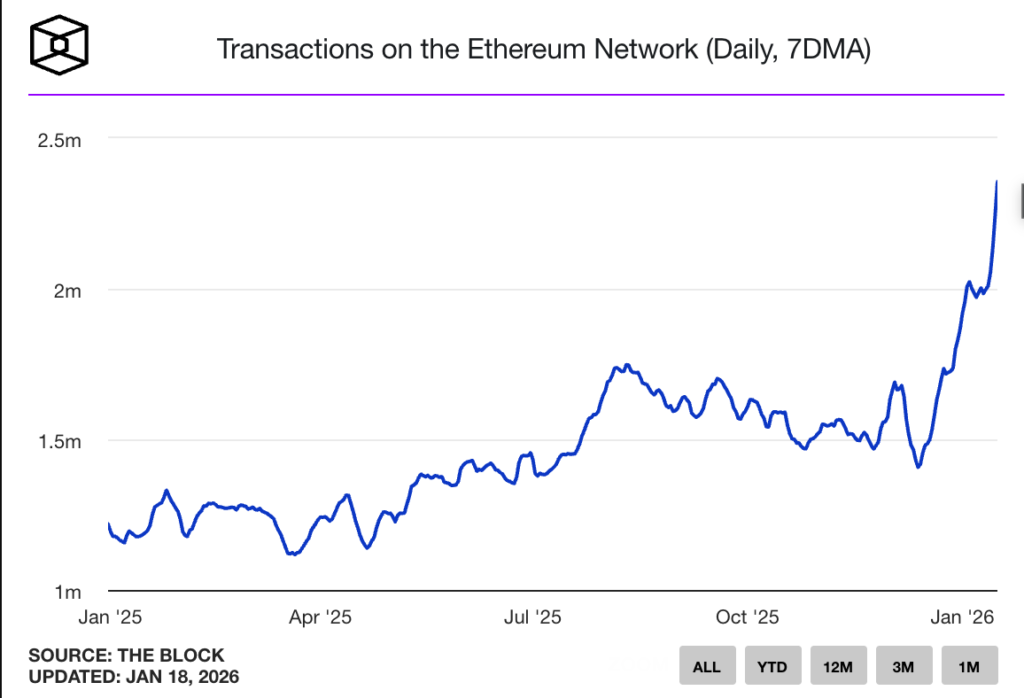
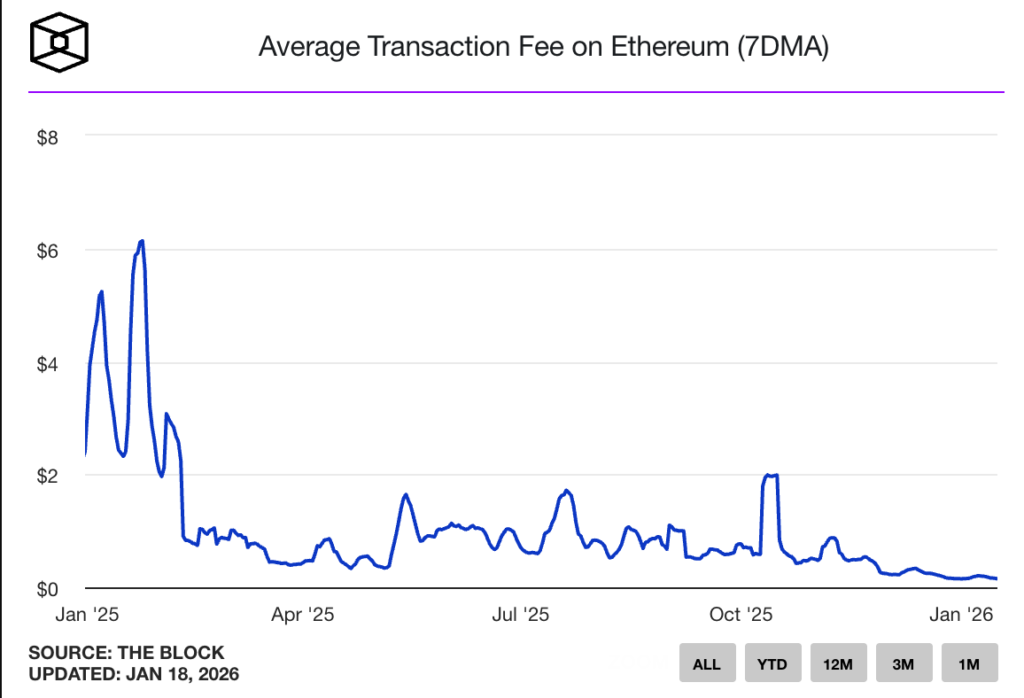
The Ethereum network processed 2.6 million transactions in a single day on January 17, setting a new record. The seven-day moving average is approaching 2.5 million transactions, doubling compared to the same period last year. Meanwhile, Gas fees have dropped to a historic low of $0.01 to $0.04, demonstrating tangible results brought by the Fusaka upgrade and PeerDAS technology.
(Background recap: Ethereum “Fusaka Upgrade” launched at the end of the year: introducing PeerDAS to improve blob usability and reduce L2 and validator costs)
(Additional background: Wall Street is losing interest in Ethereum: Why are fundamentals and ETH prices diverging?)
Table of Contents
- Goodbye to the “$50 Transaction Fee” era
- Stablecoin transfers become the main transaction type
- Stable operation under high load
The Ethereum network has recently reached an important milestone. According to on-chain data from The Block, Ethereum processed as many as 2.9 million transactions on January 16. Although it slightly decreased to 2.6 million on the following day (17th), it remains at a high historical level. The seven-day moving average transaction volume is approaching 2.5 million, nearly doubling compared to a year ago.
What’s even more remarkable is that this surge in transaction volume has not been accompanied by a spike in Gas fees. According to Etherscan data, the current Ethereum Gas fee has dropped to about $0.01. Even for more complex token swap operations, the average cost is only about $0.04, setting a new record in the modern history of the network.
Goodbye to the “$50 Transaction Fee” era
Looking back at the 2021 bull market and the NFT boom in 2024, a basic transaction on the Ethereum mainnet often cost $50, with more complex operations costing even more. While high Gas fees reflected the network’s popularity, they also kept many users out.
Today’s situation is completely different. The recent fee reduction is not due to decreased usage but is the result of several major technological upgrades:
Three Key Technological Breakthroughs
- Fusaka Upgrade and PeerDAS: The Fusaka upgrade completed at the end of 2025 introduced PeerDAS technology, significantly improving data availability and effectively alleviating mainnet congestion.
- Gas limit doubled: By the end of November 2025, Ethereum’s block Gas limit increased from 45 million to 60 million, a 100% increase from the beginning of the year.
- Blob parameter optimization: The final Blob parameter fork deployed on January 8, 2026, raised the blob target value to 14 and the upper limit to 21, further reducing data costs for L2 Rollups.
Stablecoin transfers become the main transaction type
Geoffrey Kendrick, Global Head of Digital Asset Research at Standard Chartered Bank, recently pointed out that stablecoin transfers currently account for about 35% to 40% of total Ethereum transaction volume, boldly stating:
“2026 will be the year of Ethereum.”
This data indicates that the practical applications of the Ethereum network are expanding, no longer limited to speculative trading but gradually becoming an essential infrastructure for cross-border payments and value transfer.
Stable operation under high load
The biggest significance of this surge in transaction volume is proving that Ethereum can finally handle large-scale demand while maintaining low transaction costs. The old dilemma of “more network activity, higher fees” has been broken, showing that years of scalability efforts are paying off.
As the L2 ecosystem continues to grow and mainnet technology keeps advancing, Ethereum may be preparing for the next wave of large-scale adoption.

Disclaimer: The information on this page may come from third parties and does not represent the views or opinions of Gate. The content displayed on this page is for reference only and does not constitute any financial, investment, or legal advice. Gate does not guarantee the accuracy or completeness of the information and shall not be liable for any losses arising from the use of this information. Virtual asset investments carry high risks and are subject to significant price volatility. You may lose all of your invested principal. Please fully understand the relevant risks and make prudent decisions based on your own financial situation and risk tolerance. For details, please refer to
Disclaimer.


