The trading price of Pi remains at $0.2075, far below the $3 high point. Daily trading volume has plummeted to just $6 million, yet the market capitalization reaches $1.7 billion. A new round of CEX listings has not been initiated, and $1.2 billion worth of tokens will be unlocked this year. Technically, an ascending wedge bearish pattern has formed, testing the $0.1918 low point, and a break below could create a new low.
Liquidity Crisis as Trading Volume Crashes to $6 Million
The current consolidation is mainly due to weakened investor demand. Data compiled by CoinMarketCap shows that Pi’s trading volume over the past 24 hours is only $6 million, which is negligible for a cryptocurrency with a market cap of over $1.7 billion. Its trading volume is far lower than some smaller cryptocurrencies like Render, Cosmos, and Official Trump.
The ratio of trading volume to market cap (turnover rate) is a key indicator of liquidity health. Pi’s daily turnover rate is only 0.35% (6 million / 1.7 billion), whereas healthy cryptocurrencies typically maintain between 5% and 20%. Bitcoin’s daily turnover rate is about 2%, Ethereum around 3%, and mainstream altcoins usually above 10%. Pi’s extremely low turnover rate indicates a market with very little active buying and selling, and this liquidity drought makes prices highly susceptible to manipulation.
Even after developers launched new tools to accelerate the integration of payment functions into their applications, Pi’s trading volume continues to decline. These new tools include Pi SDK and backend APIs, designed to enable developers to complete payment integrations within minutes. The Pi team is also developing decentralized exchanges, automated markets, and token creation tools, which are expected to be launched later this year. They hope these tools will enhance Pi’s utility over time.
Three Critical Reasons for the Crash in Pi’s Trading Volume
Mainstream Exchange Absence: No new CEX listings, limiting liquidity and accessibility
Supply Unlock Panic: Over 1.2 billion tokens will be unlocked this year, representing a large proportion of current circulating supply
Centralization Controversy: Pi Foundation holds billions of tokens, leading to trust issues due to high centralization
PiThe decline in Pi’s trading volume over the past few months is due to several reasons. First, unlike most tokens, Pi has not been listed on new mainstream exchanges like CEXs. This absence greatly restricts Pi’s liquidity and accessibility, as most crypto investors use these platforms. Without support from major exchanges, Pi can only be traded on smaller exchanges and OTC markets, naturally limiting liquidity.
Second, the increasing daily token unlocks have raised concerns, as this will increase the supply. Over 1.2 billion tokens will be unlocked this year. This figure is enormous relative to the current circulating supply, implying a significant increase in supply. Without a corresponding increase in demand, this supply surge will inevitably push prices down. More critically, many of these unlocked tokens are held by early miners, whose acquisition costs are near zero; once unlocked, they may sell immediately for cash.
Additionally, Pi is a highly centralized network in the crypto industry, with the little-known Pi Foundation holding billions of tokens. This centralization has triggered a serious trust crisis. Investors worry that the Foundation might sell large amounts of tokens at any time to crash the market, and the community has no means to restrain this. In contrast, Bitcoin and Ethereum’s decentralized governance structures prevent any single entity from manipulating the market.
Ascending Wedge Breakdown and the 0.1918 USD Critical Level
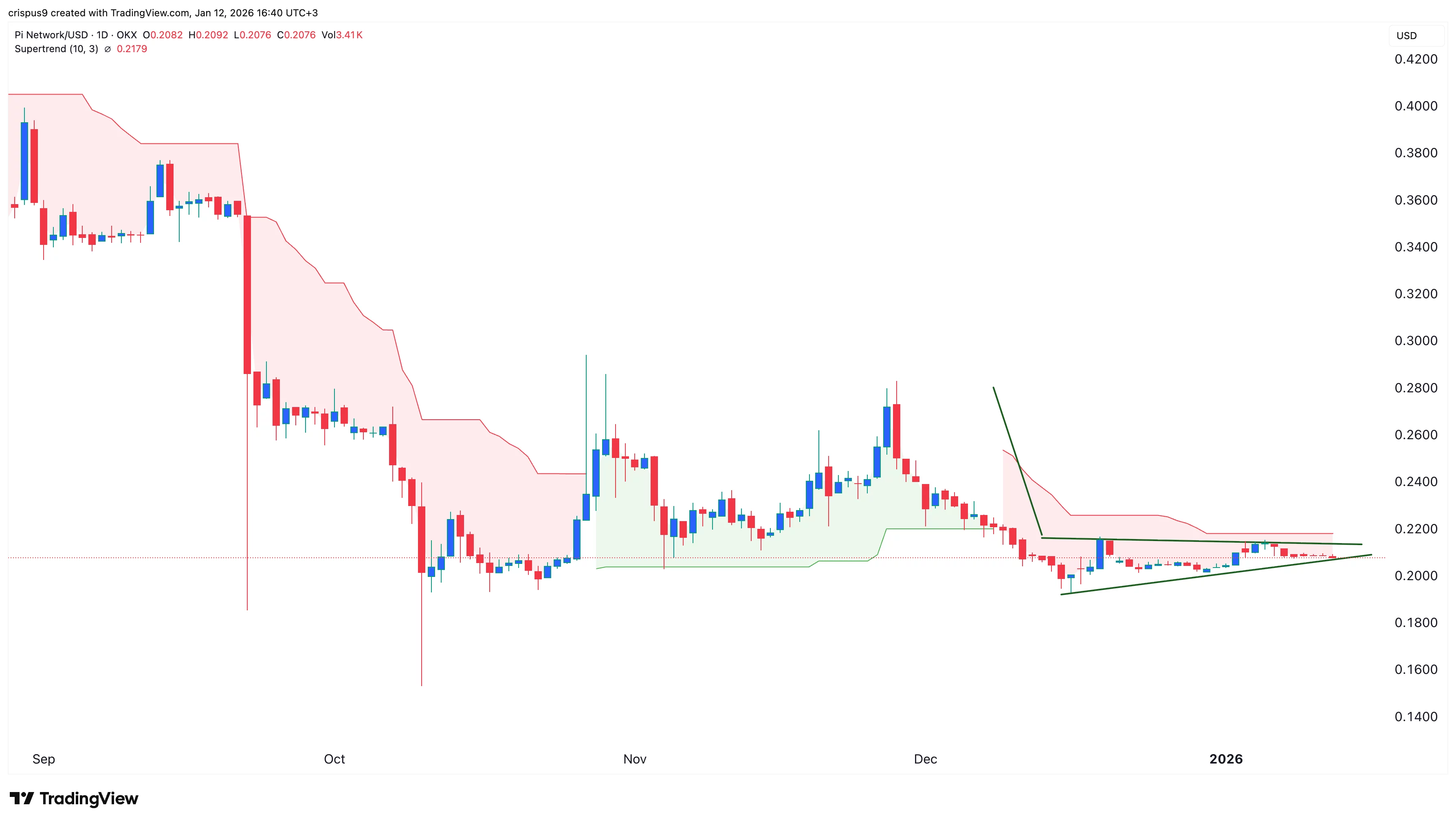
The daily chart shows that Pi has formed a highly bearish chart pattern, indicating further decline. It is forming an ascending wedge pattern, composed of two rising and converging trendlines. These trendlines are about to converge, which will likely lead to a downward breakout. The ascending wedge is one of the most reliable bearish patterns in technical analysis, with statistics showing over a 70% probability of a downward breakout.
Pi also forms a bearish pennant pattern, a common continuation signal. It remains below the 50-day exponential moving average (EMA) and the Super Trend indicator, both of which show a medium-term bearish trend. The 50-day EMA is often seen as a mid-term trend threshold; when the price stays below this line, it indicates dominant selling pressure.
Therefore, the most probable forecast for Pi is bearish, with the next key target at $0.1918, its lowest point in December. A break below this level could open a new downward space, possibly testing $0.15 or even lower. Falling below $0.1918 would increase the likelihood of hitting a new all-time low, as this is the lowest support since mainnet launch; losing this level would enter uncharted territory.
From a risk-reward perspective, Pi’s current investment value is extremely low. The technical outlook is clearly bearish, and the fundamentals (collapse in trading volume, supply unlocks, absence from major exchanges) are also negative, with no obvious bullish catalysts. For existing Pi holders, it is advisable to reduce positions on rebounds. Potential buyers should wait until the price breaks below $0.1918 and shows clear bottoming signals before considering entry.
Disclaimer: The information on this page may come from third parties and does not represent the views or opinions of Gate. The content displayed on this page is for reference only and does not constitute any financial, investment, or legal advice. Gate does not guarantee the accuracy or completeness of the information and shall not be liable for any losses arising from the use of this information. Virtual asset investments carry high risks and are subject to significant price volatility. You may lose all of your invested principal. Please fully understand the relevant risks and make prudent decisions based on your own financial situation and risk tolerance. For details, please refer to
Disclaimer.
Related Articles
PI Network (PI) Price Predictions for This Week
PI Network's price has corrected from $0.30 to $0.17, indicating a 40% drop. Currently, it hovers around $0.18, presenting a bearish outlook unless it surpasses $0.20. Volume remains low, suggesting indecision among sellers, while the RSI stays under 50, signaling further potential declines.
CryptoPotato9m ago
Pi Network Drops Big Update on Pioneers and Second Migration
Pi Network’s Core Team, which has come under serious criticism as of late, has just updated on the number of users who have completed the second migration of their balances.
As with similar posts on X before, though, the community was quick to pick up on the statement and lash out at the
CryptoPotato1h ago
Pi Network fake 2FA scams surge, with 119,000 migrated users targeted
Recently, there has been a surge in phishing attack cases targeting Pi Network. Scammers send fake 2FA links aimed at users who have already completed the second mainnet migration, attempting to steal their 24-word seed phrase. These phishing pages resemble the official interface and exploit users’ trust in official operations to carry out the scam. Experts recommend that if a user has leaked their seed phrase, they should immediately transfer their assets and stop using the old wallet to protect their assets.
MarketWhisper3h ago
Pi Network mainnet gets faster again! 109,000 users complete a second migration, and ecosystem rollout enters a critical phase
In 2026, the Pi Network mainnet rollout initiative has made progress, with more than 119,000 users completing a second migration, signaling a transition toward an “application-driven” model. Second migration allows users to transfer additional Pi balances into their mainnet accounts, but it requires KYC verification. The project team is proceeding carefully, has begun expanding real-world application scenarios, and despite disagreements within the community, the system as a whole is developing steadily; going forward, the key will be migration efficiency and the successful rollout of ecosystem applications.
GateNews3h ago
Pi Network Surpasses 119K Second Mainnet Migrations
The Pi Network has achieved a milestone with over 119,000 users completing their second migrations, allowing for transferring additional Pi balances and referral bonuses. While progression continues, priority remains on first migrations, ensuring users are not left behind. New tools are enhancing the ecosystem, contributing to real utility within the network despite some user frustrations.
Coinfomania4h ago
Pi Network mainnet migration triggers CEX deposits, bulls defend the 0.1736 USDT support line to the death
After Pi Network’s second mainnet migration, about 119,000 users completed KYC verification, resulting in more than 1.12 million PI tokens flowing into centralized exchanges and creating short-term selling pressure. Technical analysis shows that $0.1736 is a key support level, and the Protocol 21 upgrade on April 6 will affect token stability and application expansion.
MarketWhisper7h ago


