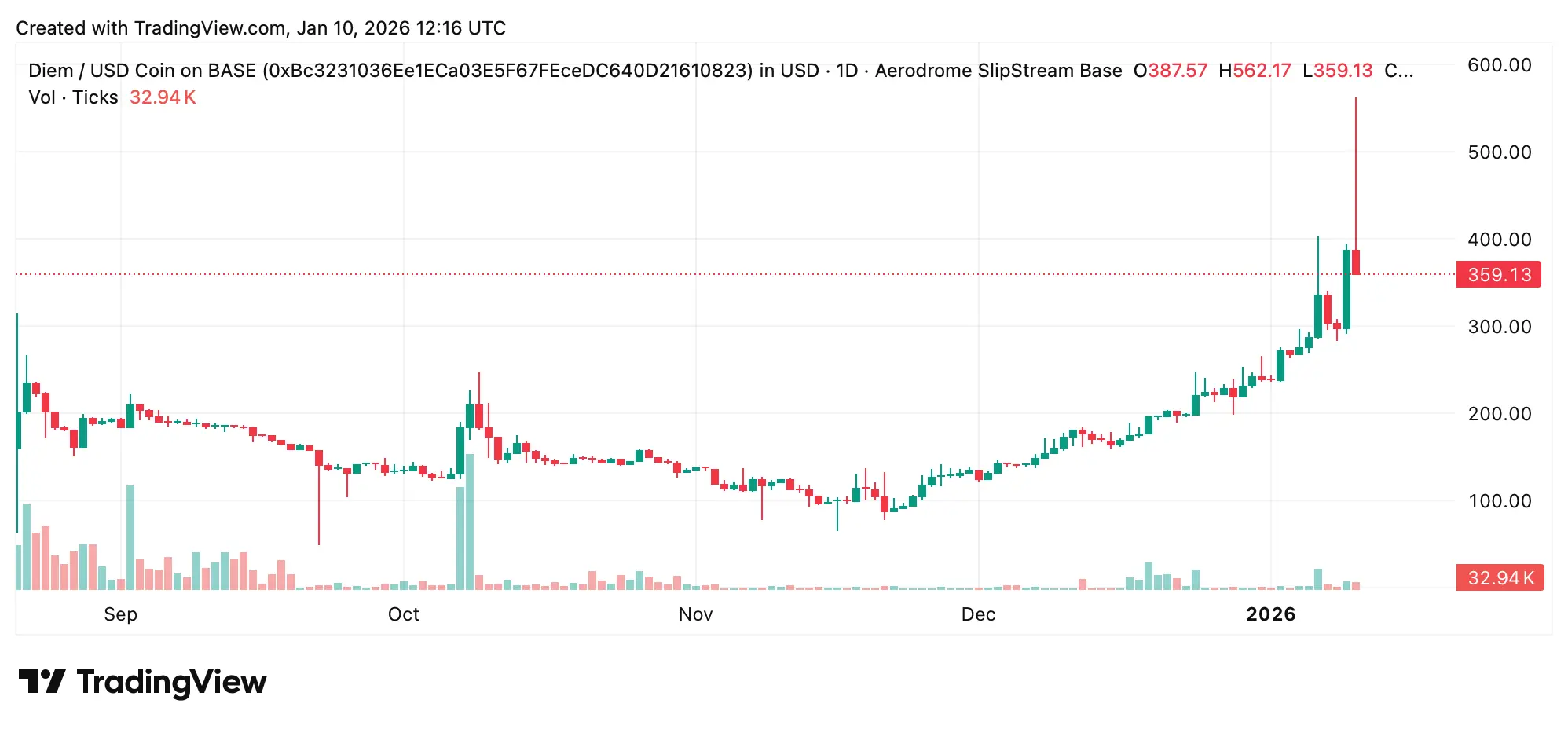
DIEM, an ERC-20 token issued on the Base blockchain, has gained nearly 120% over the past month, outperforming much of the broader crypto market as interest grows around tokenized AI compute.
Tokenized AI Compute in Focus as DIEM Climbs Nearly 120% in 30 Days
Over the last week, DIEM traded in a wide range between $263 and $426, starting the period near $263 and closing well above that level by the week’s end. As of Saturday, Jan. 10, 2026, at 7:45 a.m. Eastern time, DIEM is trading for $360 per coin. Weekly gains reached roughly 34%, according to market data, while the token’s market capitalization now stands at more than $13 million.
The price action comes during a period when many digital assets have moved sideways, placing DIEM among a small group of tokens posting strong relative performance. With a circulating supply of just over 36,000 tokens, even moderate shifts in demand have translated into noticeable price movement.
DIEM was launched in August 2025 by Venice AI as a tradeable form of tokenized AI compute. The token is designed to provide holders with ongoing access to AI inference rather than a fixed-duration subscription, distinguishing it from typical software licensing models. While the launch was initially controversial, Venice’s user growth (over 400,000 registered users) and integrations with top AI models helped counter the narratives.
Basically, each staked DIEM unlocks $1 worth of AI credits per day on the Venice platform, resetting daily at midnight UTC. These credits can be used through Venice’s web application or API for text, image, and other AI tasks, without accumulating if unused. Holders can stake, unstake, trade, or burn DIEM at any time, with unstaking subject to a one-day delay.
Venice aggregates access to multiple AI models in a single interface, positioning DIEM as a utility token tied directly to compute usage rather than governance or speculative incentives. The token is not inflationary; its supply is governed by a capped minting curve that approaches a long-term target of roughly 38,000 tokens.
The project was founded by Erik Voorhees, known for creating Satoshi Dice and Shapeshift. Voorhees has publicly framed DIEM as a way to simplify access to leading AI systems without recurring payments. Recently, Voorhees has been referencing DIEM more frequently on X, highlighting key milestones while laying out the reasons the token has resonated with users.
“People are discovering that DIEM gets you access to all AI models for free, in both the Venice.ai app or API,” Voorhees wrote this week. “Claude Opus 4.5, GPT 5.1, Gemini 3, Nano Banana Pro, GLM 4.7, and many others.”
Also read: UK Sets out Regulation Framework for Crypto Firms
DIEM is minted by locking Venice’s native VVV token, creating a closed-loop mechanism where demand for compute locks capital elsewhere in the ecosystem. Burning DIEM returns the underlying VVV used to mint it, reinforcing the link between utility demand and supply dynamics.
Recent gains appear to reflect growing awareness of this structure, as traders and users assess DIEM’s role as a perpetual access token rather than a conventional AI subscription or governance asset.
How long that demand persists will ultimately be determined over time. Venice also faces meaningful competition from established decentralized AI protocols, including offerings on Hugging Face and other compute marketplaces, which could constrain broader adoption. Even so, some observers argue that Venice’s privacy-preserving design may differentiate it from rival platforms.
FAQ 🤖
- **What is DIEM used for?**DIEM provides daily, renewing AI compute credits when staked on the Venice platform.
- **Why has DIEM’s price increased recently?**Market participants have shown increased interest in tokenized AI compute and DIEM’s utility-based design.
- **How does DIEM generate AI access?**Each staked token unlocks $1 per day in AI credits usable via Venice’s app or API.
- **Is DIEM inflationary?**No, DIEM’s supply is capped through a controlled minting curve tied to locked VVV tokens.
Disclaimer: The information on this page may come from third parties and does not represent the views or opinions of Gate. The content displayed on this page is for reference only and does not constitute any financial, investment, or legal advice. Gate does not guarantee the accuracy or completeness of the information and shall not be liable for any losses arising from the use of this information. Virtual asset investments carry high risks and are subject to significant price volatility. You may lose all of your invested principal. Please fully understand the relevant risks and make prudent decisions based on your own financial situation and risk tolerance. For details, please refer to
Disclaimer.
Related Articles
ADA Tests Key $0.230 Support While Upgrade Timeline Holds
Key Insights:
ADA trades at the wedge apex near $0.2387 as price compresses between $0.230 support and $0.245 resistance ahead of a decisive breakout move.
Protocol 11’s timeline remains intact despite the memory bug fix, keeping Cardano fundamentals stable while macro risks dominate short-t
CryptoNewsLand28m ago
XRP Breaks Above $1.40 as Spot ETF Inflows Hit $17.6M Milestone
XRP breaks $1.40 after Ripple partnership boosts investor confidence and market momentum.
Spot XRP ETFs record $17.6M inflows, signaling rising institutional demand and interest.
Technical indicators show resistance ahead, with support holding near $1.40 and $1.3840.
Ripple’s XRP is
CryptoNewsLand4h ago
PEPE Reclaims 0.00000400 — Is This 1.8% Move the Start of a Bigger Run?
PEPE rebounds from 0.00000385 support, forming higher lows and stronger bullish structure.
Technical indicators like MACD and RSI show momentum with room for further upside.
Key resistance at 0.00000410; support at 0.00000380 critical for trend continuation.
PepeCoin — PEPE, has
CryptoNewsLand9h ago
ETH drops 0.58% in 15 minutes: derivatives liquidity contraction and proactive position reduction dominate short-term pullback
From 2026-04-19 04:30 to 2026-04-19 04:45 (UTC), within ETH’s 15-minute candlestick chart, the return recorded -0.58%, and the price range was 2321.62 to 2342.04 USDT, with an amplitude of 0.87%. The short-term selloff occurred against a backdrop of increased overall market volatility and a broad decline in the prices of major crypto assets; overall market risk appetite clearly fell, and traders’ wait-and-see sentiment strengthened.
The main driver behind this abnormal move is a sharp contraction in liquidity in the derivatives market and leveraged funds proactively reducing positions. Data shows that over the past 24 hours, the ETH/USD perpetual contract trading volume dropped 67.16% to approximately 74.87 million, open interest edged down 3.33% to 329 million, and liquidation amounts did not expand unusually. This structure indicates that the market lacks the risk of passive cascades; more funds chose to proactively step aside and wait on the sidelines, intensifying short-term selling pressure.
In addition, the long/short structure in which shorts held the upper hand (long/short ratio 47.48%:52.52%) and sentiment synchronization with the panic range reinforced the downward price trend. During the same period, major coins such as BTC and SOL also fell 2%-3.4% in tandem, further showing that this pullback was driven by system-wide risk sentiment. On-chain funds did not show any large abnormal transfers or large-scale liquidations of DeFi protocols; spot and on-chain liquidity remained generally stable, and no sudden system risk resonance was observed.
Current volatility-related risks still need close monitoring, especially as overall risk appetite continues to contract—ETH’s short-term price may face further downside probing. Watch subsequent changes in derivatives trading volume and open interest, extreme shifts in the long/short ratio and funding rate, and promptly monitor on-chain fund flows, large transfers, and any signs of amplified platform net outflows. For more market anomalies and deeper analysis, please continue to follow our upcoming market updates.
GateNews10h ago
Spark Protocol's January delisting of rsETH proves prudent as Aave faces ETH liquidity crisis
Spark Protocol's strategy of delisting low-usage assets and tightening collateral has faced initial backlash but proved wise during market turmoil. While maintaining higher interest rate caps, SparkLend ensures liquidity, unlike Aave, which now faces significant risks.
GateNews10h ago
Request Network (REQ) Surges 23.68% in 15 Minutes, 24-Hour Gain Reaches 116.52%
Request Network (REQ) surged 23.68% in just 15 minutes, reaching $0.152, with a 24-hour rise of 116.52% and trading volume over $8 million. Factors include retail interest and whale accumulation. Resistance at $0.160 and support at $0.122 are under observation.
GateNews11h ago


