Tether expanded its USDT inventory on Tron with a $1 billion authorized mint, keeping the tokens in reserve for future demand.
Tether has begun the year by expanding its USDT supply on the Tron network. A newly authorized mint worth $1 billion has drawn the attention of traders who track stablecoin flows for signs of liquidity shifts. Although the newly created tokens remain inactive, the mint increases the available supply that can be released if demand picks up.
Tether Expands USDT Supply With $1B Authorized Mint
On January 9, blockchain tracking account Onchain Lens reported that Tether minted $1 billion in USDT on Tron. According to the post, the transaction marked the company’s first mint of 2026.
Onchain Lens further explained that the full amount was moved directly into Tether’s treasury. Such transactions are known as “authorized mint,” where stablecoins are created ahead of demand and held in reserve.
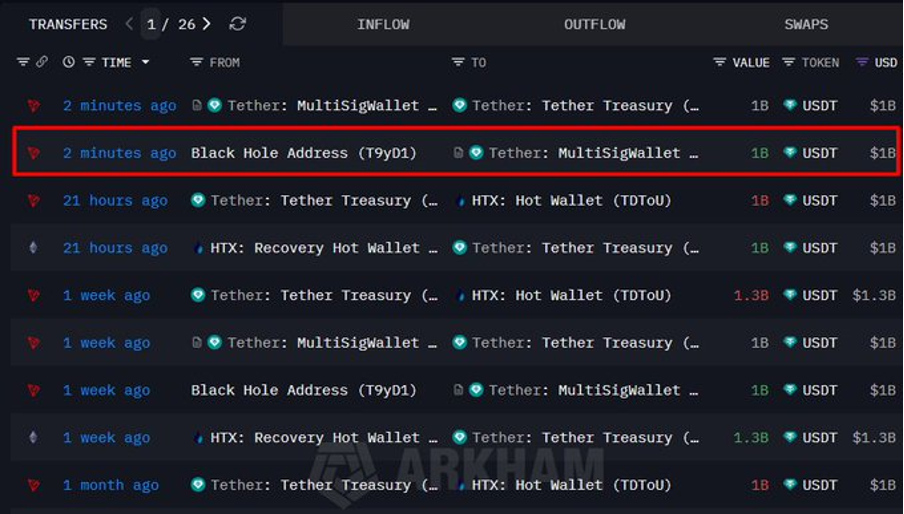 Image Source: X/Onchain Lens
Instead of being sent immediately to exchanges, the tokens remain under Tether’s control until partners request them. Under this system, USDT stays in the treasury until exchanges, institutions, or liquidity providers need additional stablecoins.
Once demand arises, distribution can occur quickly via standard on-chain transfers. This approach allows Tether to respond more quickly during periods of rising activity without waiting to mint new tokens at the last minute.
With this mint, Tether has raised its available USDT on Tron. Over recent years, this method has become the company’s standard process, especially during phases when trading volumes trend higher across crypto markets. By keeping USDT ready on-chain, Tether can meet demand with minimal delay.
Tron Network Sees Increased Stablecoin Capacity Held in Reserve
Tether’s USDT continues to lead the stablecoin sector by a wide margin, even as new competitors enter the space. Total supply now stands above $180 billion, accounting for about 60% of the overall stablecoin market valuation.
Most major centralized exchanges rely heavily on USDT trading pairs, while many decentralized platforms also use it as a core asset.
Notably, several blockchains support USDT as a key part of their payment and trading infrastructure. Traders often use USDT as a temporary store of value rather than an exit to traditional banking systems. As a result, USDT remains central to crypto market flows.
Given its scale, changes in USDT supply receive close attention. Market makers and institutional desks track treasury mints and redemptions to assess liquidity conditions. An increase in authorized supply can suggest preparation for higher demand, though it does not guarantee market moves.
In previous market cycles, large USDT mints have often appeared around periods of stronger risk appetite. Traders typically move into stablecoins before buying Bitcoin or other cryptocurrencies, using USDT as a base trading asset.
In this case, the newly minted $1 billion on Tron is still held in Tether’s treasury, so it has not affected trading yet. Any market impact will depend on whether demand rises and the funds are later released to exchanges.
Disclaimer: The information on this page may come from third parties and does not represent the views or opinions of Gate. The content displayed on this page is for reference only and does not constitute any financial, investment, or legal advice. Gate does not guarantee the accuracy or completeness of the information and shall not be liable for any losses arising from the use of this information. Virtual asset investments carry high risks and are subject to significant price volatility. You may lose all of your invested principal. Please fully understand the relevant risks and make prudent decisions based on your own financial situation and risk tolerance. For details, please refer to
Disclaimer.
Related Articles
Tether-linked Super PAC’s first $300,000 spending went to a company co-founded by the CEO, allegedly involving pay-to-play and favoritism.
A super political action committee affiliated with Tether filed paperwork with the U.S. Federal Election Commission showing that its first $300k expenditure went to Nxum Group, founded by Tether U.S. CEO Bo Hines, to buy campaign ads for Georgia Republican candidate Clay Fuller, raising questions about pay-to-play.
GateNews04-12 13:17
Tether Launches Open-Source Local AI SDK
Paolo Ardoino, CEO of Tether, criticizes centralized AI and champions decentralization through the QVAC SDK, allowing local AI model deployment. This shift enhances data privacy and user control, positioning Tether at the convergence of blockchain and AI, challenging dominant tech firms.
Coinfomania04-11 06:05
Tether CEO:USDT 在 Hyperliquid 上占 HIP-3 交易量 7.8%
Gate News message, on April 10, Tether CEO Paolo Ardoino posted that USDT’s adoption on Hyperliquid is rapidly increasing. Data shows that in less than three months, USDT has grown from having almost no share on Hyperliquid to accounting for the rest.
GateNews04-10 14:09
Tether launches open-source AI toolkit QVAC SDK, positioning it as a general-purpose artificial intelligence foundation module
Tether’s QVAC team launched the QVAC SDK, which is an open-source, cross-platform AI development toolkit aimed at building the intelligent ecosystem of the future and supporting a wide range of devices. QVAC is seen as a next-generation intelligent framework with modular and infinitely extensible features to adapt to future development.
GateNews04-09 12:11


