Speculation that Bitcoin “whales” are undergoing a large-scale reaccumulation phase has been overstated, indicating that the structure of the digital asset market has not undergone significant changes, according to onchain data from CryptoQuant.
Julio Moreno, Head of Research at CryptoQuant, stated that the common view that large investors are actively accumulating Bitcoin is actually misleading. Most publicly available “whale accumulation” data is influenced by internal exchange activities and does not accurately reflect actual investor behavior.
In reality, cryptocurrency exchanges frequently consolidate assets from many small wallets into larger wallets to facilitate operations and comply with regulations. This process artificially increases the number of wallets holding large balances, causing onchain monitoring systems to mistakenly interpret this as whale accumulation.
When removing exchange-related noise, the data shows that large investors still tend to distribute Bitcoin rather than accumulate it, Moreno said.
As a result, the total holdings of whales continue to decline. Even holdings at addresses with 100 to 1,000 BTC are decreasing, reflecting a continuous withdrawal trend from exchange-traded funds (ETFs).
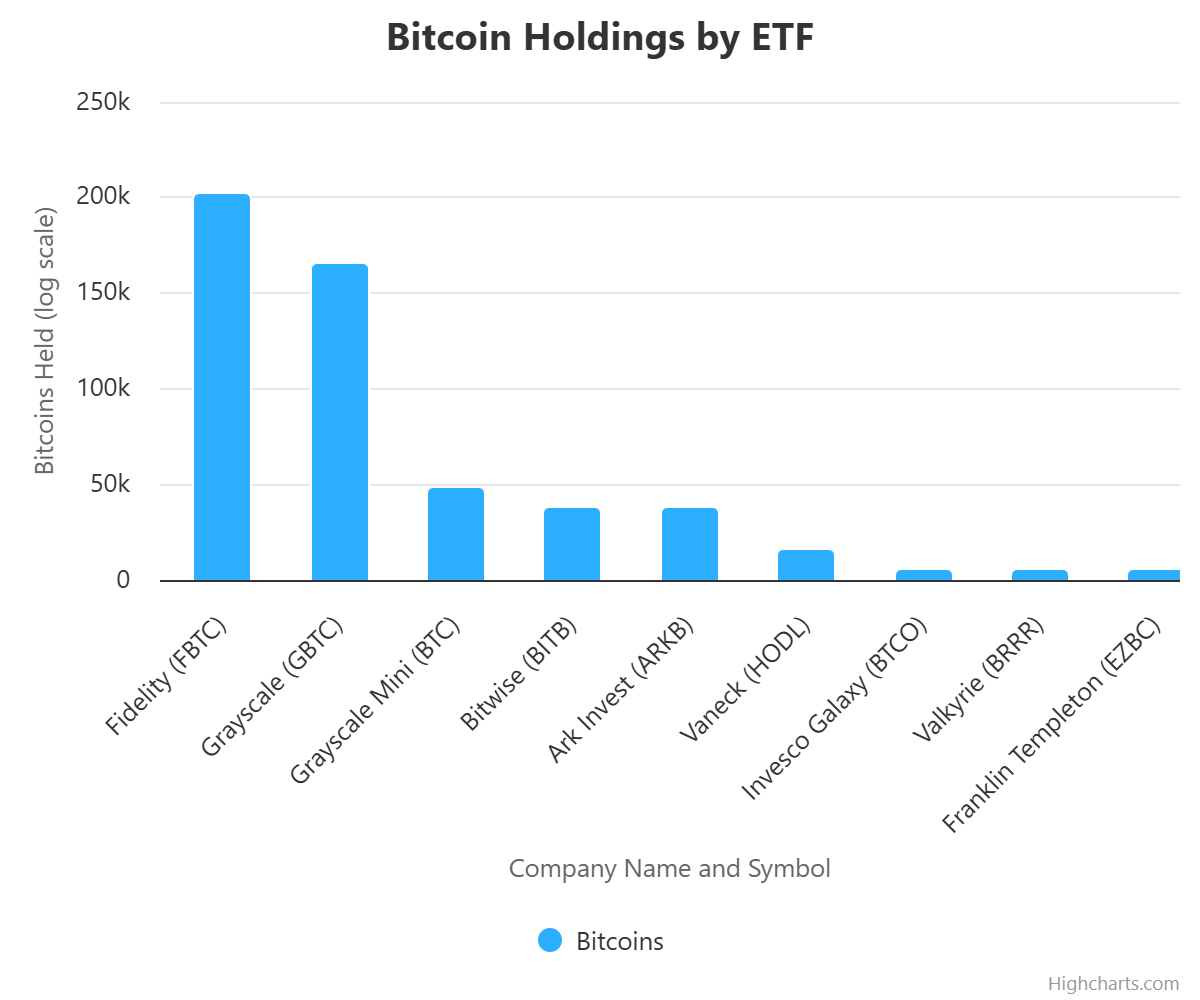 US-based spot Bitcoin ETFs hold nearly 1.3 million BTC, accounting for about 6.2% of the total Bitcoin supply | Source: BitboThis information is particularly important because Bitcoin whales have a significant influence on the market; large-volume transactions often cause sharp price fluctuations and periods of volatility. However, the market structure has shifted since the beginning of 2024, when US spot Bitcoin ETFs emerged and became new major investors in this digital asset.
Bright Spot: Long-term Holders Increasing Accumulation
While debates about whether Bitcoin whales are truly reaccumulating continue, other onchain data shows a positive development among long-term investors.
Matthew Sigel, Head of Digital Asset Research at VanEck, said that in the past 30 days, long-term Bitcoin investors have become net accumulators after their largest sell-off since 2019.
This shift indicates that the recent selling pressure on Bitcoin is easing, at least in the short term.
Although Bitcoin’s price has not yet shown a sustainable recovery, it has avoided falling below the $80,000 level like in November. As of the time of writing, Bitcoin is trading at over $90,000.
Mr. Giáo
Disclaimer: The information on this page may come from third parties and does not represent the views or opinions of Gate. The content displayed on this page is for reference only and does not constitute any financial, investment, or legal advice. Gate does not guarantee the accuracy or completeness of the information and shall not be liable for any losses arising from the use of this information. Virtual asset investments carry high risks and are subject to significant price volatility. You may lose all of your invested principal. Please fully understand the relevant risks and make prudent decisions based on your own financial situation and risk tolerance. For details, please refer to
Disclaimer.
Related Articles
BTC 15-minute pump 0.55%: Large on-chain funds inflows and options positioning resonate to lift spot prices
2026-04-09 17:00 to 2026-04-09 17:15 (UTC), the BTC spot market saw a rapid spike with a +0.55% return. The price range was 72,063.9 to 72,518.5 USDT, and the full-period amplitude reached 0.63%. This upswing coincided with rising market attention; volatility clearly intensified, drawing funds into short-term trading in a mix of cautious sentiment and localized increased volume.
The main driving force behind this move was concentrated inflows to exchanges from on-chain large transfers, which pushed up spot market buy orders in a short time. Data shows that, in the past 24 hours, on-chain BTC transfers
GateNews38m ago
Mainstream CEX and DEX funding-rate displays suggest an increasingly bearish market sentiment
On April 10, the Bitcoin price broke through $72k again. According to Coinglass data, the funding rates on major trading platforms show that the market’s bearish sentiment is strengthening. Funding rates are used to balance the contract price with the asset price; a rate below 0.005% indicates that the market is broadly bearish.
GateNews1h ago
Over the past 1 hour, forced liquidations across the entire market totaled $101 million, including $80.39 million in BTC liquidations.
Gate News message, on April 9, CoinGlass data shows that over the past 1 hour, liquidations across the entire network totaled $101 million, including $97.07 million from short liquidations and $3.54 million from long liquidations. In addition, the liquidation amount for BTC reached $80.39 million, while the liquidation amount for ETH reached $11.79 million.
GateNews1h ago
CME Group BTC futures liquidity falls to a 14-month low, with basis trading failures triggering institutional capital outflows
The Chicago Mercantile Exchange’s Bitcoin futures market has continued to weaken. In March 2026, the daily average open interest fell to $7.2 billion, hitting a new low since February 2024, and has been declining for five straight months. The main reason is the large-scale unwinding of basis trades, which eliminated the arbitrage spread and caused leveraged capital to exit.
GateNews1h ago
BTC 15-minute pump of 1.03%: integer-level breakout and macro risk-hedging resonance amplifying the move
From 2026-04-09 15:30 to 15:45 (UTC), the BTC return rate recorded +1.03%, with the price ranging from 71,291.5 to 72,226.9 USDT, and the amplitude reaching 1.31%. During the abnormal move, market attention rose rapidly, volatility noticeably intensified, and prompted investors to closely watch short-term trends.
The main driver behind this abnormal move was BTC breaking through the 72,000 USDT integer level at 15:34, which directly activated some algorithmic trading and drew short-term funds in. The rapid breakout above this key price level boosted spot and derivatives trading volumes in the short term
GateNews2h ago


