As the crypto market navigates year-end volatility, investors are asking one big question: Is a new altcoin season on the horizon after the 2024 Bitcoin halving?
This article breaks down the definition, history, key indicators, and outlook for the remainder of 2025.
(Sources: X)
What Is Altcoin Season?
Altcoin season describes a distinct market cycle where most alternative cryptocurrencies significantly outperform Bitcoin.
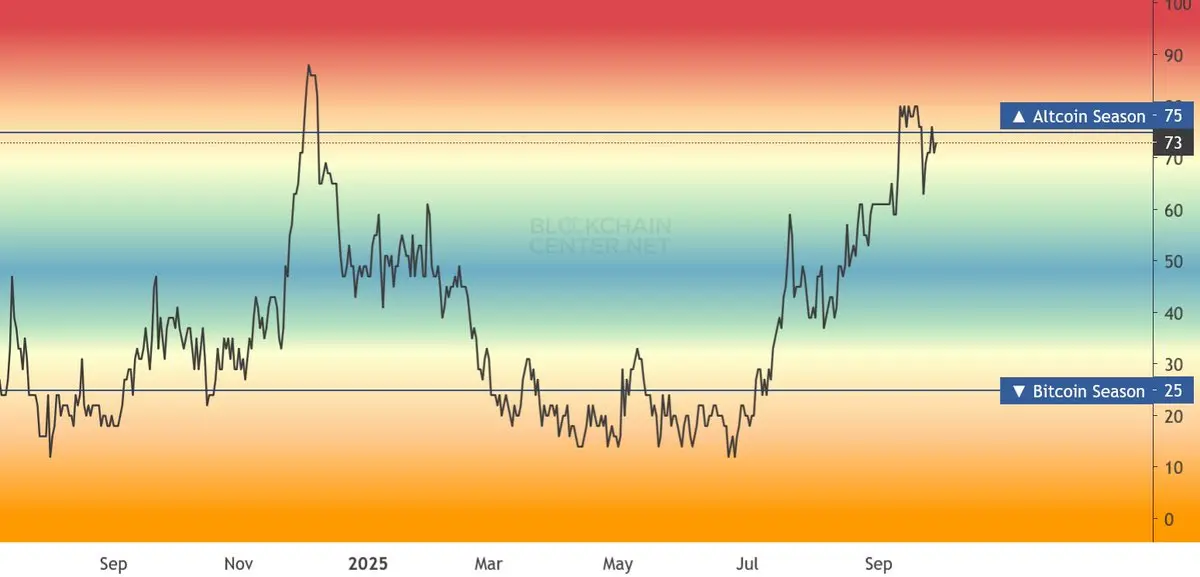
A common benchmark: if at least 75% of the top 50–100 altcoins beat BTC over a 90-day period, the market is in altcoin season.
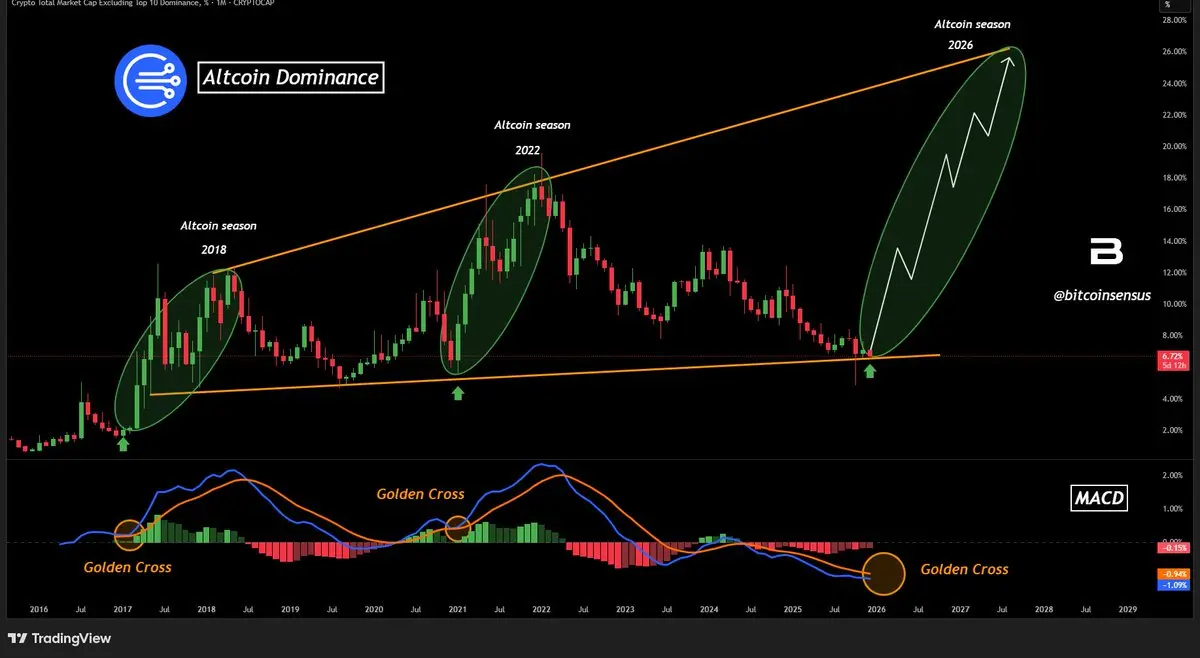
Typical signs include declining Bitcoin dominance (often below 50%) and rising combined altcoin market capitalization.
(Sources: TradingView)
Altcoin Season vs. Bitcoin Bull Run
In a Bitcoin bull market, BTC leads the charge. Once Bitcoin stabilizes after strong gains, capital often rotates into altcoins seeking higher returns.
This rotation sparks altcoin season: profits from BTC flow into Ethereum and other alts, driving outsized gains across the sector.
Historical Altcoin Seasons: Lessons from the Past
Looking back helps contextualize potential 2025 developments. Past cycles reveal recurring patterns and typical durations.
The Iconic 2021 Altcoin Season
The most prominent altseason ran from late 2020 into spring 2021. Bitcoin dominance plunged from ~70% to ~38%, while altcoin market share surged from 30% to 62%.
The Altcoin Season Index peaked at 98/100 on April 16, 2021. Ethereum neared its all-time high, while meme coins like Dogecoin and Shiba Inu posted explosive gains.
Earlier cycles showed similar behavior: in 2017/18, Bitcoin dominance fell from 86.3% to 38.7%.
How Long Does Altcoin Season Typically Last?
Historical data suggests altseasons are relatively short-lived, lasting weeks to a few months.
The BlockchainCenter index estimates an average duration of ~18 days, with the longest recorded at 117 days. The average gap between seasons is ~66 days, though the longest was 486 days.
Altseasons are unpredictable and depend on Bitcoin price action, liquidity, and overall sentiment. Multiple seasons can occur in a single year under the right conditions.
How to Spot the Start of Altcoin Season
Because altseasons often arrive suddenly and last briefly, traders rely on specialized tools and indicators.
The Altcoin Season Index
Popular versions from CoinMarketCap and BlockchainCenter track how many top altcoins outperform Bitcoin over 90 days.
An index reading above 75/100 generally signals altcoin season—though it’s reactive, meaning much of the move may already be underway by confirmation.
Current reading (mid-2025): around 40/100, showing early tendencies but not yet full rotation.
Key Indicators and Early Signals
Experienced traders watch several leading signs:
- Bitcoin Dominance: A sustained drop below ~50–55% often precedes altcoin outperformance.
- Altcoin Market Cap: Rising relative to total market cap indicates capital rotation.
- Trading Volume: Sudden spikes in altcoin volume, especially with declining BTC volume, signal shifting interest.
- Technical Patterns: Bearish MACD crossovers on BTC dominance, RSI divergences, or trendline breaks can provide early clues.
- On-Chain & Sentiment Data: Rising active addresses/transactions on alt projects, social media hype, or major news (partnerships, upgrades) frequently ignite rotation.
Outlook: Will 2025 Deliver Another Altcoin Season?
Current conditions show building factors typically associated with altseason onset.
Analysts point to high liquidity, improving regulation, and Bitcoin dominance dipping to multi-month lows (~58.6% in mid-August) as supportive.
Ethereum’s share climbed to 12.26%—its highest in some time—while tokens like Solana and Chainlink posted double-digit gains in short periods.
However, caution remains: no single indicator guarantees rotation, and macro shifts (Fed policy, regulation) could delay or derail momentum.
Opportunities and Risks for Investors
Altseasons offer high-reward potential but come with elevated volatility.
Strategies for Altcoin Investing
- Diversify across strong fundamentals (Ethereum, Layer-1s, infrastructure).
- Combine fundamental and technical analysis for entries/exits.
- Consider early exposure via IDOs/IEOs for new tokens.
- Scale positions gradually rather than all-in.
Risk Management Essentials
- Use only capital you can afford to lose.
- Take profits progressively; employ stop-losses.
- Store assets securely (preferably cold wallets).
- Stay informed on regulatory changes (e.g., EU’s MiCA).
Conclusion: Signs Point to Potential Rotation Ahead
The altcoin rebound reflects returning risk appetite, but full altcoin season requires clearer confirmation—declining BTC dominance, broader participation, and sustained volume.
As 2025 progresses, watch for dominance breaking lower and the Altcoin Season Index climbing past 50–75. Until then, selective altcoin opportunities may emerge, but Bitcoin remains the cycle’s anchor.
Altcoin Season FAQ
1. When is the next altcoin season expected?
No fixed timeline—typically follows Bitcoin stabilization after strong gains, often 12–18 months post-halving.
2. How reliable is the Altcoin Season Index?
Useful but reactive; readings above 75 confirm season, but early signs (dominance drop, volume shift) often precede it.
3. Are altcoins safer during Bitcoin season?
No—altcoins usually underperform and face higher volatility in BTC-dominant phases.
4. What triggers the end of altcoin season?
Bitcoin reclaiming dominance, macro shocks, or profit-taking rotating capital back to BTC.
5. Should beginners chase altseason?
High risk/reward—focus on research, diversification, and risk management rather than FOMO entries.
Disclaimer: The information on this page may come from third parties and does not represent the views or opinions of Gate. The content displayed on this page is for reference only and does not constitute any financial, investment, or legal advice. Gate does not guarantee the accuracy or completeness of the information and shall not be liable for any losses arising from the use of this information. Virtual asset investments carry high risks and are subject to significant price volatility. You may lose all of your invested principal. Please fully understand the relevant risks and make prudent decisions based on your own financial situation and risk tolerance. For details, please refer to
Disclaimer.


