
Pi coin drops over 20% to $0.192, with the head and shoulders neckline at $0.182 at risk. The MFI hitting new highs indicates retail investors are buying the dip, forming a bullish divergence, but the CMF not breaking zero suggests large funds are watching. Breaking above $0.218 could lead to a 6% rally, while falling below $0.182 may crash 25% to $0.137. Can retail investors’ bottom-fishing sustain until institutional money enters?
Pi Coin Technical Split: Retail Bottom-Fishing vs Institutional Caution
(Source: Trading View)
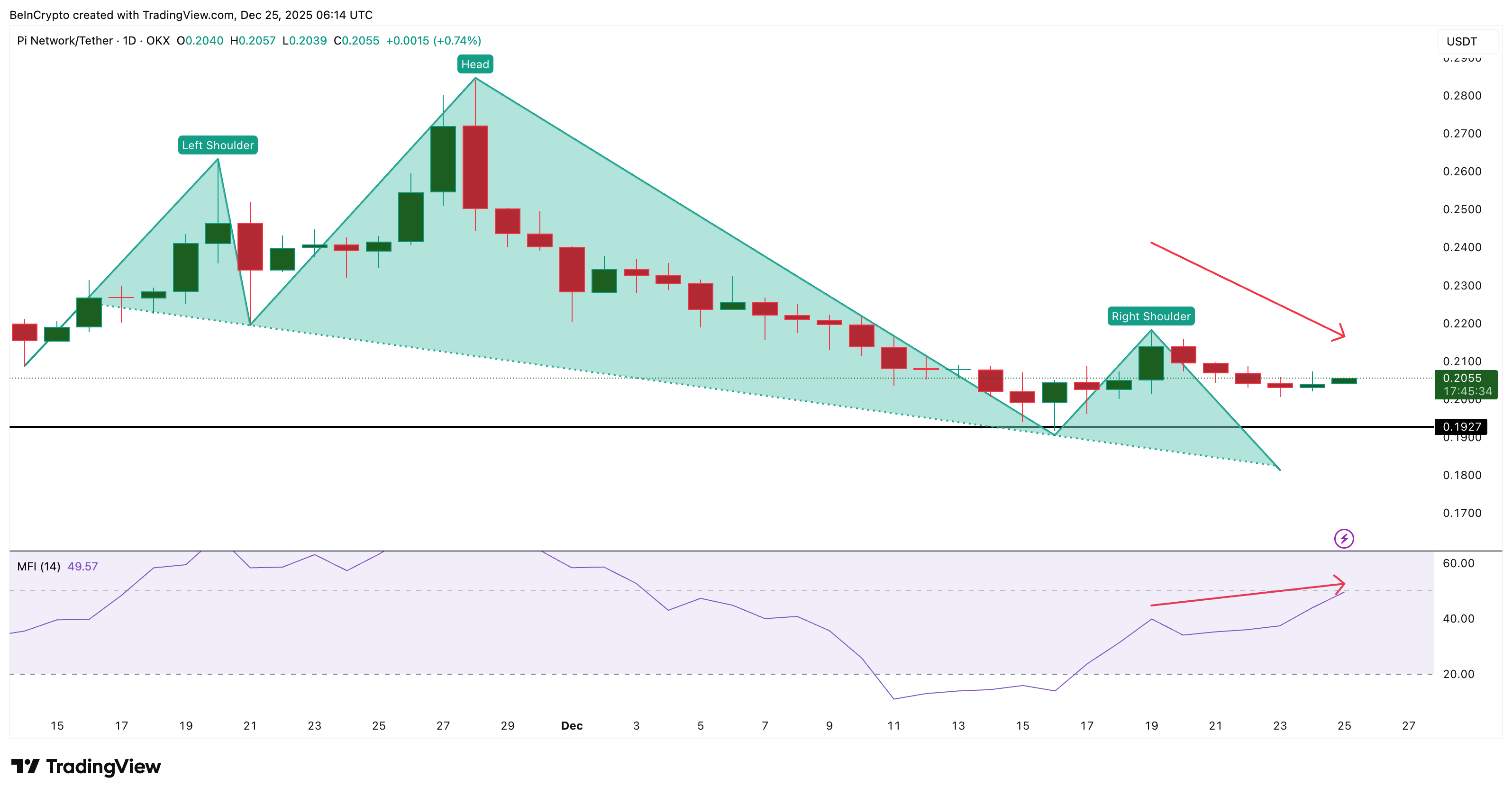
The current situation of Pi coin can be summarized as “retail rushing in, institutions holding back.” From December 19 to 25, the price continued to decline, but the Money Flow Index (MFI) hit new highs, creating a classic bullish divergence. MFI tracks whether funds are entering at lows; an increasing reading means buying interest is present during dips. This divergence is not superficial—the MFI curves upward at the moment Pi’s price begins to move toward the head and shoulders neckline, helping prevent an immediate crash.
However, retail bottom-fishing has a ceiling. The Chaikin Money Flow (CMF) indicator tracks large fund flows, measuring whether significant liquidity and big orders are entering the market. Pi’s CMF has broken its downtrend line and is heading toward its first cross above zero since mid-November. The key is that CMF must close above zero to confirm a trend reversal. The last time CMF broke above zero was November 14-16, when Pi surged 10.76% in subsequent trading days.
The current structure resembles November but lacks confirmation signals. CMF has not yet crossed zero, indicating large funds remain on the sidelines. While retail investors are bravely bottom-fishing, without institutional follow-through, this support may only delay a collapse rather than reverse the trend. Pi’s price chart is pausing near a pivot point, caught between buying dips and large capital inflows.
Deadly Threat of Head and Shoulders Pattern
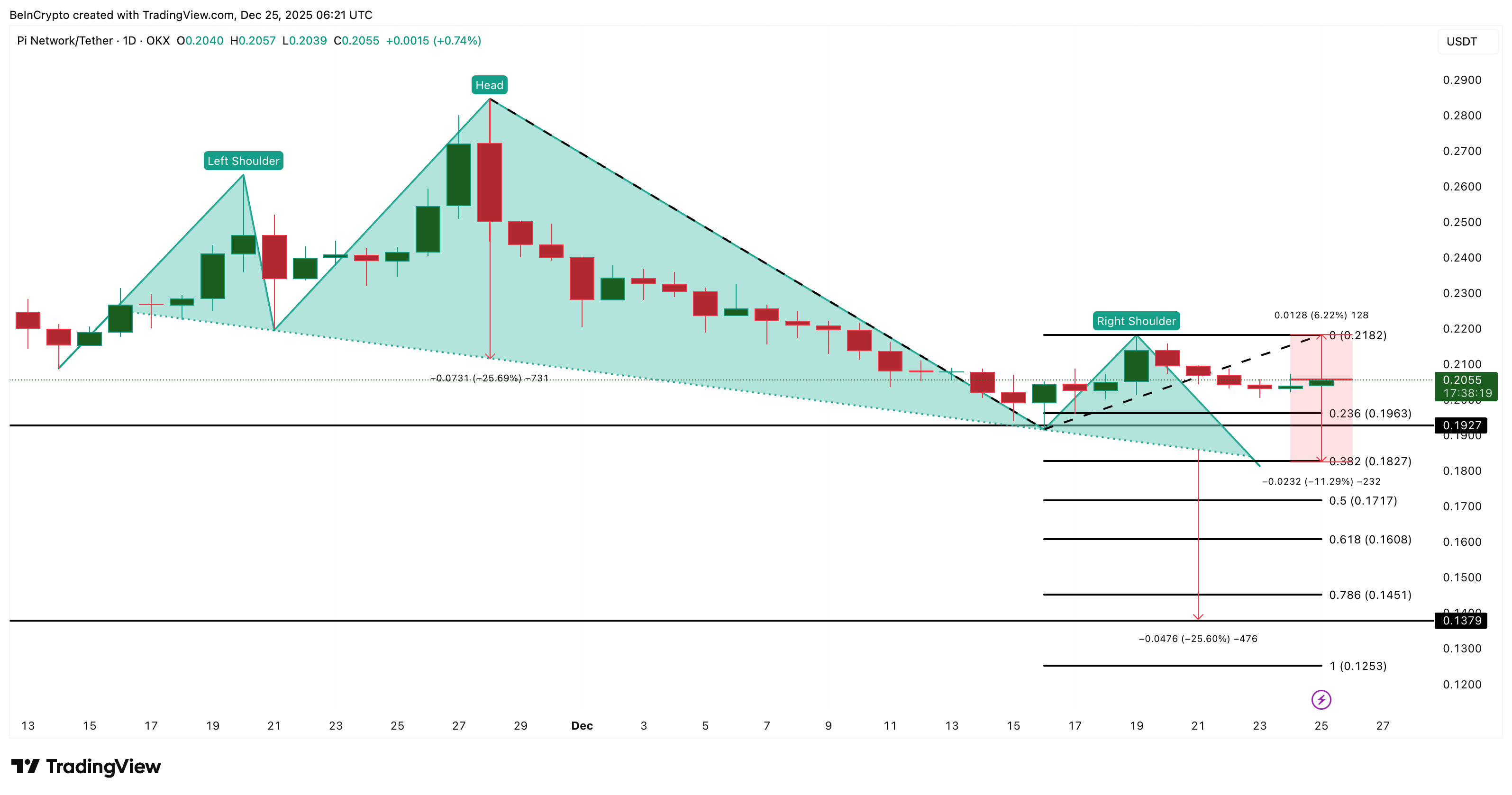
In technical analysis, the head and shoulders is one of the most reliable bearish patterns. Pi’s current formation shows the left shoulder, head, and right shoulder are basically complete, with the neckline around $0.182. This level is the last line of defense in the bulls vs bears battle; as long as the price stays above the neckline, the bearish structure is unconfirmed. But once broken, the pattern completes, and the target decline is measured by the distance from the head to the neckline.
According to head and shoulders measurement rules, if the daily close drops below $0.182 (an 11% decline from current), it confirms the neckline break, with a target around $0.137, representing a 25% drop. This is not alarmism but an objective statistical estimate. Historical data shows that after a head and shoulders completes, the target is reached over 70% of the time.
Three Key Price Levels Decide the Fate
$0.218 Breakout Level: 6% rally and break above the right shoulder, weakening bearish logic, confirming CMF trend change
$0.192 Warning Level: Falling below this signals a resumption of downtrend, the first sign retail support fails
$0.182 Neckline: Final line of defense; breaking below confirms head and shoulders, opening a 25% plunge to $0.137
Currently, Pi is near $0.192, just one step from the warning level. If it continues downward, retail bottom-fishing will face severe tests. Even more dangerous, a break below $0.192 could trigger a “false breakout trap”—retailers think it’s a buying opportunity, but in reality, it’s liquidity for institutions to offload.
MFI and CMF Battle: Who Will Lead the Next Move?
The divergence between the Money Flow Index (MFI) and Chaikin Money Flow (CMF) reveals a structural contradiction among market participants. MFI reflects retail behavior—small, nimble funds willing to buy at dips. They see “cheap prices,” not “a crash.” This mindset is common in crypto markets, especially in community-based projects like Pi.
CMF reflects institutional behavior—large, cautious funds that need clear trend reversal signals before entering. They look not at “cheap or not,” but at “is the trend changing.” A CMF breakout above zero indicates accumulated buying pressure exceeds selling, a buy signal from institutions. Currently, CMF is approaching zero but has not yet broken through, showing institutions are still observing.
Historical experience shows retail-only bottom-fishing often ends in failure. During the Luna collapse in 2022, MFI repeatedly diverged during sharp declines, attracting retail to buy the dip, only to be wiped out. Conversely, when MFI and CMF strengthen together, rebound success rates increase significantly. Bitcoin’s early 2023 rebound is a typical example: MFI diverged first, then CMF broke above zero, with price bouncing from $16,000 to $28,000.
Pi is at this critical juncture: retail has acted, but institutions have not yet followed. If CMF breaks above zero and stabilizes in the coming days, Pi could replicate the November rebound. If CMF falls back below zero, retail bottom-fishing will be isolated, and losing the neckline will only be a matter of time.
Investor Strategies and Risk Management
For Pi holders, the current situation demands clear risk management. Aggressive investors can hold above $0.192 with a stop-loss below $0.182, risking about 11%, aiming for a 6% gain if it rebounds to $0.218. Conservative investors should wait for CMF to confirm a breakout above zero before entering, even if it means missing the bottom, to avoid falling into a false breakout trap.
For observers, $0.182 is a key level to decide whether to enter. If the price tests this level repeatedly without breaking below and CMF turns positive, it could be the best risk-reward entry point. Conversely, if the price quickly breaks the neckline with increased volume, it’s better to stay on the sidelines and wait for a secondary bottom around $0.137.
Disclaimer: The information on this page may come from third parties and does not represent the views or opinions of Gate. The content displayed on this page is for reference only and does not constitute any financial, investment, or legal advice. Gate does not guarantee the accuracy or completeness of the information and shall not be liable for any losses arising from the use of this information. Virtual asset investments carry high risks and are subject to significant price volatility. You may lose all of your invested principal. Please fully understand the relevant risks and make prudent decisions based on your own financial situation and risk tolerance. For details, please refer to
Disclaimer.
Related Articles
Pi Network 18 million users complete KYC, and 26.5 million PI are issued to verifiers
Pi Network distributes 26.5 million PI tokens to more than 1 million community members who have completed KYC verification, to accelerate user identity verification and strengthen the decentralized model. 18 million already-verified users have laid the groundwork for the ecosystem’s development, but the key lies in how to convert these users into active participants. With the protocol upgrade, Pi Network is moving toward the open network phase, and smart contract support signals richer application scenarios.
MarketWhisper14h ago
Pi Network price hits a new 7-week low as a wave of 60 million token unlocks comes in
Pi Network's native token PI fell to $0.165 in April, hitting a 7-week low and leaving market sentiment weak. The unlock peak will release more than 60 million PI, adding downward pressure. Despite the core team recently publishing technical updates, it failed to improve market confidence and instead drew community criticism due to KYC access issues and the ongoing slide in price. Increased future supply could further drive prices lower.
MarketWhisper16h ago
Pi Network Distributes 26.5M PI to 1M KYC Validators
Pi Network has taken another step forward in building its ecosystem. The project recently distributed 26.5 million PI tokens to more than 1 million KYC validators.
These rewards were given to users who helped verify identities on the network. This process is important. Because it ensures that
Coinfomania04-13 13:30
Pi Network PIRC baseline protection mechanism sparks controversy, implying a “quasi-stablecoin” logic
Pi Network member Daniel F raised a logical contradiction in the PIRC token design, noting that if it has a 23.8% floor protection, it would need to behave like a stablecoin, which conflicts with its high volatility on CEX. This floor is based on Pi’s price calculations; if Pi itself fluctuates significantly, it will be unable to effectively protect holders. Daniel emphasized the importance of transparency, but the project team did not respond to it, leading the community to continue speculating about the reasons for its silence.
MarketWhisper04-13 02:23
Pi Network Major Transformation: 210 Ecosystem Applications Deployed, 23k Developers Ready
The Pi Network ecosystem is accelerating its transition, with more than 210 active applications and 23,000 developers actively participating in Pi Studio, spanning multiple areas such as payments, community engagement, education, and gaming. The ecosystem’s diversity shows indicators of healthy development, and developers’ engagement is driving ongoing application optimization. In the future, improving the usefulness of the mainnet will be a key challenge, including issues that need to be urgently addressed such as scalability, security, and user adoption rates.
MarketWhisper04-13 02:06


