The Ethereum network is facing an unprecedented data inflation crisis, with the storage requirements for verification nodes skyrocketing to 70GB. Experts warn that without action, it could soon exceed 1.2TB. This development not only threatens the decentralized nature of the network but may also exclude ordinary household users from the verification process. Ethereum co-founder Vitalik Buterin has proposed Peer Data Availability Sampling (PeerDAS) as a key solution, which will be implemented in the upcoming Fusaka upgrade.
Ethereum Data Crisis: Milestone of 6 Blobs per Block Triggers Alarm
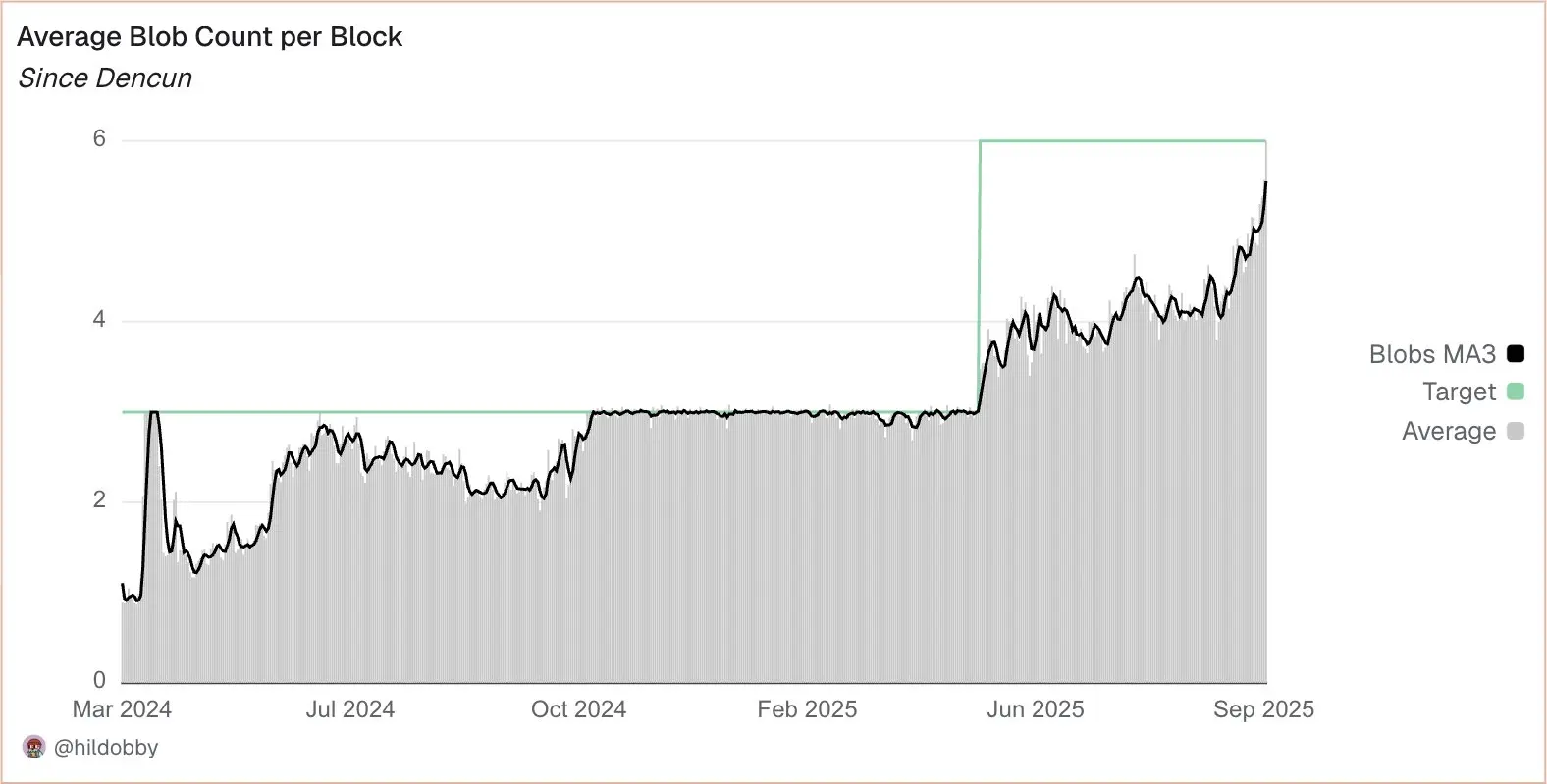
(Source: X)
The Ethereum network recently reached an important milestone of 6 Blobs per block. This development, while marking an increase in network throughput, has also exacerbated the data inflation crisis faced by the entire ecosystem. On September 24, on-chain analyst Hildobby released a report showing that several mainstream Layer 2 solutions, including Worldcoin, Soneium, and Scroll, are now heavily reliant on Blob technology.
Blockchain expert Hildobby explained: “The Blob introduced by EIP-4844 was originally intended as a temporary on-chain data container, aimed at reducing the costs of Layer-2 Rollups while avoiding permanent storage pressure. Unlike traditional call data, Blobs are designed to expire in about two weeks, which should theoretically reduce long-term storage requirements. However, the large-scale adoption of Blobs by Layer 2 solutions has far exceeded expectations, resulting in exponential growth in storage demands.”
Currently, Ethereum validators require over 70GB of space to manage Blob data. Analysts warn that without the implementation of effective data pruning mechanisms, this figure could quickly balloon to an astonishing 1.2TB. This development poses a serious threat to the decentralization of the network, as ordinary home users may not be able to afford such massive storage demands, ultimately leading to the validation process being concentrated in the hands of a few entities with powerful hardware resources.
The Impact of Data Inflation on the Ethereum Ecosystem
Cryptoeconomists point out: “One of the core value propositions of Ethereum is its decentralization characteristic, and the surge in storage demand directly threatens this fundamental principle. When validation nodes require 1.2TB of storage space, we will see a significant increase in the participation threshold, which may lead to a decrease in network security and an increase in centralization risks.”
This data inflation also brings about other chain reactions, including:
· Network synchronization time extended: The time required for new nodes to join the network has significantly increased.
· Rising hardware costs: The investment cost of equipment for running nodes has increased.
· Increased energy consumption: Processing and storing more data requires more energy
· Network latency risk: Increased data transmission may lead to network congestion.
· PeerDAS: A revolutionary solution proposed by Vitalik
In response to this challenge, Vitalik Buterin proposed Peer Data Availability Sampling (PeerDAS) as a solution, which will be implemented in the upcoming Fusaka upgrade. The core idea of PeerDAS is to change the current model where each Node needs to store the complete dataset, and instead adopt a distributed storage strategy.
Buterin explained: “The way PeerDAS works is that each node requests a small amount of 'data blocks' to probabilistically verify whether more than 50% of the data blocks are available. If more than 50% of the data blocks are available, then theoretically the node can download these data blocks and use erasure codes to recover the remaining data blocks.”
Technical expert Zhang Wei further explained: “This method essentially distributes the storage burden across the entire network, rather than requiring each node to bear the entire burden. This not only significantly reduces the storage requirements of individual nodes but also maintains the security and integrity of the network.”
However, Buterin also pointed out that the system still requires complete block data at certain critical stages, such as during the initial broadcast period or when it is necessary to reconstruct blocks from partial data. To prevent potential manipulation, the network still relies on “honest participants” to fulfill these responsibilities. However, he emphasized that PeerDAS is resilient even in the face of a large number of dishonest participants, as other nodes can take on responsibilities when needed.
Phased Implementation: Cautious Technical Roadmap
Although PeerDAS is considered key to addressing data bloat issues, the core development team of Ethereum still adopts a cautious phased implementation strategy. Buterin revealed that the development team has agreed to a phased rollout using only Blob parameter optimization (BPO) forks, rather than a single large capacity increase.
This phase implementation plan includes:
· First Fork: Scheduled to take place on December 17, raising the Blob target from 6/9 to 10/15
· Second Fork: Scheduled for January 7, 2026, will again raise the limit to 14/21.
Blockchain consultant Chen Ming stated: “This incremental approach allows developers to monitor network performance and make necessary adjustments at each step. This reflects the Ethereum development team's consistent cautious attitude; even in the face of urgent technical challenges, they are unwilling to sacrifice the stability and security of the network.”
Buterin predicts that with the implementation of these changes, the usage of blobs will further increase, laying the foundation for more aggressive network growth in the future. He emphasizes that PeerDAS is crucial for maintaining the continuous growth of Layer 2 solutions, while also preparing Ethereum's base layer to handle higher gas limits, with the ultimate goal of fully migrating execution data into blobs.
The Future of Ethereum: Balancing Scalability and Decentralization
The data expansion challenge facing Ethereum highlights a core contradiction in the development of blockchain technology: how to balance increasing network capacity with maintaining decentralization.
Cryptocurrency researchers point out: “The development history of Ethereum has always been about finding this balance point. From the initial PoW to PoS, and now to Layer 2 scaling and PeerDAS, every step has been an attempt to solve this fundamental problem.”
With the implementation of PeerDAS and the advancement of the phased capacity enhancement plan, the Ethereum community holds a cautiously optimistic attitude towards whether the network can successfully meet this challenge. However, experts also warn that as the adoption of blockchain applications increases and user demand grows, data management will continue to be a long-term challenge faced by Ethereum and other blockchain networks.
“Ultimately, whether Ethereum can maintain its position as the leading smart contract platform will depend on its ability to effectively address these technical challenges without sacrificing its core value proposition,” the researcher concluded. “PeerDAS is an important step in the right direction, but this technological revolution is still ongoing.”
For Ethereum users and investors, closely monitoring the progress of the Fusaka upgrade and the implementation effects of PeerDAS will be crucial in the coming months. These developments will not only affect the technical performance of the network but may also have far-reaching impacts on Ethereum's long-term competitiveness and market position.
Related Articles
Kevin O'Leary Allocates 90% of Crypto Portfolio to Bitcoin and Ethereum, Dismisses Other Tokens
Kevin O'Leary has shifted 90% of his crypto investments to Bitcoin and Ethereum, dismissing other assets as "garbage." He emphasizes their liquidity and market dominance, while also investing in Bitcoin mining and AI infrastructure.
GateNews3h ago
Bitmine Records Largest Weekly Ethereum Accumulation in 4 Months with 101,627 ETH
Bitmine recently acquired 101,627 ETH, bringing its total to 4,976,485 ETH, which is 4.12% of the circulating supply. The company aims to reach 5% of total ETH supply and is the world’s largest ETH staker, recently launching an institutional staking platform.
GateNews4h ago
Whale Address 0x8Ad4 Withdraws 12,000 ETH from CEX to Repay Aave Loans
Gate News message, whale address 0x8Ad4 withdrew 12,000 ETH, valued at $27.6 million, from centralized exchanges over the past 3 hours. The withdrawn ETH was used to repay loans on Aave.
GateNews4h ago
Vitalik Buterin Outlines Ethereum's 5-Year Roadmap Focused on Quantum Security and Scalability
Vitalik Buterin presented Ethereum's five-year roadmap, focusing on quantum security and scalability. Key goals include increasing gas limits, implementing Zero Knowledge Proofs, and enhancing transaction confirmation times by 2028, despite challenges with quantum-resistant signatures.
GateNews6h ago
Bitmine bought 101,627 ETH in a single week, worth $230 million: the largest single-week purchase in 2026, with ETH holdings nearing 5 million coins
Bitmine Immersion Technologies bought 101,627 ETH against the market trend, with a total value exceeding $230 million, becoming the largest one-week purchase in 2026. The company holds nearly 5 million ETH, accounting for 4.12% of the total supply, and may affect ETH’s circulating supply and market valuation. While other treasury firms are reducing their purchases, Bitmine has strengthened its position in the ETH space with an advantage-driven strategy. Investors in Taiwan can participate by directly buying ETH, joining Bitmine, or waiting for authorization of an ETH ETF.
ChainNewsAbmedia7h ago
ETH Whale Takes Profit on 20,000 ETH Worth $46.33M, Realizes $551K Gain
On April 20, an ETH whale closed a 4,000 ETH long position, earning $144,000, while another address took profit on 20,000 ETH, realizing $551,000 in gains and holding an additional 20,000 ETH.
GateNews7h ago


