Silver experienced intense volatility over the weekend, surging for 70 minutes before sharply retreating. The market is betting on rate cuts in 2026 amid geopolitical signals, prompting capital to shift from Bitcoin to tangible precious metals.
(Background: Google searches for “cryptocurrency” plummeted to a low, with silver emerging as a new safe haven)
(Additional context: Elon Musk rarely comments on silver’s rally, warning of supply chain risks: “This is not good.”)
Table of Contents
- Powell’s term countdown, market bets on 2026 rate cuts
- Geopolitical tensions and low inventories: dual signals amplify volatility
- Bitcoin absent from the party, risk appetite shifts to tangible assets
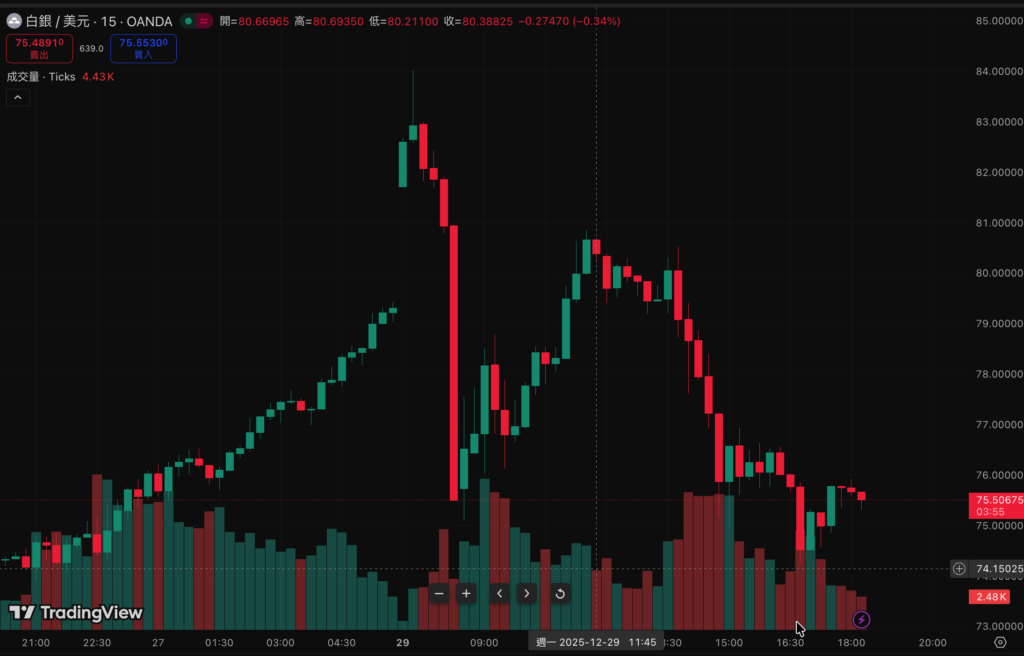
If readers are slightly inattentive during the last weekend of December, they might miss the most dramatic price movements of 2025: silver futures opened in New York on Sunday evening and within less than 70 minutes surged 6% to a historic high of $84, then immediately dropped 10% back to the $75 range.
Such unprecedented wild swings have even left veteran traders stunned. Market communication The Kobeissi Letter posted on X bluntly:
“This is absolute madness. Silver’s performance within an hour makes cryptocurrencies look stable.”
Short-term liquidity ignited by large automated orders, combined with algorithmic chasing, along with safe-haven buying, pushed silver to historic highs; profit-taking and insurance-driven sell-offs then flooded in, causing a flash crash. This kind of script has often occurred with meme coins in the past, but now it appears in a precious metal with a 4,000-year trading history, indicating that silver trading logic is increasingly “crypto-like.”
Powell’s term countdown, market bets on 2026 rate cuts
The rally is driven not only by technical factors. On a macro level, Fed Chair Powell’s term ends in 2026, and investors expect President Trump might nominate a more dovish successor, paving the way for low interest rates. According to CME FedWatch, futures markets imply at least two rate cuts. Low rates reduce the opportunity cost of holding non-yielding assets, prompting funds to shift into silver and gold to hedge against future debt expansion and currency devaluation risks.
Gold also hit a high of $4,530 over the weekend, but in terms of momentum and volatility indicators, silver is clearly more favored by short-term traders, and its nickname “the devil’s metal” has been recalled by the market.
Geopolitical tensions and low inventories: dual signals amplify volatility
Fundamentals are not absent, but their role is more like a catalyst. Fortune reported that last Friday, U.S. military operations in Nigeria and escalating Venezuela tensions boosted safe-haven buying; however, FXStreet reported that after positive progress in Russia-Ukraine peace talks on Sunday, the war premium was quickly stripped away, triggering a sharp price decline.
On the supply-demand side, Shanghai Silver Exchange inventories fell to about 715 tons, the lowest since 2016. Meanwhile, global demand for conductive materials for solar panels and AI electronics remains strong, creating structural tightness in physical silver. This “industrial blood” role provides long-term support and explains why prices, despite the sharp drop, remain near historic highs.
Bitcoin absent from the party, risk appetite shifts to tangible assets
Unlike the passion for silver, Bitcoin (BTC) has been nearly flat over the past 30 days, retreating about 25% from its October high of $120,000. During this period of increased influence of the Trump administration and uncertainty over Fed policy shifts, investors view BTC as a high-beta risk asset correlated with U.S. stocks rather than a traditional safe haven.
Funds are thus flowing into tangible precious metals. Silver is not only assigned “digital asset-level” volatility but also benefits from industrial demand and liquidity, making it the top choice for institutional portfolio adjustments. Weekend market movements may just be a prelude: under the interplay of low interest rate expectations, geopolitical turbulence, and tight supply, silver’s high volatility could become the new normal before 2026.
Looking back at this trend, the boundary between traditional assets and crypto markets is being blurred by sentiment and liquidity. Silver, with its 4,000-year history, proves it can be as wild as Bitcoin but also provide a bottom line through physical scarcity. As investors adjust their bets on interest rates and political risks, the next sharp volatility may no longer be surprising—only a matter of time.

Disclaimer: The information on this page may come from third parties and does not represent the views or opinions of Gate. The content displayed on this page is for reference only and does not constitute any financial, investment, or legal advice. Gate does not guarantee the accuracy or completeness of the information and shall not be liable for any losses arising from the use of this information. Virtual asset investments carry high risks and are subject to significant price volatility. You may lose all of your invested principal. Please fully understand the relevant risks and make prudent decisions based on your own financial situation and risk tolerance. For details, please refer to
Disclaimer.
Related Articles
Behind the rebound in Asian stock markets: a surge in mining stocks, pressure on platform stocks, and an intensifying split in capital flows in the crypto market
With expectations of a easing in the Middle East situation, Asian stock markets moved higher across the board, and falling oil prices eased market tensions. Despite pressure on crypto-related stocks on trading platforms, Bitcoin mining stocks performed strongly, indicating a trend of capital being reallocated. The market remains cautious about geopolitical developments and the outlook will be shaped by multiple factors.
GateNews2m ago
That’s why a drop in Bitcoin below $68,000 would increase the risk of a crash to below $60,000
That’s why falling below $68,000 could increase the risk of a crash that pushes Bitcoin down below $60,000.
SuperCryptoWahaha666662m ago
Before Bitcoin options expire, a big whale flips short: 2,000 put contracts with a $66k bet face the risk of breaking down
Before Bitcoin and Ethereum options expire, the market saw a large “whale” move: first going long, then switching to buy put options, signaling caution about the price. With Bitcoin currently around $66,575, the key range is between $66k and $68k, and the market expects future price volatility to increase. This move reflects professional capital reassessing the near-term outlook.
GateNews6m ago
Bitcoin drops to the $66,000 warning line: a $600 billion unrealized loss weighs heavily, and key support may determine the trend
Bitcoin’s price has remained sluggish, currently hovering around $66,000, with a nearly 6% decline over the past week. On-chain data shows that unrealized losses among holders are close to $60 billion, and market risk is increasing. The macroeconomic environment is unfavorable; institutional capital is returning slowly. Technical analysis indicates that the key resistance level is $71,500 and the support level is $64,000. Large holders are increasing their selling, strengthening the market’s cautious sentiment. Going forward, price action will depend on capital returning and the market sentiment improving.
GateNews14m ago


