BTC_POWER_LA

vip
Age 2.1 Yıl
Peak Tier 0
No content yet
Another power law applies to the recovery rallies after the drawdown.
Size=a duration^0.7.
Rallies are more efficient than drawdowns given the higher exponent.
  • Reward
  • Comment
  • Repost
  • Share
Give me how big the drawdown is and we can predict how long it will last.
I will do this soon with the current one.
  • Reward
  • Comment
  • Repost
  • Share
One more Bitcoin power law.
I measured the drawdown size vs their duration and we have:
size = a · duration^β
where β~0.53.
This is very similar to diffusion processes.
The R^2=0.94.
BTC3,01%
  • Reward
  • Comment
  • Repost
  • Share
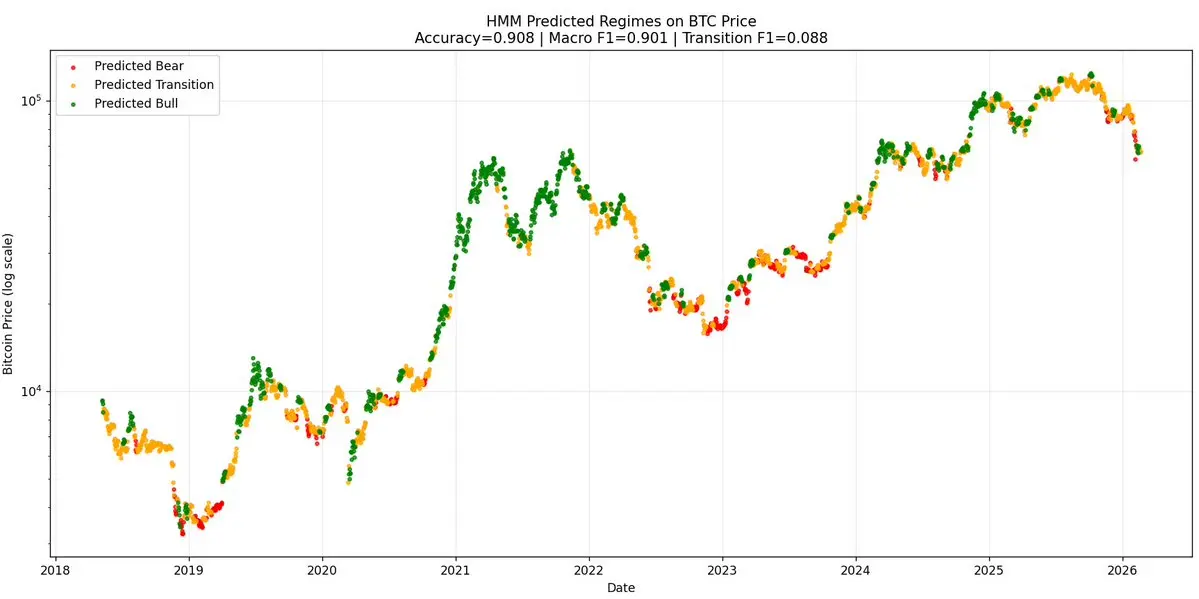
You can build a Hidden Markov Model (HMM) using the slopes of Bitcoin’s growth to identify and predict three regimes: bullish, transition, and bearish. In preliminary tests, this approach can classify the regime with around 90% accuracy.
Below is a link to a Veritasium video that explains how Hidden Markov Models work and why they are powerful tools for prediction problems.
HMMs are widely used in quantitative finance; notably, variations of this technique were reportedly among the methods employed by Jim Simons’ Medallion Fund, one of the most successful trading strategies in history.
BTC3,01%
post-image
  • Reward
  • Comment
  • Repost
  • Share
Bitcoin Live with the Power Law & Minotaur Team, #28 3/12/2026
BTC3,01%
  • Reward
  • Comment
  • Repost
  • Share
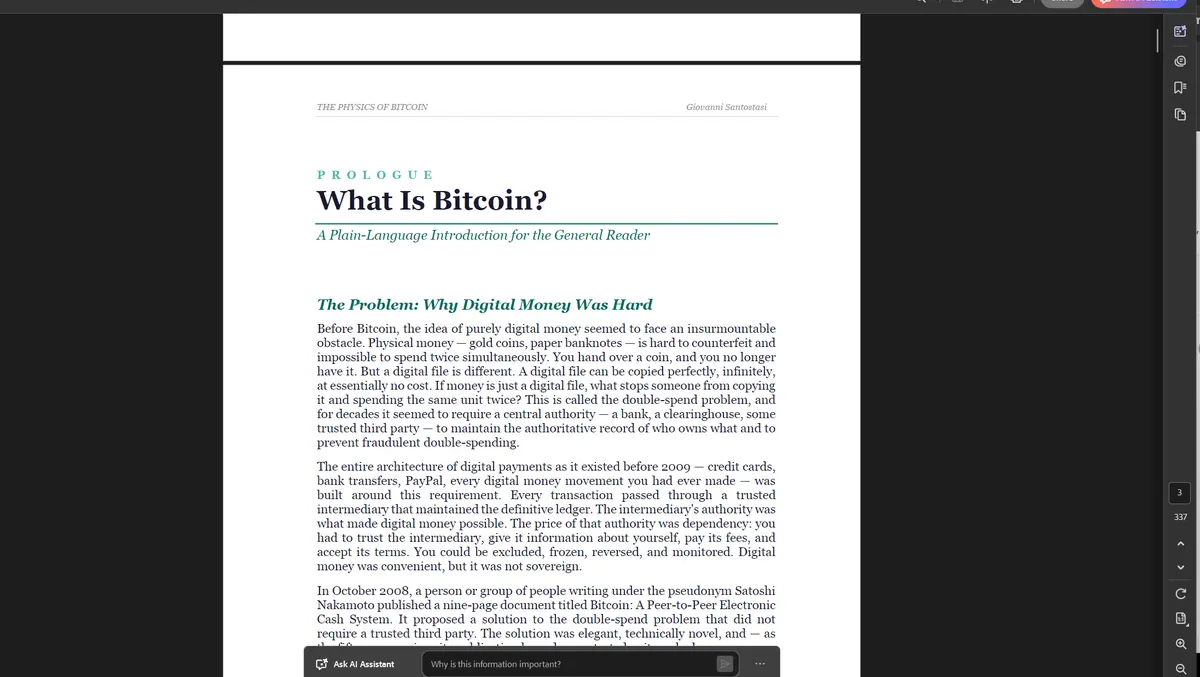
It is crazy Claude read the entire 339 pages Physics of Bitcoin book and gave me a full editorial review page by page.
I also asked for fun to write an Amazon type review. This is what it said.
⭐⭐⭐⭐⭐
The book Bitcoin has needed — and didn't know it
Most books about Bitcoin argue for it or against it. This one does something rarer and more interesting: it asks what kind of thing it is. Giovanni Santostasi's answer — that Bitcoin is a self-organized critical system obeying the same mathematical laws as earthquakes, cities, and the sleeping brain — sounds provocative until you see the data. The
BTC3,01%
  • Reward
  • Comment
  • Repost
  • Share
"The Physics of Bitcoin" with Giovanni and Stephen #39 3/11/2026
BTC3,01%
  • Reward
  • Comment
  • Repost
  • Share
Come and visit us at the Physics of Bitcoin show.
Starts in 5 minutes on X, YouTube and Twitch.
Many things to cover tonight including 3D power law and scaling test.
BTC3,01%
post-image
  • Reward
  • Comment
  • Repost
  • Share
The book covers an ambitious range of territory — from the statistical mechanics of power law scaling to the network physics underlying Bitcoin's adoption curve, from the thermodynamics of proof-of-work to the renormalization group theory that explains why Bitcoin's growth exponents form an integer-ratio family.
If this work proves important, it will not be because of its author. It will be because the subject itself is important — perhaps more important than most people currently realize.
Bitcoin is not merely a financial instrument or a technological curiosity. It is a emergent physical sys
BTC3,01%
  • Reward
  • Comment
  • Repost
  • Share
The Physics of Bitcoin book is done and I'm going through major revisions.
It is an incredible feeling. I published in books before as a co-author of chapters but never a full book (well besides my Ph.D. dissertation that was book long).
It is probably one of the most satisfying feelings in the world. The book is 337 pages on a letter format.
post-image
  • Reward
  • Comment
  • Repost
  • Share
The graph below is something every Bitcoiner should print and put it in their bedroom.
From the Physics of Bitcoin book:
Bitcoin is the only asset that passes the Scaling Test.
Here's a model-independent way to prove Bitcoin follows a power law — no curve fitting, no cherry-picked dates, no assumptions.
Pick two random days from Bitcoin's history. Compute the ratio of the prices. Compute the ratio of the times. Plot one against the other. Repeat thousands of times.
For a true power law, those points should collapse onto a perfectly straight line — because if P(t) ∝ tⁿ, then P(t₂)/P(t₁) = (t₂/
BTC3,01%
post-image
  • Reward
  • Comment
  • Repost
  • Share
We test here the log(P2/P1) on the Y axis vs log(t2/t1).
A true power law would show as a scattered line in a log-log graph.
Notice this test doesn't use regression, doesn't care about fitting lines.
How Bitcoin compares with other assets? It is the only one with crazy R^2 and that looks as a true power law.
BTC3,01%
post-image
  • Reward
  • 1
  • Repost
  • Share
ybaservip:
2026 GOGOGO 👊
The problem with most economists that they didn't have to take any physics class.
I'm very serious.
  • Reward
  • Comment
  • Repost
  • Share
Every single AI response to these ignorant remarks:
Claude for example.
"The power law is just a spurious correlation because the data is autocorrelated" — wrong
  • Reward
  • Comment
  • Repost
  • Share
Centered moving average in a 4 year window. How cleaner of a power law do you need?
post-image
  • Reward
  • Comment
  • Repost
  • Share
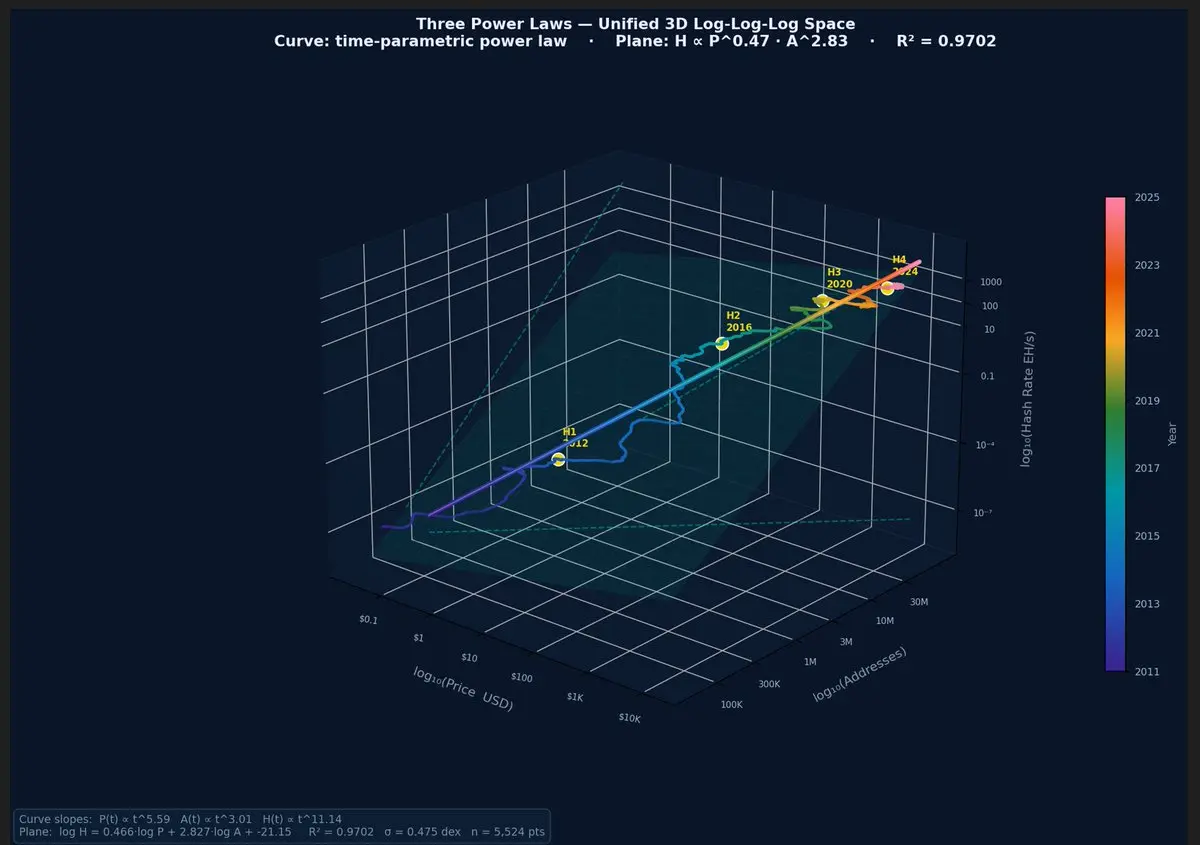
The 3D power law is a plane.
One single plane through all 5,524 data points with R² = 0.970.
The equation:
log⁡10(H)=0.47⋅log⁡10(P)+2.83⋅log⁡10(A)+constant.
The grey drop lines show individual residuals from the plane — the data hugs it remarkably tightly across 15 years and ~10 orders of magnitude in hash rate. The shadow projections on the three walls show the 2D marginal relationships you'd see if you collapsed any one dimension.
The key physical insight from the single fit: the three quantities don't just each follow a power law in time — they form a power law manifold together.
Hash r
post-image
  • Reward
  • Comment
  • Repost
  • Share
A power law of 3 is what many information networks choose as their growth pattern. The internet, the movie catalog IMDB and Bitcoin.
BTC3,01%
post-image
  • Reward
  • Comment
  • Repost
  • Share
2 birds of the same flock.
The internet and Bitcoin grow with power laws with similar exponents.
BTC3,01%
post-image
  • Reward
  • Comment
  • Repost
  • Share
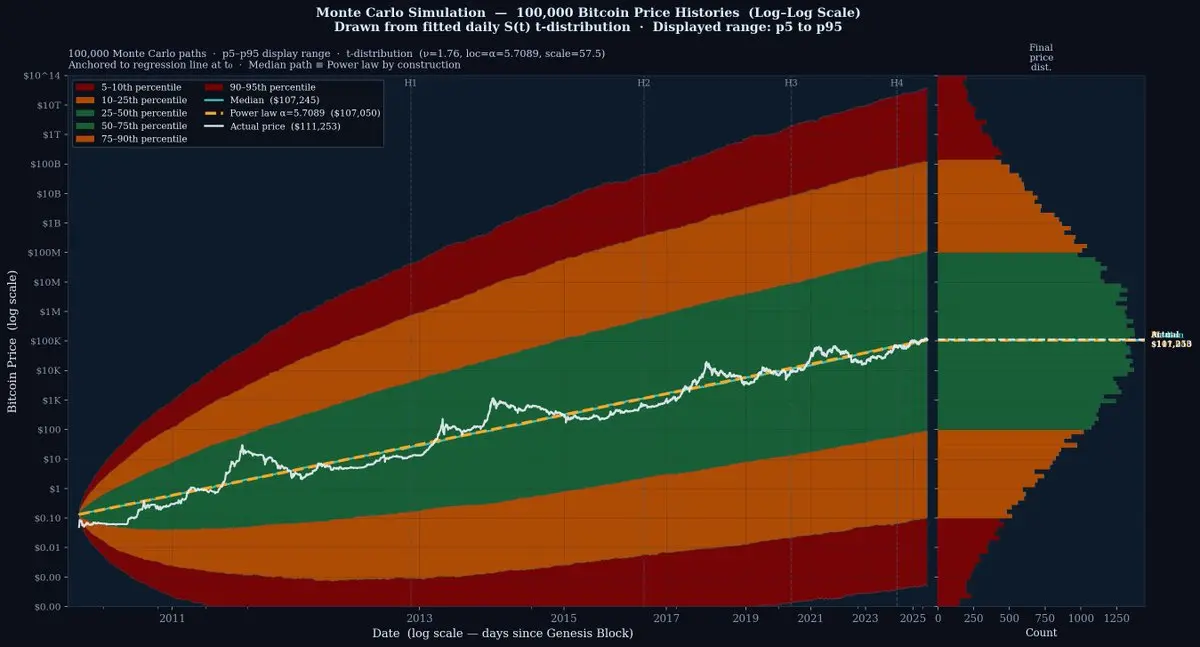
The Power Law is simply the most likely path.
What it means mathematically is straightforward: by construction, when you draw S from a distribution centered on α, the expected log-price increment at every step equals α · dlog(t). Summed over all steps, the expected trajectory is exactly the power law. The median tracks the mean because the t-distribution with ν > 1 is symmetric around its loc parameter. So the median path is the power law — not approximately, but exactly.
What it means physically is much deeper. You have 100,000 completely independent price histories, each generated by random
BTC3,01%
post-image
  • Reward
  • Comment
  • Repost
  • Share
  • Pin