




#StrategyBuys4871BTC
1. What Happened — The Core Event
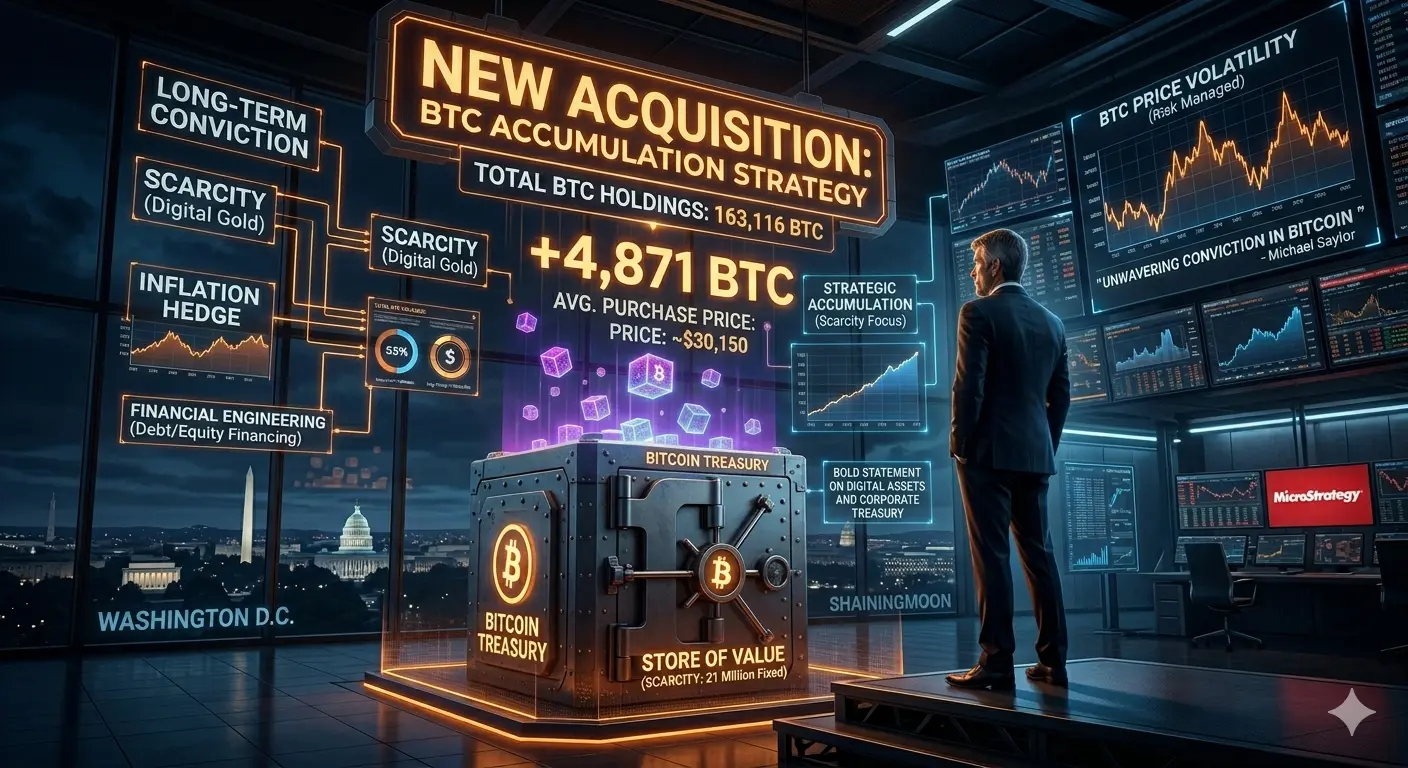
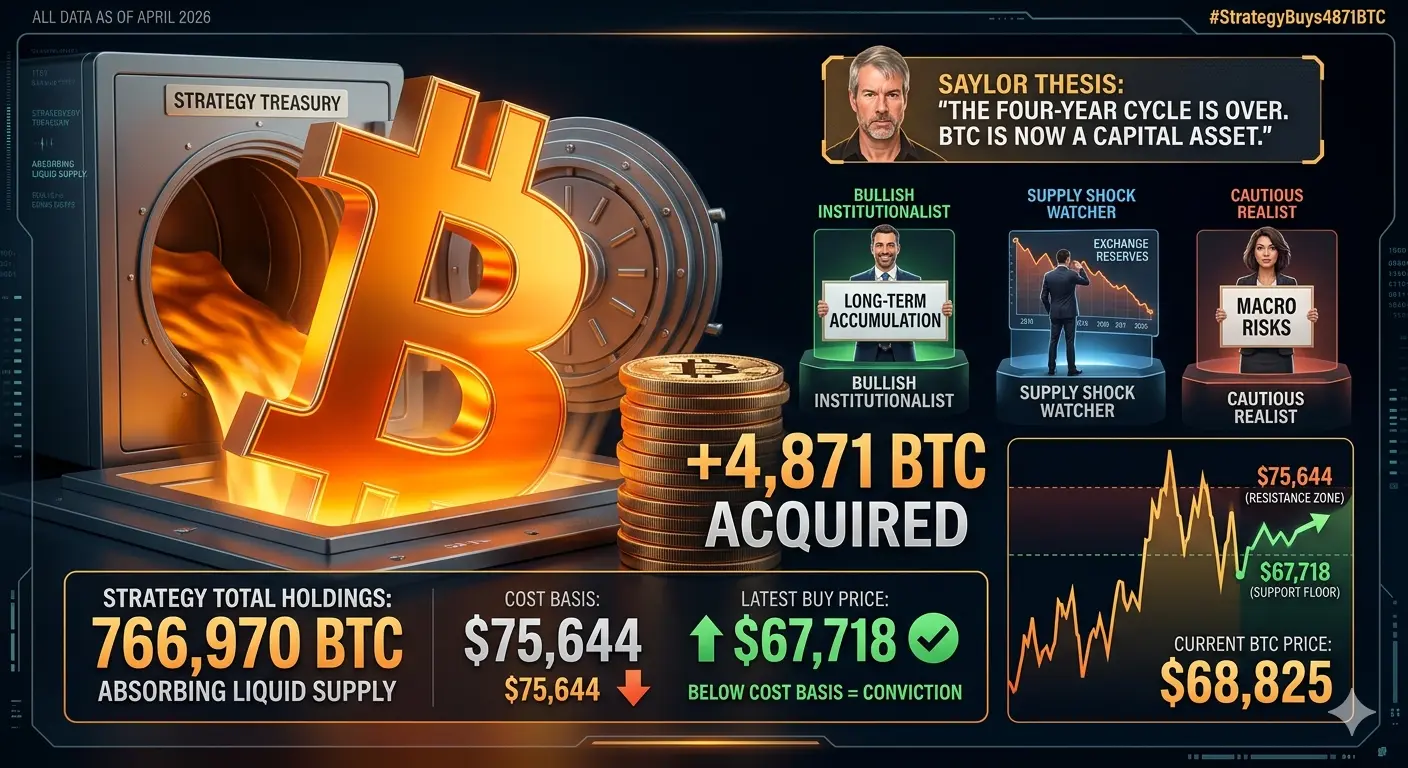
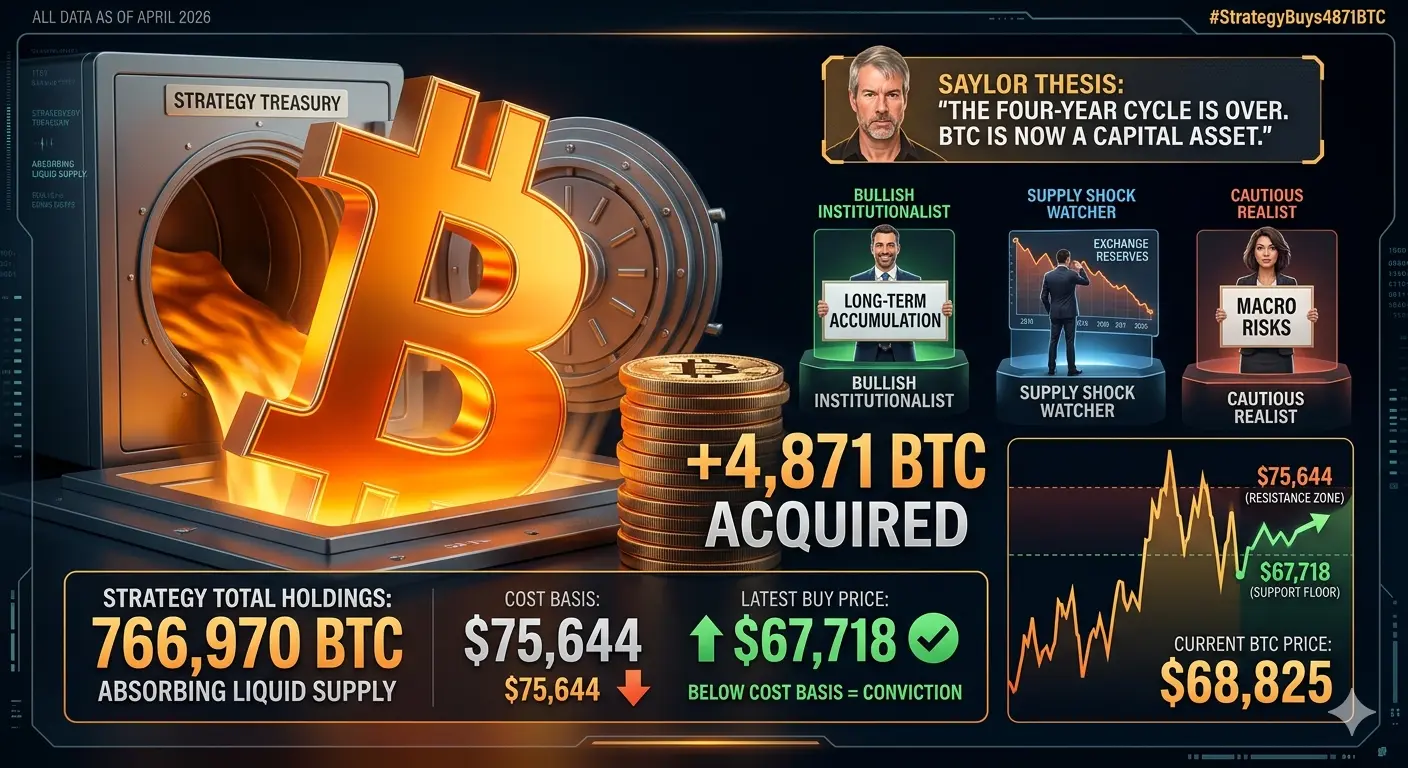
On April 6, 2026, Strategy (formerly MicroStrategy, traded as $MSTR on NASDAQ) officially announced it had acquired 4,871 BTC for approximately $329.9 million. The average purchase price came out to $67,718 per Bitcoin — a figure that sits notably below the company's own blended average cost basis of $75,644 per coin.
This was not a surprise move — it is entirely consistent with Michael Saylor's well-documented philosophy of relentless Bitcoin accumulation regardless of short-term price fluctuations. Saylor himself confirmed the buy on X (formerly Twitter), linking to Strategy's official press release.
---
2. The Scale — How Big Is Strategy's Hoard?
With this latest buy, Strategy's total holdings now stand at 766,970 BTC, purchased across multiple tranches for a combined cost of approximately $58.02 billion.
To put the scale in perspective:
Strategy controls roughly 3.5% of Bitcoin's entire total supply (capped at 21 million BTC)
The company holds approximately 76% of all Bitcoin sitting on publicly traded corporate balance sheets worldwide
For comparison: the entire rest of the corporate Bitcoin world combined holds far less than Strategy alone
The company's market-cap-to-net-asset-value (mNAV) ratio currently sits at approximately 0.85, meaning Strategy's equity is actually trading below the raw dollar value of its Bitcoin holdings — a discounted entry point that many institutional investors watch closely.
---
3. The Current Price Picture
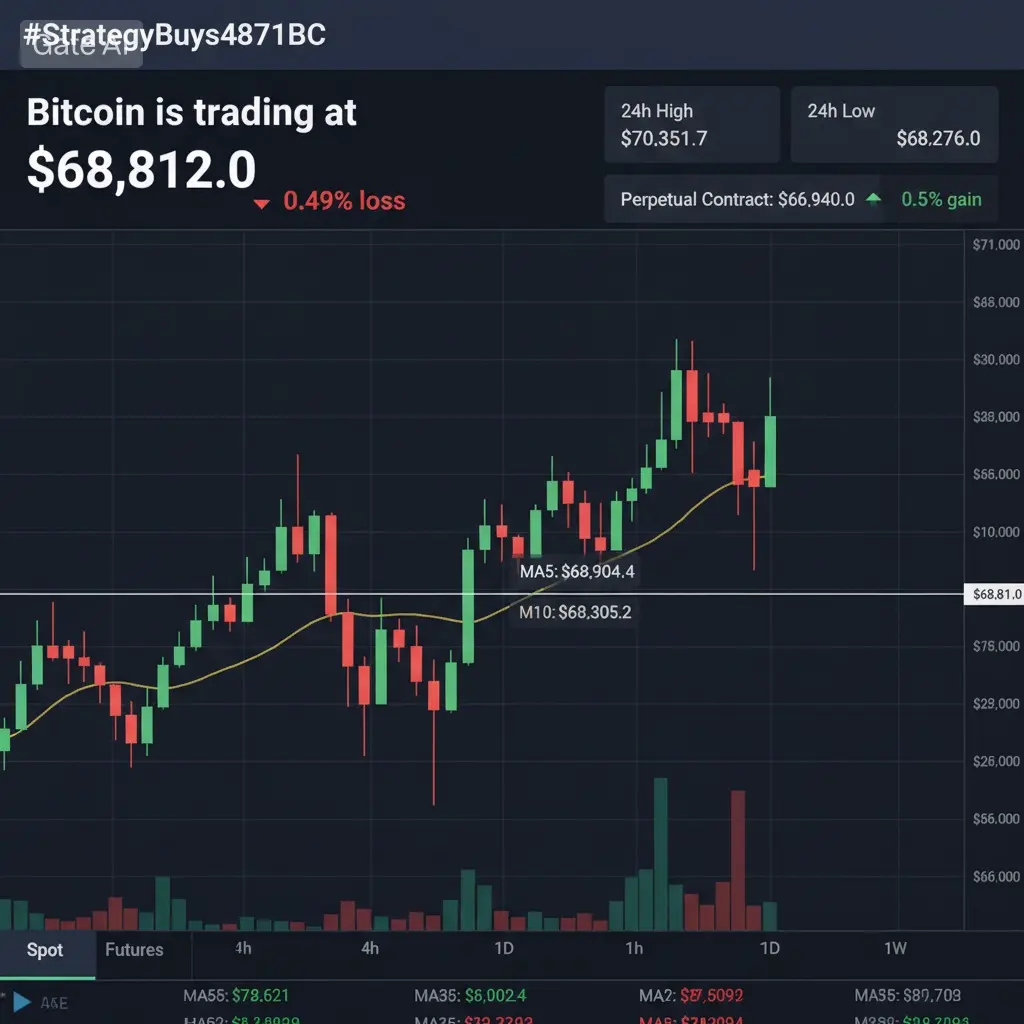
As of right now, BTC is trading at approximately $68,825 — with a 24-hour range between $68,276 and $70,351. The broader 90-day trend shows Bitcoin is still about 24% off its highs from earlier in the cycle. This makes Strategy's purchase at $67,718 almost surgical in timing — they bought almost exactly at the current floor.
Key price levels to watch:
Level Significance
$67,718 Strategy's latest average buy price — acts as a psychological floor
$68,825 Current spot price
$70,351 Recent 24-hour high — near-term resistance
$75,644 Strategy's overall blended cost basis — key overhead zone
$80,000+ Next major psychological resistance
---
4. Does This Buy Move the Market?
This is the question everyone on X is debating. The honest answer is: directly, modestly. Indirectly, significantly.
Direct supply impact: 4,871 BTC worth $329.9 million removed from the open market in a single transaction meaningfully tightens liquid supply. At a time when exchange reserves are already declining and thin order books dominate, this kind of absorption from a whale-level buyer removes potential sell-side pressure.
Psychological floor effect: When the largest corporate Bitcoin holder in the world buys $330 million worth at $67,718, it plants a very loud signal in the market: "We see value here." This doesn't guarantee prices go up immediately, but it does create a reference floor in the minds of retail traders and other institutions.
Reflexivity mechanics: Traders on X are calling this a "reflexivity starter" — meaning Strategy's buying creates conditions that nudge other institutions to follow, either out of conviction or fear of being left behind in what some call a "debasement race." Once one anchor buyer establishes a floor, it becomes harder for short sellers to push aggressively below it.
Macro override: The honest caveat here — Federal Reserve liquidity conditions, macro risk-off events, and broader equities sentiment still dominate short-term BTC price action. A single $330M buy does not override macro headwinds. It adds a structural layer of support, but does not eliminate downside risk in the near term.
---
5. Michael Saylor's Bigger Thesis — "The Four-Year Cycle Is Over"
This buy doesn't exist in isolation. On April 5, 2026 — just one day before the purchase announcement — Saylor made a provocative statement that is generating significant discussion:
"Bitcoin has won. The four-year cycle is over."
His argument, in plain language:
Bitcoin no longer follows the old halving-driven four-year boom-bust cycle
Price is now primarily driven by capital flows — institutional money, banking credit, and digital finance mechanisms — not retail speculation cycles
The banking system increasingly treating Bitcoin as collateral and a reserve asset changes the demand structure fundamentally
Strategy's shift in funding strategy (moving toward STRC preferred shares rather than pure common stock dilution) reflects this institutional evolution
This is a meaningful philosophical shift. If Saylor is right, the game has changed from a speculative trading instrument to a macro-capital asset — which would imply far more sustained, less volatile demand over time.
He also flagged a risk: BIP-110, a proposed protocol change that would allow miners to vote on which blocks to accept. Saylor calls this Bitcoin's greatest self-inflicted threat — governance complexity has historically been what derails crypto assets.
---
6. What Traders Are Saying — X Sentiment Breakdown
The mood on X around #StrategyBuys4871BTC can be summarized in three camps:
Camp 1 — Bullish Institutionalists (dominant)
This group sees the buy as a textbook example of high-conviction accumulation during a fear phase. They point to the fact that Strategy is buying below its own cost basis as evidence of genuine conviction rather than momentum chasing. The common phrase circulating: "They are not timing bottoms — they are building a position."
Camp 2 — Supply Shock Watchers
These are the on-chain analysis crowd. Their view: every BTC Strategy locks away is one less Bitcoin available for the rest of the market. With exchange reserves declining and long-term holder supply increasing, removing another 4,871 coins from liquid circulation tightens a market that is already structurally short on available supply. They see this as an upside volatility multiplier — not today, but when momentum shifts.
Camp 3 — The Cautious Realists
This group acknowledges the signal but warns against reading it as a guarantee. Strategy is sitting on roughly $14.46 billion in unrealized Q1 losses. The buy at $67,718 when the average cost basis is $75,644 is rational but also reflects that the company is in a drawdown. They argue this should be read as "sophisticated holder sees long-term value" — not as a short-term price catalyst.
One prominent recurring comment: Saylor's hint of "Back to Work" on X suggests more buys are incoming, which would compound the supply pressure further.
---
7. The Broader Corporate Bitcoin Landscape
Here is a striking data point from recent reports: non-Strategy corporate Bitcoin purchases have collapsed by 99% from their August 2025 peak, when the broader group of treasury companies bought 69,000 BTC in a single month.
Strategy is essentially the only institution still buying aggressively. This creates a bifurcated picture:
Bullish read: Strategy is a lone conviction buyer in a fear-dominated market — historically, that is when the best long-term entries are made
Bearish read: The rest of corporate America has stepped back — which could mean the institutional wave has paused, removing a demand catalyst the market was counting on
Notably, Strive (the Bitcoin treasury firm founded by Vivek Ramaswamy) separately bought 113 BTC for $7.75 million at around $68,577 — broadly confirming the same price range as a value zone among informed buyers.
---
8. Price Forecast — What Could Happen Next
Putting together all the above factors, here is a layered outlook. These are informed market observations, not financial advice.
Short-term (days to weeks):
Expect continued volatility in the $66,000 to $72,000 range. The $67,718 Strategy buy price acts as a psychological anchor — a break below it would be a notable negative signal, while holding above it supports the floor narrative. Watch for futures open interest data and stablecoin inflows as lead indicators.
Medium-term (1-3 months):
If macro conditions stabilize (Fed policy, equity markets, dollar index) and Strategy continues buying, the path toward $75,644 — their blended cost basis — becomes a logical magnetic target. Markets tend to gravitate toward major participant cost bases. A recovery to that level would represent roughly a 10% gain from current prices.
Long-term (beyond Q3 2026):
The Saylor thesis, if directionally correct, implies a structurally higher BTC floor over time as banking and institutional frameworks increasingly treat Bitcoin as a reserve asset. The 766,970 BTC locked by Strategy alone represents a 3.5% supply constraint that grows more meaningful as demand increases.
---
9. What Is the Next Plan — Key Signals to Watch
For traders watching this story, here are the specific indicators to track:
1. Saylor's next X post with a BTC purchase chart — He consistently announces each buy publicly. Another buy in the $65,000-$70,000 range would confirm continued accumulation at these levels.
2. Strategy's 8-K SEC filings — Every purchase is disclosed. Frequency and size of future filings will indicate how aggressively they are deploying capital.
3. mNAV ratio — Currently 0.85 (trading at a discount to Bitcoin holdings). If it drops further, institutional arbitrage buyers tend to step in, which indirectly supports BTC.
4. Exchange BTC reserves — If balances continue declining while Strategy accumulates, the supply squeeze thesis gains traction quickly.
5. BIP-110 debate outcome — If protocol governance becomes contentious and divisive, it could introduce risk premium into Bitcoin pricing regardless of accumulation dynamics.
---
10. Bottom Line Summary
Strategy's 4,871 BTC purchase is not a random event — it is the latest chapter in a deliberate, multi-year campaign to position one company as the largest private holder of a capped-supply monetary asset. The timing — below their own cost basis, during a fear phase, at $67,718 — signals conviction, not desperation.
Will it alone push BTC meaningfully higher? Not immediately. But it does three important things: it removes supply, it establishes a psychological price floor, and it sends a signal to every other institution watching from the sidelines. When the largest corporate Bitcoin holder keeps buying through a drawdown, that is information worth taking seriously.
Saylor's declaration that the four-year cycle is over may sound like marketing — but the funding mechanics and institutional structural changes he is pointing to are real. The market is watching whether he is early, right, or both.
1. What Happened — The Core Event
On April 6, 2026, Strategy (formerly MicroStrategy, traded as $MSTR on NASDAQ) officially announced it had acquired 4,871 BTC for approximately $329.9 million. The average purchase price came out to $67,718 per Bitcoin — a figure that sits notably below the company's own blended average cost basis of $75,644 per coin.
This was not a surprise move — it is entirely consistent with Michael Saylor's well-documented philosophy of relentless Bitcoin accumulation regardless of short-term price fluctuations. Saylor himself confirmed the buy on X (formerly Twitter), linking to Strategy's official press release.
---
2. The Scale — How Big Is Strategy's Hoard?
With this latest buy, Strategy's total holdings now stand at 766,970 BTC, purchased across multiple tranches for a combined cost of approximately $58.02 billion.
To put the scale in perspective:
Strategy controls roughly 3.5% of Bitcoin's entire total supply (capped at 21 million BTC)
The company holds approximately 76% of all Bitcoin sitting on publicly traded corporate balance sheets worldwide
For comparison: the entire rest of the corporate Bitcoin world combined holds far less than Strategy alone
The company's market-cap-to-net-asset-value (mNAV) ratio currently sits at approximately 0.85, meaning Strategy's equity is actually trading below the raw dollar value of its Bitcoin holdings — a discounted entry point that many institutional investors watch closely.
---
3. The Current Price Picture
As of right now, BTC is trading at approximately $68,825 — with a 24-hour range between $68,276 and $70,351. The broader 90-day trend shows Bitcoin is still about 24% off its highs from earlier in the cycle. This makes Strategy's purchase at $67,718 almost surgical in timing — they bought almost exactly at the current floor.
Key price levels to watch:
Level Significance
$67,718 Strategy's latest average buy price — acts as a psychological floor
$68,825 Current spot price
$70,351 Recent 24-hour high — near-term resistance
$75,644 Strategy's overall blended cost basis — key overhead zone
$80,000+ Next major psychological resistance
---
4. Does This Buy Move the Market?
This is the question everyone on X is debating. The honest answer is: directly, modestly. Indirectly, significantly.
Direct supply impact: 4,871 BTC worth $329.9 million removed from the open market in a single transaction meaningfully tightens liquid supply. At a time when exchange reserves are already declining and thin order books dominate, this kind of absorption from a whale-level buyer removes potential sell-side pressure.
Psychological floor effect: When the largest corporate Bitcoin holder in the world buys $330 million worth at $67,718, it plants a very loud signal in the market: "We see value here." This doesn't guarantee prices go up immediately, but it does create a reference floor in the minds of retail traders and other institutions.
Reflexivity mechanics: Traders on X are calling this a "reflexivity starter" — meaning Strategy's buying creates conditions that nudge other institutions to follow, either out of conviction or fear of being left behind in what some call a "debasement race." Once one anchor buyer establishes a floor, it becomes harder for short sellers to push aggressively below it.
Macro override: The honest caveat here — Federal Reserve liquidity conditions, macro risk-off events, and broader equities sentiment still dominate short-term BTC price action. A single $330M buy does not override macro headwinds. It adds a structural layer of support, but does not eliminate downside risk in the near term.
---
5. Michael Saylor's Bigger Thesis — "The Four-Year Cycle Is Over"
This buy doesn't exist in isolation. On April 5, 2026 — just one day before the purchase announcement — Saylor made a provocative statement that is generating significant discussion:
"Bitcoin has won. The four-year cycle is over."
His argument, in plain language:
Bitcoin no longer follows the old halving-driven four-year boom-bust cycle
Price is now primarily driven by capital flows — institutional money, banking credit, and digital finance mechanisms — not retail speculation cycles
The banking system increasingly treating Bitcoin as collateral and a reserve asset changes the demand structure fundamentally
Strategy's shift in funding strategy (moving toward STRC preferred shares rather than pure common stock dilution) reflects this institutional evolution
This is a meaningful philosophical shift. If Saylor is right, the game has changed from a speculative trading instrument to a macro-capital asset — which would imply far more sustained, less volatile demand over time.
He also flagged a risk: BIP-110, a proposed protocol change that would allow miners to vote on which blocks to accept. Saylor calls this Bitcoin's greatest self-inflicted threat — governance complexity has historically been what derails crypto assets.
---
6. What Traders Are Saying — X Sentiment Breakdown
The mood on X around #StrategyBuys4871BTC can be summarized in three camps:
Camp 1 — Bullish Institutionalists (dominant)
This group sees the buy as a textbook example of high-conviction accumulation during a fear phase. They point to the fact that Strategy is buying below its own cost basis as evidence of genuine conviction rather than momentum chasing. The common phrase circulating: "They are not timing bottoms — they are building a position."
Camp 2 — Supply Shock Watchers
These are the on-chain analysis crowd. Their view: every BTC Strategy locks away is one less Bitcoin available for the rest of the market. With exchange reserves declining and long-term holder supply increasing, removing another 4,871 coins from liquid circulation tightens a market that is already structurally short on available supply. They see this as an upside volatility multiplier — not today, but when momentum shifts.
Camp 3 — The Cautious Realists
This group acknowledges the signal but warns against reading it as a guarantee. Strategy is sitting on roughly $14.46 billion in unrealized Q1 losses. The buy at $67,718 when the average cost basis is $75,644 is rational but also reflects that the company is in a drawdown. They argue this should be read as "sophisticated holder sees long-term value" — not as a short-term price catalyst.
One prominent recurring comment: Saylor's hint of "Back to Work" on X suggests more buys are incoming, which would compound the supply pressure further.
---
7. The Broader Corporate Bitcoin Landscape
Here is a striking data point from recent reports: non-Strategy corporate Bitcoin purchases have collapsed by 99% from their August 2025 peak, when the broader group of treasury companies bought 69,000 BTC in a single month.
Strategy is essentially the only institution still buying aggressively. This creates a bifurcated picture:
Bullish read: Strategy is a lone conviction buyer in a fear-dominated market — historically, that is when the best long-term entries are made
Bearish read: The rest of corporate America has stepped back — which could mean the institutional wave has paused, removing a demand catalyst the market was counting on
Notably, Strive (the Bitcoin treasury firm founded by Vivek Ramaswamy) separately bought 113 BTC for $7.75 million at around $68,577 — broadly confirming the same price range as a value zone among informed buyers.
---
8. Price Forecast — What Could Happen Next
Putting together all the above factors, here is a layered outlook. These are informed market observations, not financial advice.
Short-term (days to weeks):
Expect continued volatility in the $66,000 to $72,000 range. The $67,718 Strategy buy price acts as a psychological anchor — a break below it would be a notable negative signal, while holding above it supports the floor narrative. Watch for futures open interest data and stablecoin inflows as lead indicators.
Medium-term (1-3 months):
If macro conditions stabilize (Fed policy, equity markets, dollar index) and Strategy continues buying, the path toward $75,644 — their blended cost basis — becomes a logical magnetic target. Markets tend to gravitate toward major participant cost bases. A recovery to that level would represent roughly a 10% gain from current prices.
Long-term (beyond Q3 2026):
The Saylor thesis, if directionally correct, implies a structurally higher BTC floor over time as banking and institutional frameworks increasingly treat Bitcoin as a reserve asset. The 766,970 BTC locked by Strategy alone represents a 3.5% supply constraint that grows more meaningful as demand increases.
---
9. What Is the Next Plan — Key Signals to Watch
For traders watching this story, here are the specific indicators to track:
1. Saylor's next X post with a BTC purchase chart — He consistently announces each buy publicly. Another buy in the $65,000-$70,000 range would confirm continued accumulation at these levels.
2. Strategy's 8-K SEC filings — Every purchase is disclosed. Frequency and size of future filings will indicate how aggressively they are deploying capital.
3. mNAV ratio — Currently 0.85 (trading at a discount to Bitcoin holdings). If it drops further, institutional arbitrage buyers tend to step in, which indirectly supports BTC.
4. Exchange BTC reserves — If balances continue declining while Strategy accumulates, the supply squeeze thesis gains traction quickly.
5. BIP-110 debate outcome — If protocol governance becomes contentious and divisive, it could introduce risk premium into Bitcoin pricing regardless of accumulation dynamics.
---
10. Bottom Line Summary
Strategy's 4,871 BTC purchase is not a random event — it is the latest chapter in a deliberate, multi-year campaign to position one company as the largest private holder of a capped-supply monetary asset. The timing — below their own cost basis, during a fear phase, at $67,718 — signals conviction, not desperation.
Will it alone push BTC meaningfully higher? Not immediately. But it does three important things: it removes supply, it establishes a psychological price floor, and it sends a signal to every other institution watching from the sidelines. When the largest corporate Bitcoin holder keeps buying through a drawdown, that is information worth taking seriously.
Saylor's declaration that the four-year cycle is over may sound like marketing — but the funding mechanics and institutional structural changes he is pointing to are real. The market is watching whether he is early, right, or both.

 :
: