Today in crypto, Kalshi is facing another state-level lawsuit after the state of Washington on Friday filed allegations that the prediction market operator violated state gambling laws with its products, spot Bitcoin ETFs posted $296.18 million in weekly outflows, and Morgan Stanley sets a 0.14% fee for its spot Bitcoin ETF, potentially forcing competitors to cut fees to stay competitive.
Kalshi legal woes grow with Washington state gambling suit
Kalshi is facing another state-level lawsuit after the state of Washington on Friday filed allegations that the prediction market operator violated state gambling laws with its products.
The Washington Attorney General’s complaint cites the Pacific Northwest state’s existing ban on online gambling and otherwise strict oversight of the gaming market, in claiming Kalshi violated the Washington Consumer Protection Act, Gambling Act, and Recovery of Money Lost at Gambling Act.
“Kalshi’s website and app show consumers a range of events that they can bet on and the odds for those various events, which dictate how much the bettor will be paid out if the event occurs,” an announcement from Attorney General Nick Brown said. “This is exactly how sportsbooks and other gambling operations function. Kalshi advertises that they allow consumers to ‘bet on anything’ by simply calling their service a ‘prediction market’ rather than ‘gambling.’”
Kalshi immediately sought to move the case to federal court, saying in its filing that the issues raised by the Washington suit are already being litigated in other federal courts and that there had been “no warning or dialogue” from Washington state prior to the lawsuit.
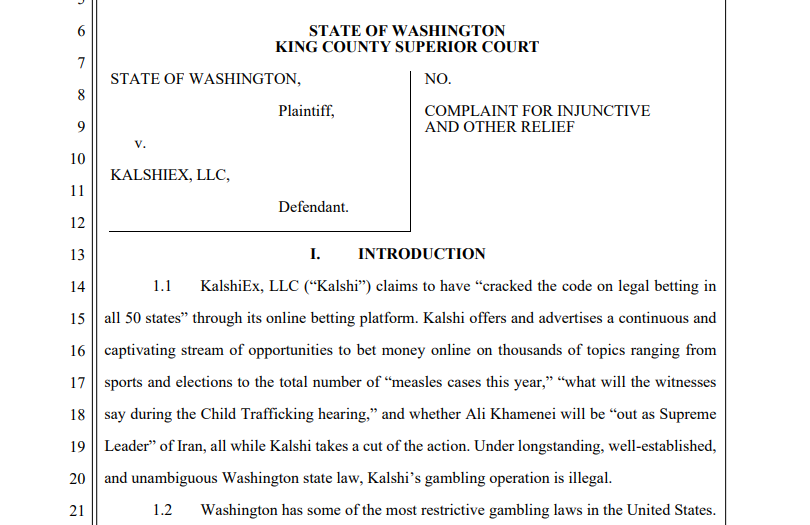
_Cover page of State of Washington v. KalshiEx, Source: _King County Superior Court
Spot Bitcoin ETFs break 4-week inflow streak as capital avoids ‘directional risk’
Spot Bitcoin exchange-traded funds (ETFs) snapped a four-week inflow streak, posting $296.18 million in net outflows for the week ending Friday.
The reversal follows a sustained run of inflows totaling more than $2.2 billion across four consecutive weeks, including $787.31 million, $568.45 million and $767.33 million in early March, before slowing to $95.18 million in the prior week, according to SoSoValue data.
The weekly outflow followed back-to-back daily withdrawals on Thursday and Friday totaling more than $396 million, including a $225.48 million outflow on Friday alone, their biggest day of redemptions since March 3, when they posted $348 million in outflows.
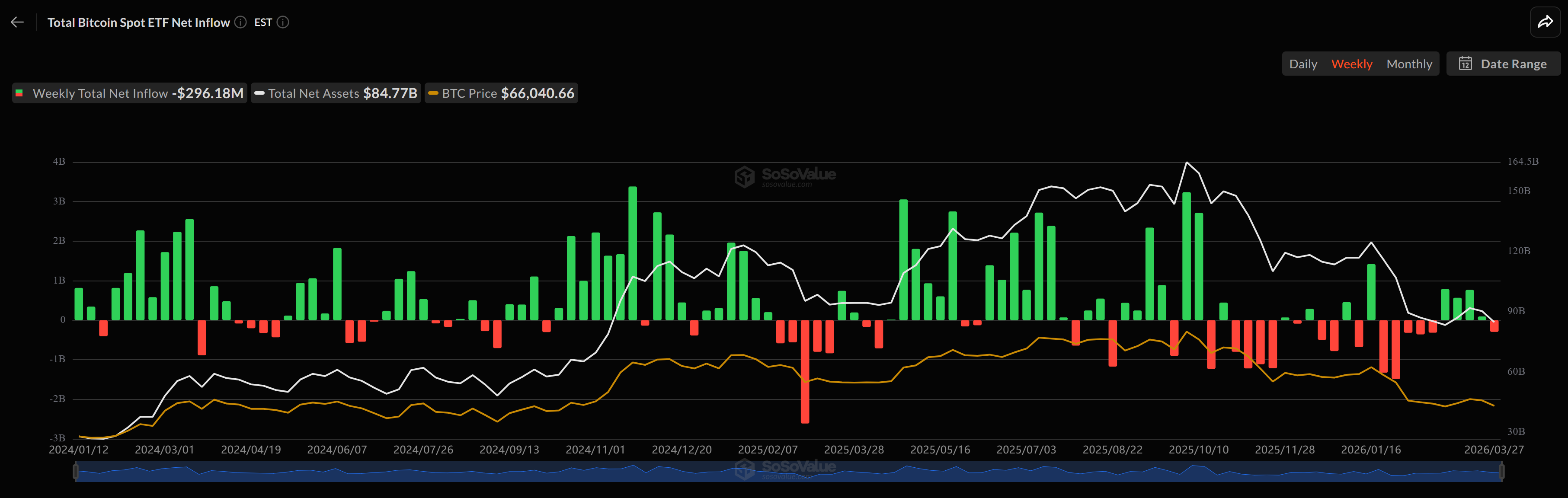
_Spot Bitcoin ETFs see weekly outflows. Source: _SoSoValue
Notably, cumulative net inflows into spot Bitcoin (BTC) ETFs stand at $55.93 billion, while total net assets have slipped to $84.77 billion from over $90 billion a week earlier. Trading activity also moderated, with weekly volume falling to $14.26 billion from $25.87 billion earlier in March.
Morgan Stanley sets 0.14% Bitcoin ETF fee, lowest in market if approved
Investment bank Morgan Stanley is seeking to launch its spot Bitcoin exchange-traded fund with a 0.14% fee, which would make it the cheapest in the US market and potentially force rivals to cut fees to stay competitive.
The 0.14% fee, proposed in Morgan Stanley’s latest S-1 registration statement on Friday, would be one basis point below the Grayscale Bitcoin Mini Trust ETF (BTC), currently the cheapest in the US market, and 11 basis points below the BlackRock-issued iShares Bitcoin Trust ETF (IBIT).
“Big move here. They are not messing around,” Bloomberg ETF analyst James Seyffart said, predicting that the Morgan Stanley Bitcoin Trust (MSBT) is “likely to launch in early April.”
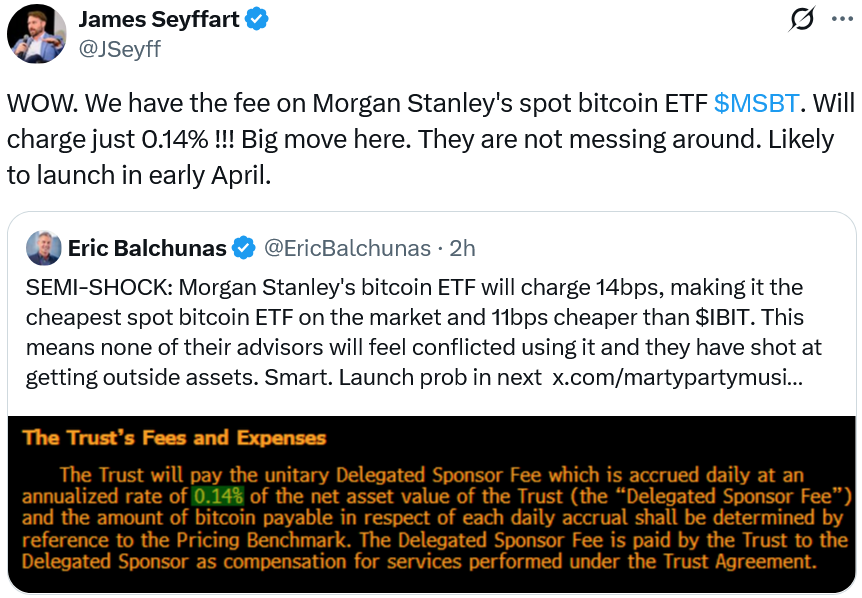
Source:_ James Seyffart_
Fellow Bloomberg ETF analyst Eric Balchunas said the low fee means that none of Morgan Stanley’s roughly 16,000 financial advisors — which manage $6.2 trillion in client assets — would feel conflicted in recommending the product to its clients.
Given that spot Bitcoin ETFs track the price movements of Bitcoin (BTC), Morgan Stanley’s ultra-low fee could spark a fresh fee war in the $83 billion market, putting immediate pressure on rivals to cut costs or risk losing assets.
Cointelegraph is committed to independent, transparent journalism. This news article is produced in accordance with Cointelegraph’s Editorial Policy and aims to provide accurate and timely information. Readers are encouraged to verify information independently. Read our Editorial Policy https://cointelegraph.com/editorial-policy
- #Cryptocurrencies
- #Politics
- #Business
- #NYSE
- #Fees
- #Morgan Stanley
- #Bitcoin ETF
- #Tokenization
- #Industry
- #Polymarket
Disclaimer: The information on this page may come from third parties and does not represent the views or opinions of Gate. The content displayed on this page is for reference only and does not constitute any financial, investment, or legal advice. Gate does not guarantee the accuracy or completeness of the information and shall not be liable for any losses arising from the use of this information. Virtual asset investments carry high risks and are subject to significant price volatility. You may lose all of your invested principal. Please fully understand the relevant risks and make prudent decisions based on your own financial situation and risk tolerance. For details, please refer to
Disclaimer.


