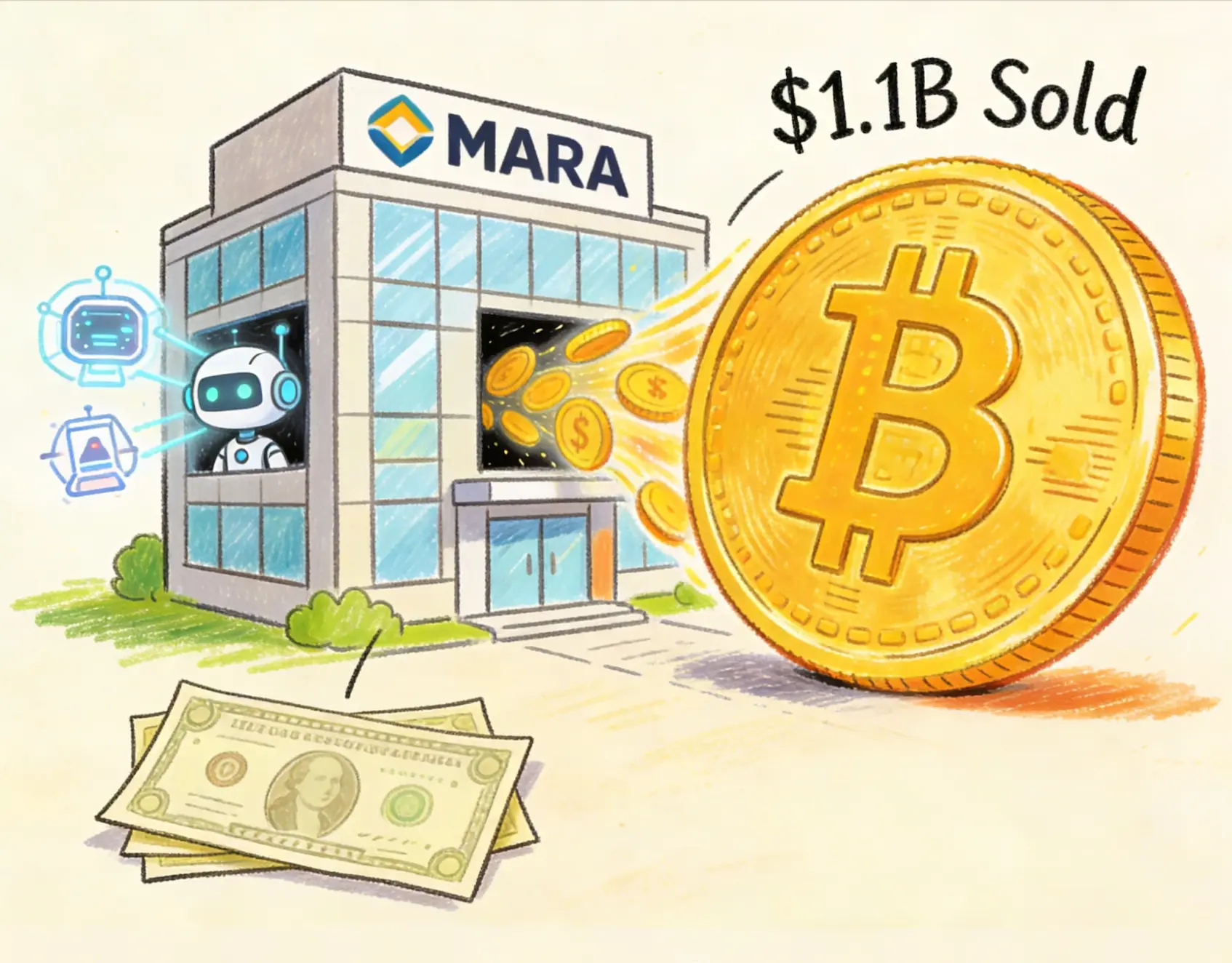
 MARA Holdings (NASDAQ: MARA), the world’s largest Bitcoin miner by market capitalization, announced on March 26, 2026, that it sold 15,133 bitcoin for approximately $1.1 billion between March 4 and March 25, while simultaneously repurchasing $913 million of its convertible notes at a discount to reduce outstanding indebtedness by roughly 30%.
The company now holds 38,689 bitcoin valued at approximately $2.3 billion, falling from the second to third position in corporate Bitcoin treasury rankings behind Strategy and Twenty One Capital. The move reflects a broader industry shift as miners pivot from pure-play Bitcoin mining to AI and high-performance computing (HPC) infrastructure amid squeezed margins following the 2024 halving.
Transaction Details
Bitcoin Sale and Debt Repurchase
MARA sold 15,133 bitcoin for an aggregate price of approximately $1.1 billion over a three-week period ending March 25. The company used proceeds to repurchase $367.5 million principal of its 0.00% Convertible Senior Notes due 2030 for $322.9 million and $633.4 million principal of its 2031 notes for $589.9 million. The repurchases captured approximately $88.1 million in value through cash savings before transaction costs, representing roughly a 9% discount to par value.
Balance Sheet Impact
Following the transactions, MARA’s outstanding convertible indebtedness will decrease from approximately $3.3 billion to $2.3 billion, a reduction of about 30%. The company now holds 38,689 bitcoin, down from 53,822 bitcoin held at the end of 2025.
Strategic Rationale
CEO Statement
Fred Thiel, MARA’s chairman and chief executive officer, stated: “Our decision to sell a portion of our bitcoin holdings reflects a strategic capital allocation move designed to strengthen our balance sheet and position the company for long-term growth. By retiring over $1 billion of face value debt at a discount, we captured approximately $88 million in value that would otherwise have been lost, reduced potential shareholder dilution, and leveraged our bitcoin holdings to meaningfully de-lever the balance sheet on our terms.” He added that the transaction “enhances financial flexibility and increases strategic optionality as we expand beyond pure-play bitcoin mining into digital energy and AI/HPC infrastructure.”
Industry Context
The pivot comes as mining economics have tightened following the April 2024 halving, which reduced block rewards to 3.125 bitcoin. Transaction fees have also collapsed as bitcoin increasingly moves into exchange-traded funds rather than trading on-chain. Bernstein analysts have noted that companies that could profitably mine at $50,000 per coin now struggle to break even at $100,000, with bitcoin currently trading near $69,000.
Broader Miner Shift to AI
Industry Trends
MARA’s sale is the largest example of a broader trend among publicly traded miners:
Core Scientific contracted 590 megawatts to AI cloud provider CoreWeave for 12 years in a deal expected to generate $10 billion in revenue
IREN is targeting over half a billion in annualized revenue from AI cloud services in 2026
CleanSpark appointed a senior vice president for AI data centers in October 2025, despite previous commitment to pure Bitcoin mining
Market Dynamics
Matthew Sigel, head of digital assets research at VanEck, noted in February that “the once-dominant AI trade has weakened,” adding that “this has had second-order effects on Bitcoin miners as financing conditions tightened alongside Bitcoin weakness,” forcing many to sell off more of their coins to fund their pivots.
Stock Performance
MARA shares traded at $8.50 on March 26, up approximately 3.5% on the day, according to Yahoo Finance.
Frequently Asked Questions
Why did MARA sell $1.1 billion worth of bitcoin?
MARA sold bitcoin to repurchase convertible debt at a discount, reducing outstanding indebtedness by approximately 30% and capturing roughly $88 million in value. The move also strengthens the company’s balance sheet as it expands beyond pure-play Bitcoin mining into AI and high-performance computing infrastructure.
How much bitcoin does MARA now hold?
Following the sale, MARA holds 38,689 bitcoin valued at approximately $2.3 billion, down from 53,822 bitcoin held at the end of 2025. The company now ranks third among corporate Bitcoin treasuries, behind Strategy and Twenty One Capital.
Why are Bitcoin miners pivoting to AI?
Mining economics have tightened following the April 2024 halving, which cut block rewards to 3.125 bitcoin, while transaction fees have collapsed as bitcoin trading moves off-chain. AI companies are willing to pay premium rates for power capacity, making the pivot economically attractive for miners with existing infrastructure.
Disclaimer: The information on this page may come from third parties and does not represent the views or opinions of Gate. The content displayed on this page is for reference only and does not constitute any financial, investment, or legal advice. Gate does not guarantee the accuracy or completeness of the information and shall not be liable for any losses arising from the use of this information. Virtual asset investments carry high risks and are subject to significant price volatility. You may lose all of your invested principal. Please fully understand the relevant risks and make prudent decisions based on your own financial situation and risk tolerance. For details, please refer to
Disclaimer.


