The central bank will focus on designing a regulatory framework for the so-called institutional VASPs, defined as organizations that operate infrastructure and provide crypto services to other institutions. The move would bring clarity to companies like Fireblock, Ripple, and Bitgo in the Brazilian market.
Brazil to Regulate Institutional VASPs by 2027
Brazil is advancing fast to bring clarity to all sectors of the crypto market, including Business-to-Business (B2B) interactions.
Local reports indicate that the Central Bank of Brazil will advance regulations regarding the operation of institutional virtual asset service providers (VASPs) in the country before 2027.
Institutional VASPs are defined as companies that construct, provide, and operate crypto infrastructure to serve other institutions, focusing their action on serving other businesses rather than end users.
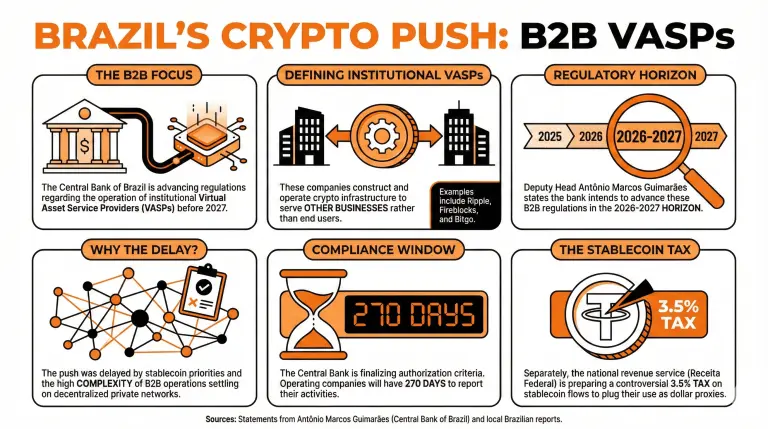
Companies like Ripple, which operates crypto-based payment networks; Fireblocks, which provides various crypto infrastructure products and services; and Bitgo, a custody provider, would fall under this classification.
During a live transmission, Antônio Marcos Guimarães, deputy head of the bank’s Regulation Department, stated that the bank would “intend to advance in the regulation of institutional VASPs (B2B)” in the 2026-2027 horizon.
Furthermore, he stated that the proposal to regulate these institutions’ activities was born of the bank’s public consultations. Nonetheless, other regulatory activities involving stablecoins and more pressing matters took the bank’s attention before this.
An element that has taken this regulatory push aback is the complexity of these businesses’ activities, as there is no brokerage between them, and transactions or deals are settled using decentralized private networks.
In addition, Guimarães added that the bank is finalizing the authorization criteria for companies operating in the country, which will have 270 days to report their activities.
Brazil has been hard at work regarding crypto regulation in 2026, having already streamlined new rules for banks entering the crypto market.
In addition, the national revenue service (Receita Federal) is reportedly preparing a controversial measure that would tax stablecoin flows with 3.5%, aiming to plug a loophole that allowed users and institutions to benefit from using these solutions as dollar proxies for payments and remittances.
FAQ
- What steps is Brazil taking towards crypto regulation?
Brazil is advancing regulations for institutional virtual asset service providers (VASPs) to clarify operations in the B2B sector before 2027.
- What defines an institutional VASP in Brazil?
Institutional VASPs are companies that provide and manage crypto infrastructure specifically to serve other businesses rather than individual users.
- What is the Central Bank’s timeline for these regulations?
Deputy head Antônio Marcos Guimarães indicated that the regulation of institutional VASPs is expected to progress during the 2026-2027 timeframe.
- Are there additional regulatory measures related to stablecoins?
Yes, Brazil’s national revenue service is preparing to implement a 3.5% tax on stablecoin flows to close a loophole in their use as dollar proxies for payments.
Disclaimer: The information on this page may come from third parties and does not represent the views or opinions of Gate. The content displayed on this page is for reference only and does not constitute any financial, investment, or legal advice. Gate does not guarantee the accuracy or completeness of the information and shall not be liable for any losses arising from the use of this information. Virtual asset investments carry high risks and are subject to significant price volatility. You may lose all of your invested principal. Please fully understand the relevant risks and make prudent decisions based on your own financial situation and risk tolerance. For details, please refer to
Disclaimer.
Related Articles
Thailand’s SEC plans to bring the hidden funding parties behind crypto companies into shareholder oversight reviews
The Thai Securities and Exchange Commission proposes bringing into regulation the sources of funds behind crypto-asset company shareholders, aiming to curb hidden capital flows and the infiltration of illegal funds. This proposal includes reviews for both directly and indirectly supporting parties, and for shareholders of government-related entities, it only examines their shareholdings.
GateNews3h ago
Thailand proposes tighter scrutiny of funders behind crypto firms
Thailand’s securities regulator is seeking to curb money laundering and technology-related crimes by tightening funding rules for cryptocurrency companies.
The Securities and Exchange Commission of Thailand (Thai SEC) on Monday proposed expanding approval requirements for crypto businesses to
Cointelegraph3h ago
South Korea takes away exchange discretion in a major anti-phishing crackdown
South Korea's financial regulators have mandated that all domestic crypto exchanges implement a uniform withdrawal delay system to combat voice phishing scams. This decision removes prior flexibility for platforms in managing withdrawal exceptions, aiming to give victims time to reconsider transactions.
CoinDesk3h ago
White House CEA: Banning stablecoin yields will have little to no impact on community banks; USDC rewards can still be profitable
The White House Council of Economic Advisers released a report stating that prohibiting crypto companies from offering stablecoin yield will have a negligible impact on community banks, with traditional loan growth of only 0.02%. The report said the ban deprives consumers of competitive returns and reflects tensions between the crypto industry and banking. The conclusion differs significantly from the risks warned by the Community Bankers Association, and could have potential effects on the market and investors.
GateNews4h ago
U.S. SEC Chair Terminates “Enforcement-Style Regulation,” Says 7 Crypto Cases from the Previous Administration Were a Misallocation of Resources
Gate News update: On April 8, U.S. Securities and Exchange Commission (SEC) Chair Paul Atkins announced that he has ended “enforcement-led regulation,” and said that the seven crypto-related registration cases brought by the previous administration were a “misallocation of resources,” providing no direct benefit to investors.
GateNews4h ago


