
- Ethereum has unveiled a ‘trillion dollar security dashboard’ that displays the network’s strengths and where it can improve across six security dimensions.
- These include user experience and infrastructure, where it ranks highly, as well as incident response and the social layer, where it has room for improvement.
The Ethereum Foundation has unveiled the ‘trillion dollar security dashboard,’ a new initiative that showcases the network’s six most important dimensions, displaying what it has excelled on and what needs to improve.
In its announcement on X, the Foundation called on the network’s developers to pitch in with their feedback and contributions to make the dashboard better.
Now live: One Trillion Dollar Security Dashboard
A comprehensive view of Ethereum’s security across the ecosystem by the Ethereum Foundation. pic.twitter.com/dtWvz0ueAh
— Ethereum Foundation (@ethereumfndn) February 5, 2026
Many users welcomed the initiative, lauding the network for being transparent enough to admit that it had some insufficiencies which need improvement.
The dashboard displays Ethereum’s six most important dimensions: user experience, smart contracts, infrastructure and cloud security, consensus protocol, monitoring and incident response, and social layer and governance.
It’s the latest effort to boost Ethereum adoption as the Foundation works with other stakeholders to cement the network’s position as the ultimate smart contract protocol. As we reported, the core developers have started work on the Hegota upgrade, which is scheduled to take priority once the Glamsterdam upgrade is implemented this year. The network has also welcomed ERC-8004, a new standard for agentic AI interaction and communication in a trustless environment.
Ethereum’s Trillion Dollar Dashboard
The Foundation says that the dashboard, “makes Ethereum’s security measurable, drives and communicates its security posture across the entire ecosystem — ensuring it can scale as neutral, open infrastructure for the internet and global economy.”
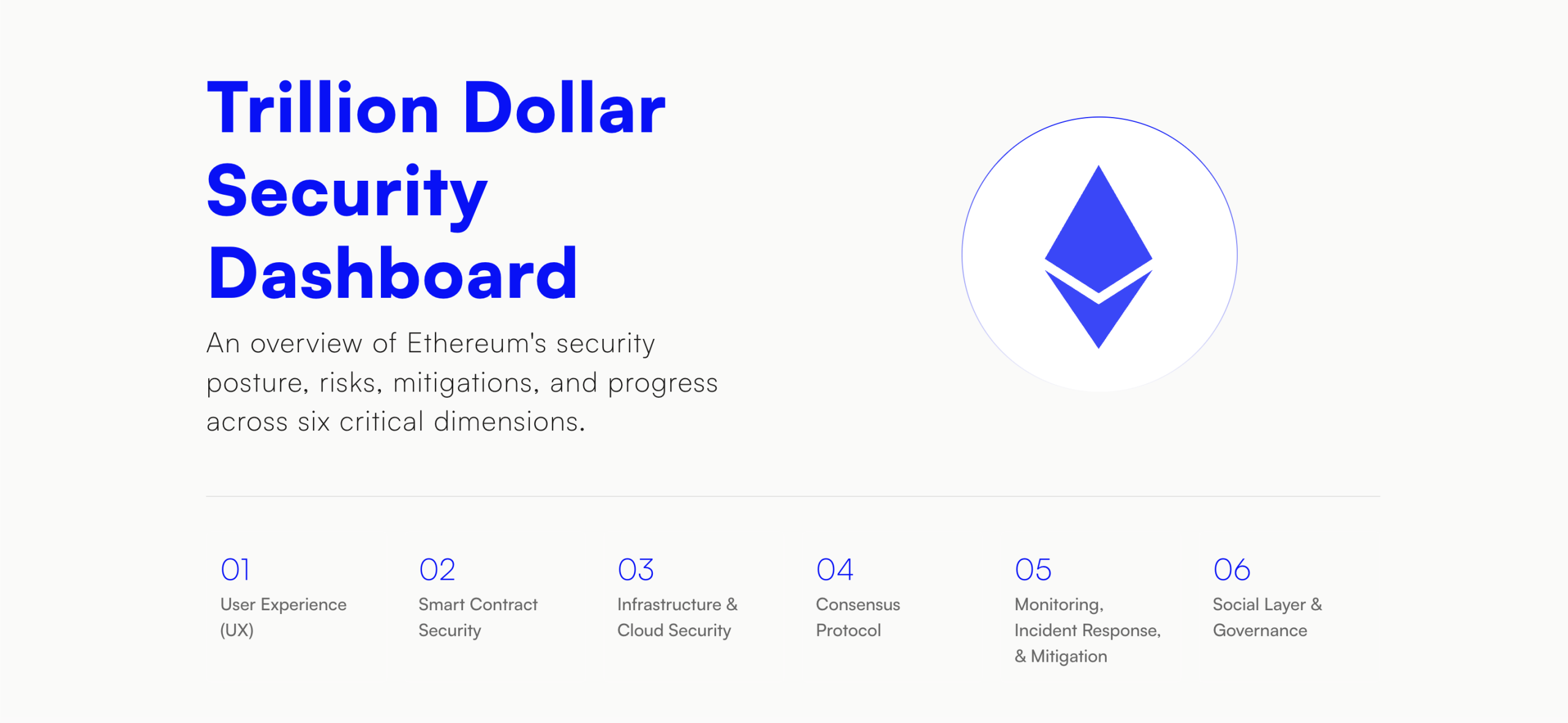
Image courtesy of Trillion Dollar Security.
On user experience, the Foundation acknowledged the importance of user-facing security surfaces, saying they directly shape security outcomes. These include key management, privacy, permissions and transaction readability. The Foundation believes the network has performed well in this area with 29 controls across all stages, with 13 ongoing and 8 in research.
On smart contract security, it claims to have 13 controls across all stages, four being live. The priority work in this area is the Verifier Alliance, which provides easy and unified access to the source-code for EVM contracts, and whose members include Blockscout and Routescan.
Smart contracts are especially vulnerable because logic errors, upgrade mechanisms and privileged roles can be exploited long after deployment. Developers also get to rewrite the custom security modules for their projects, which can introduce latent bugs.
Consensus protocol security is also critical for Ethereum, and the network currently has 15 controls. While client distribution is publicly monitored, one client has previously exceeded the 33% threshold, risking centralization. Relying on a single client “increases the risk of correlated failures that threaten liveness or safety.”
There has also been a concentration of staking power among a small set of validators which can lead to coordinated failure risk and increase the chances of censorship.
Disclaimer: The information on this page may come from third parties and does not represent the views or opinions of Gate. The content displayed on this page is for reference only and does not constitute any financial, investment, or legal advice. Gate does not guarantee the accuracy or completeness of the information and shall not be liable for any losses arising from the use of this information. Virtual asset investments carry high risks and are subject to significant price volatility. You may lose all of your invested principal. Please fully understand the relevant risks and make prudent decisions based on your own financial situation and risk tolerance. For details, please refer to
Disclaimer.
Related Articles
Ethereum Foundation Researcher: The execution ticket mechanism converts MEV revenue into protocol burn, returning the validator’s role to pure staking
The Ethereum Foundation’s Barnabé Monnot introduced an “execution tickets” mechanism at the EthCC conference. The goal is to reduce block proposer monopolistic power by using a protocol auction for transaction execution and ordering rights, thereby increasing transparency and fairness. The revenue from execution tickets will be directly burned, ensuring that MEV profits are fairly distributed to all ETH holders, and lowering the participation barrier for home stakers. This mechanism is a core proposal of the Ethereum roadmap’s “Scourge” phase, and it will effectively prevent transaction censorship.
GateNews1h ago
ETH 15-minute drop of 0.78%: A pullback triggered by a short-term long position liquidation and a surge in trading volume converging in tandem
2026-04-01 13:30 to 13:45 (UTC), over a 15-minute period ETH’s return rate is -0.78%, and the price range fluctuates from 2109.18 to 2135.43 USDT, with a swing of 1.23%. Market attention has increased, local volatility has intensified, short-term capital battles are noticeably more pronounced, and spot and derivatives trading volumes on major exchanges have expanded in parallel.
The main driving force behind this unusual move is a localized surge in short-term trading volume, along with concentrated selling and the passive triggering of stop-loss orders, which caused ETH’s price to dip in the short term. At the same time, some long positions were also passively liquidated at key price levels; although they still maintained a certain degree of resilience, the overall market sentiment showed increased caution and risk aversion.
GateNews1h ago
Ethereum privacy framework Kohaku integrates Helios light client and TEE technology
Vitalik Buterin and Nicolas Consigny presented new progress on Kohaku, a privacy framework, at the EthCC conference, emphasizing the capabilities of integrating the network layer, the hardware layer, and light clients. By directly integrating the Helios light client into a wallet SDK, Kohaku enables user self-verification, protects privacy, and introduces an automated privacy routing mechanism, improving privacy and security within the Ethereum ecosystem.
GateNews1h ago


