Bitcoin’s latest stumble has caught the attention of several crypto desks, with Galaxy Digital’s Alex Thorn warning that mounting technical and onchain signals suggest prices may still have room to fall.
Thorn Sees More Bitcoin Pain Before a Bottom
As of Monday, Feb. 2, 2026, bitcoin was trading at $78,640 per coin, roughly 37.6% below its all-time high above $126,000 set in early October 2025. In a research note summarized publicly on X, Alex Thorn, head of firmwide research at Galaxy Digital, said the market’s recent behavior points to additional downside risk.
Thorn said the analysis was circulated to Galaxy clients Sunday before being posted online, framing the move as an update rather than a hot take. His core argument is straightforward: bitcoin has lost key technical levels, while onchain data shows limited signs of aggressive dip-buying.
Bitcoin’s late-January selloff saw prices slide sharply, including a steep weekend drop that triggered more than $2 billion in long liquidations across futures venues, according to Galaxy’s report. The move briefly pushed bitcoin below several widely watched cost bases, including the average entry price for U.S. spot bitcoin exchange-traded funds (ETFs).
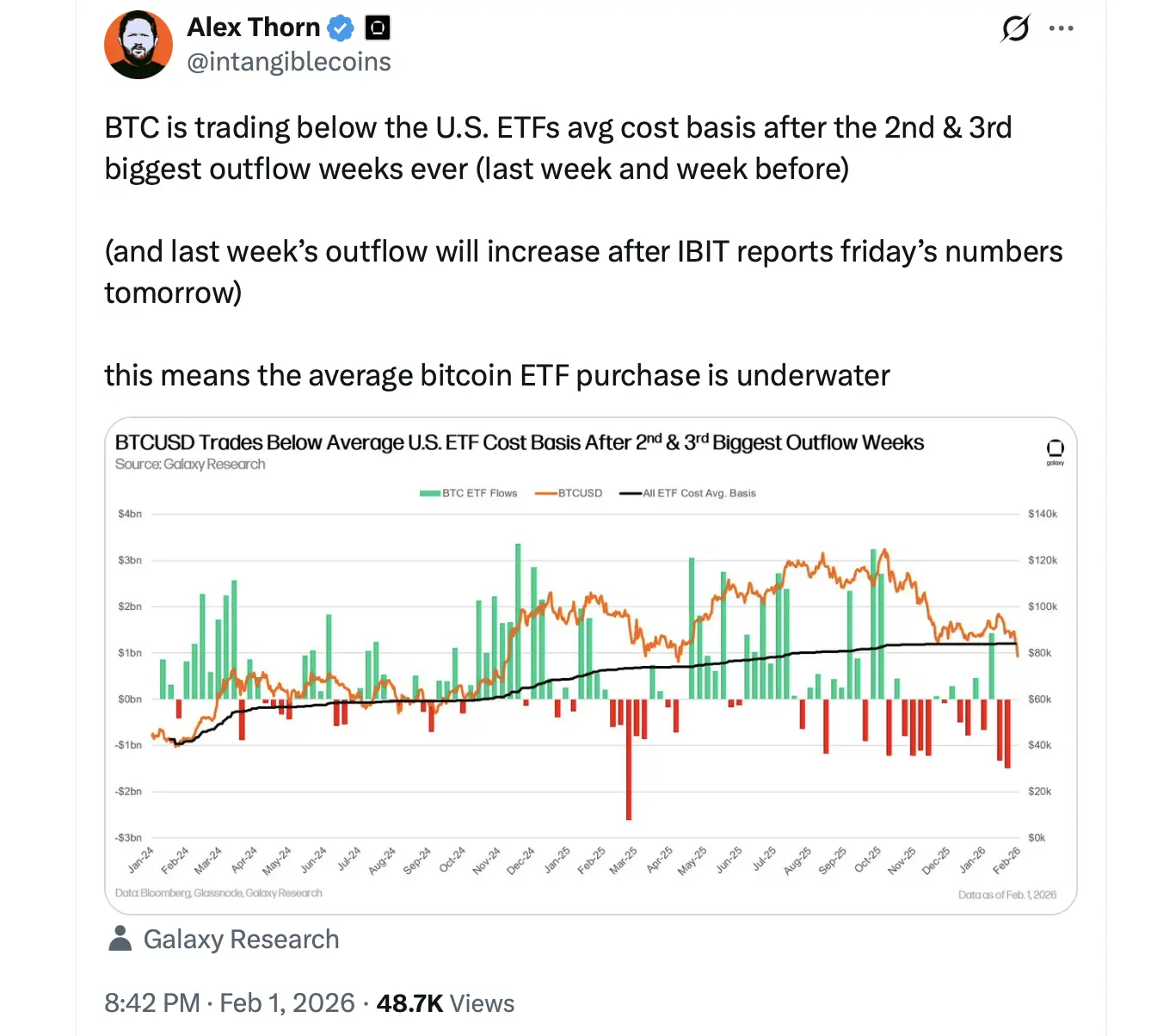
Thorn noted that bitcoin has now logged four consecutive red monthly closes, a pattern last seen in 2018. Historically, similar drawdowns from all-time highs have often extended further before finding durable support, he wrote.
One focal point in the analysis is the so-called supply gap between roughly $70,000 and $80,000, where relatively few coins last changed hands onchain. Thorn argues that thin ownership in this range could make it easier for prices to drift lower as the market searches for demand.
Galaxy’s data also shows nearly 46% of bitcoin’s circulating supply is currently held at a loss, a figure that has tended to rise toward a near-even split at prior cycle bottoms. That convergence, while not yet complete, is moving in that direction.
Macro conditions add another layer of pressure. Thorn pointed out that bitcoin has underperformed traditional hedges such as gold and silver in recent months, dulling its appeal during a period of heightened geopolitical and economic uncertainty.
Still, the note stops well short of calling a crash. Thorn emphasized that levels near bitcoin’s realized price and its 200-week moving average—both in the high-$50,000 range—have historically attracted long-term buyers. If prices slide toward those areas, they could again serve as accumulation zones, he said.
For now, the message from Galaxy’s research desk is cautious rather than catastrophic: the trend looks heavy, catalysts are scarce, and patience may be required before bitcoin finds firmer footing.
FAQ ❓
- **Why does Galaxy think bitcoin could fall further?**Galaxy’s analysis cites broken technical levels, weak accumulation signals, and onchain supply gaps that may allow prices to drift lower.
- **What price levels are being watched as potential support?**The report highlights bitcoin’s realized price and 200-week moving average in the high-$50,000 range as key long-term areas.
- **How far is bitcoin from its all-time high?**As of Feb. 2, 2026, bitcoin is about 37.6% below its October 2025 peak above $126,000.
- What onchain trend suggests a potential bottom may be forming later?
The report shows long-term holder profit-taking has slowed, a pattern seen near prior cycle lows.
Disclaimer: The information on this page may come from third parties and does not represent the views or opinions of Gate. The content displayed on this page is for reference only and does not constitute any financial, investment, or legal advice. Gate does not guarantee the accuracy or completeness of the information and shall not be liable for any losses arising from the use of this information. Virtual asset investments carry high risks and are subject to significant price volatility. You may lose all of your invested principal. Please fully understand the relevant risks and make prudent decisions based on your own financial situation and risk tolerance. For details, please refer to
Disclaimer.
Related Articles
USD/JPY Hits 160 Again – Is a Bitcoin Crash Coming Next?
_USD/JPY crosses 160 for the first time since July 2024, raising attention from global investors._
_July 2024 BOJ intervention dropped USD/JPY 20 points, Bitcoin 30%, and S&P 500 10%._
_Strengthening yen raises borrowing costs for leveraged investors, affecting stocks and crypto
LiveBTCNews32m ago
The cryptocurrency fear index has dropped to 9, with the market continuing to maintain "extreme fear."
The current cryptocurrency market fear and greed index has dropped to 9, indicating extreme fear in the market, well below yesterday's 12 and last month's average of 13. This index consolidates multiple indicators to assess market sentiment.
BlockBeatNews1h ago
Bitcoin Sell-Off Reveals Whale-Driven Rotation as Retail Capitulates and Leverage Resets
_Whales drove the sell-off, absorbed liquidity, while retail exited and leverage flushed across the market._
Bitcoin’s recent price action points to a calculated liquidity event rather than broad market weakness. A sharp decline initially appeared tied to macro uncertainty, but the underlying
LiveBTCNews2h ago
CEO of Goldman Sachs admits to holding Bitcoin amid accelerating institutionalization
David Solomon, CEO of Goldman Sachs, acknowledged holding a small amount of Bitcoin in February 2026, contrasting with his 2024 stance of viewing it as speculative. This reflects Wall Street's deepening involvement in crypto, amid legal constraints. The positive community reaction suggests a normalization of Bitcoin among affluent individual and institutional investors.
TapChiBitcoin2h ago
Since the "1011 crash," the BTC ETF has recovered $3 billion in outflows, and the fund flows for the year are close to flat.
According to Bloomberg's data, from October 2025 to the end of February 2026, Bitcoin ETF saw an outflow of approximately $9 billion, with about $3 billion recovered so far. Although the overall net outflow still exceeds $6 billion, the inflow and outflow of funds in 2026 have nearly balanced out.
GateNews2h ago


