- Bitcoin and SaaS declines are driven by US liquidity constraints, not broken markets.
- Resolution of the US government shutdown could restore liquidity and ease market pressure.
- Full-cycle investing favors patience; time matters more than short-term crypto price swings.
Macro investor Raoul Pal has dismissed claims that Bitcoin and crypto are fundamentally broken. In a detailed analysis shared over the weekend, Pal revealed a surprising connection between Bitcoin’s decline and SaaS stocks.
The Real Vision founder addressed growing concerns about the current market downturn. His findings point to US liquidity issues rather than structural problems with digital assets.
US Liquidity Constraints Drive Market Decline
Pal discovered that Bitcoin and the UBS SaaS Index show nearly identical chart patterns. This revelation challenges the narrative that crypto has uniquely failed during this cycle.
The macro analyst explained that US liquidity has been constrained by two government shutdowns.
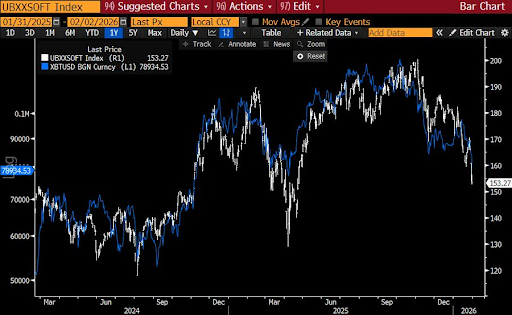
Bitcoin and the UBS SaaS Index show nearly identical patterns, Source: X
Treasury General Account rebuilding in July and August created additional drains. The Reverse Repo facility essentially completed its drawdown in 2024, removing a crucial monetary offset.
“Those are both the longest duration assets that exist,” Pal noted regarding Bitcoin and SaaS stocks. Both asset classes faced discounting because liquidity was temporarily withdrawing from the system.
Gold Rally Absorbed Available Liquidity
The recent gold rally played a significant role in the liquidity crunch. According to Pal, gold essentially absorbed all marginal liquidity that would have flowed into Bitcoin and SaaS.
The market lacked sufficient liquidity to support all these assets simultaneously. Consequently, the riskiest assets took the hardest hits during this period.
Pal emphasized that the current government shutdown represents the final liquidity hurdle. Treasury hedged against this shutdown by not drawing down the TGA after the previous one.
Instead, officials added more to it, creating another liquidity drain.
Fed Policy Shifts Expected Under New Leadership
Pal addressed what he called false narratives about potential Fed Chair Kevin Warsh. Many commentators have labeled Warsh as hawkish based on outdated statements from 18 years ago.
The macro investor explained that Warsh’s mandate involves running the Greenspan-era playbook. This approach means cutting rates and letting the economy run hot.
The strategy assumes AI productivity gains will keep core inflation subdued, similar to the 1995-2000 period.
“Warsh will cut rates and do nothing else,” Pal stated. He expects the incoming Fed chair to facilitate Trump and Treasury Secretary Bessent’s liquidity plans.
https://t.co/M5mLAi3XLA
— Raoul Pal (@RaoulGMI) February 1, 2026
Recovery Timeline and Market Outlook
Pal acknowledged his team missed the shift from Global Total Liquidity to US Total Liquidity dominance. Typically, Global Total Liquidity shows the highest correlation to Bitcoin and tech stocks over full cycles.
However, US Total Liquidity currently drives market dynamics because America remains the key global liquidity provider. The confluence of events, Reverse Repo drain, TGA rebuild, shutdowns, and gold rally, created unforeseen impacts.
Once the current shutdown resolves, Pal expects several liquidity catalysts to activate. These include the eSLR reduction, partial TGA drain, fiscal stimulus, and rate cuts. Political considerations around mid-term elections should accelerate these moves.
The Real Vision founder noted that smaller tokens typically fall 70% when Bitcoin drops 30%. High-quality projects generally recover faster once liquidity conditions improve.
Pal maintained his bullish stance for 2026, citing confidence in the Trump-Bessent-Warsh policy framework. He stressed that patience matters more than short-term price action in full-cycle investing.
The macro analyst concluded by urging investors not to abandon positions during temporary air pockets. Market resolution depends more on time than price in complete cycle trades.
Disclaimer: The information on this page may come from third parties and does not represent the views or opinions of Gate. The content displayed on this page is for reference only and does not constitute any financial, investment, or legal advice. Gate does not guarantee the accuracy or completeness of the information and shall not be liable for any losses arising from the use of this information. Virtual asset investments carry high risks and are subject to significant price volatility. You may lose all of your invested principal. Please fully understand the relevant risks and make prudent decisions based on your own financial situation and risk tolerance. For details, please refer to
Disclaimer.
Related Articles
Solana and XRP Slide Continues — New $100 BTC Reward Model Keeps Rising
SOL entered 2026 above $140 and has spent the first quarter giving most of that back. The asset is currently consolidating between $85 and $90 inside a rising wedge pattern that technical analysts flag as pointing toward further downside — a formation that typically signals weakening recovery
CryptoPotato1m ago
Arkham: Satoshi Nakamoto holds approximately 1.096 million BTC, followed closely by major exchanges, ETF issuers, governments, and publicly traded companies.
As of the beginning of 2026, Satoshi Nakamoto is still the world’s largest Bitcoin holder, holding about 1.096 million BTC. Other major holders include exchanges, ETF issuers, and governments, and the holdings of BlackRock and the U.S. government are both significant.
GateNews8m ago
'Extreme Fear' on Cryptocurrency Market: XRP, Ethereum, Bitcoin and Others Under Immense Pressure - U.Today
Major assets follow fear
Market will not stabilize
The Fear and Greed Index is currently printing single-digit values, indicating that the cryptocurrency market is deep in extreme fear. That type of reading indicates widespread risk aversion, forced selling and a lack of confidence among
UToday31m ago
Analyst: The key resistance level for Bitcoin is $72,500, which may continue to face pressure in the coming months.
CryptoQuant analyst Darkfost stated that Bitcoin's failure to return to the realized price of $72,500, excluding long-term inactive supply, may face continued downward pressure, having historically remained below this level for 6 to 10 months during bear markets.
BlockBeatNews49m ago
Bitcoin Faces Extended Weakness Below Key Cost Basis
Bitcoin struggles below the key $72.5K realized price, indicating resistance and consistent selling pressure. Recent price action highlights weak recovery signs with potential further declines if support at $66K fails.
CryptoFrontNews56m ago


