Article by: willthetrill
Translated by: Chopper, Foresight News
Is the cryptocurrency industry’s hiring market already saturated? The answer is both yes and no. Although there have been scattered layoffs in December, overall, the hiring momentum in the fourth quarter remains strong.
To uncover the truth, I specifically retrieved data from major vertical recruitment websites in the crypto industry during the first two weeks of January 2026 (excluding official corporate recruitment pages). The results show that only 85-90 new independent positions were added during this period.
The start of this year has been quite quiet. In contrast, the data from January 2025 was quite impressive, with as many as 1,192 positions posted in that month alone, making it the month with the highest recruitment volume of 2025.
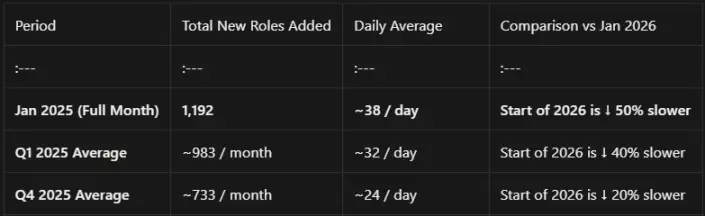
Data as of January 12, 2026
In the first two weeks of January 2025, the average daily job postings were about 38; in the same period in 2026, the average daily postings dropped to only about 6.5.
Recruitment activity at the beginning of January declined by approximately 80% compared to the same period last year. This data confirms the widespread market speculation: the industry’s start this year is far less heated than last year.
Based on the detailed analysis of the above job data, the main characteristics of the current recruitment market are as follows:
- Job Type Distribution: 60% technical/engineering roles, 40% non-technical/market expansion roles.
- Seniority Distribution: About 65% of positions are mid-to-senior level, including specialists, senior specialists, managers, and department heads. This indicates that companies are prioritizing recruiting experienced talent to lead core product development and key projects related to business growth.
- Experience Requirements: Most positions require candidates to have over 5 years of relevant experience; management roles typically require over 7 years.
When screening and interviewing candidates, I often ask: what currently attracts you to join the crypto industry? The answers usually boil down to two: market prediction and stablecoins. Therefore, it’s not surprising that about 60% of recruitment demand is concentrated in infrastructure teams, stablecoin projects, and payment/fintech infrastructure startups. Additionally, the talent war between platforms like Kalshi and Polymarket continues, and this competition is expected to persist.
The most aggressive hiring actions currently come from companies in the growth stage (i.e., those that have completed Series A funding or above). A quick look at several companies’ recruitment pages and Ashby platform information also confirms this conclusion.
- Series A funded companies: Lifi Protocol has 13 open positions, Privy IO (acquired) has 10, Crossmint has 10, Coinflow Labs has 14;
- Series B funded companies: TurnkeyHQ has 12 open positions;
- Series C funded companies: Raincards has 49 open positions;
- Series D funded companies: Anchorage has 66 open positions.
However, perhaps more intriguing is the change in talent flow.
I have been working full-time in crypto industry recruitment for five years and can’t help but wonder: “Has there ever been a public chain ecosystem that, like Solana, challenged Ethereum’s dominance in recruitment and developer growth?” The answer is: no, at least never on such a scale.
Looking back, other public chains like Polkadot and Cosmos have experienced phases of rapid developer growth, but they have never managed to make an impact comparable to Ethereum in market share and sustained recruitment scale.
Solana is the first ecosystem with real strength to rival Ethereum. In 2024, it set a historic record: for the first time since 2016, the proportion of new contributing developers exceeded that of Ethereum. Solana attracted over 22% of new developers in the crypto industry, while Ethereum’s share was about 16%. This phenomenon is quite rare; historically, Ethereum has almost monopolized the majority of new talent.
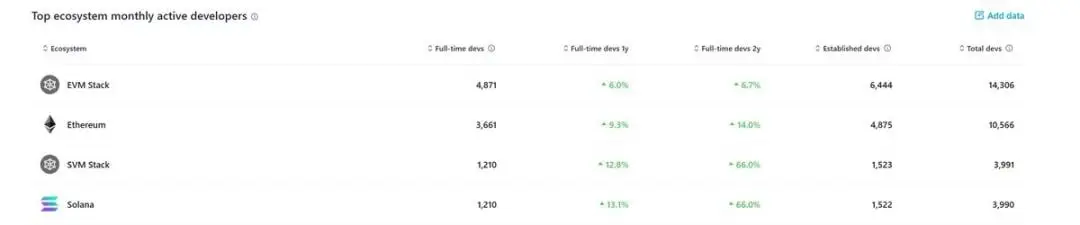
Data source: Electric Capital “Developer Report,” as of January 14, 2026
In the third quarter of 2025 alone, 23 Solana ecosystem projects completed funding, raising a total of $211 million, a 70% year-over-year increase in ecosystem funding.
For example: when a project completes a $13.5 million funding round (such as Raikucom in Q3 2025), its primary task is to recruit 5-10 senior engineers to build the core engineering team and market expansion team. These roles are often not listed on public recruitment sites but are recruited through investor/angel investor networks, hackathon events, and targeted headhunting.
The crypto industry is continuously evolving, and the landscape of the recruitment market will also change accordingly. Through token issuance, crypto technology has driven the maximization of internet capital markets, but the reality is that most tokens issued in the past two years have seen declining prices.
I believe that in 2026, the chain reaction of this phenomenon will gradually become apparent, affecting corporate risk financing methods, market expansion strategies, and of course, talent recruitment strategies.
Projects that stand out this year will be those with solid business fundamentals, a genuine user base, solutions to real needs, and most importantly, the ability to generate revenue.
Disclaimer: The information on this page may come from third parties and does not represent the views or opinions of Gate. The content displayed on this page is for reference only and does not constitute any financial, investment, or legal advice. Gate does not guarantee the accuracy or completeness of the information and shall not be liable for any losses arising from the use of this information. Virtual asset investments carry high risks and are subject to significant price volatility. You may lose all of your invested principal. Please fully understand the relevant risks and make prudent decisions based on your own financial situation and risk tolerance. For details, please refer to
Disclaimer.
Related Articles
Vitalik praises AI model Qwen 35B: analyzes Willans formula in under 3 minutes
Ethereum co-founder Vitalik Buterin praised the mathematical analytical capabilities of AI model Qwen 35B, particularly its performance in parsing the Willans formula. He was impressed by the model's ability to complete complex calculations in a short timeframe and called its approach of combining modular arithmetic with elementary functions very cool.
GateNews57m ago
Ethereum Spot ETF saw net outflows of $41.9715 million yesterday, marking three consecutive days of capital outflows
March 22 News: Ethereum spot ETFs experienced a net outflow of $41.9715 million on March 20, marking the third consecutive day of capital outflows. Among these, BlackRock's Staked ETH ETF had a net inflow of $5.4658 million, while BlackRock's ETF ETHA saw a net outflow of $31.4508 million. Currently, Ethereum spot ETFs have total net assets of $12.328 billion, with cumulative net inflows of $11.729 billion throughout history.
GateNews2h ago
A certain whale withdrew 1,979 ETH from a certain CEX 1 hour ago, worth 4.16 million USD.
Gate News: On March 22, according to Onchain Lens monitoring, a whale withdrew 1979 ETH from a certain CEX 1 hour ago, valued at $4.16 million. Over the past month, the whale has cumulatively withdrawn 8662 ETH through the exchange, with a total value of $18.23 million.
GateNews2h ago
Resolv Attacker Spent 200,000 USDC to Mint 80 Million USR, Already Purchased 9,111 ETH
Onchain Lens detected that the Resolv attacker spent 200,000 USDC to mint 80 million USR and has already used it to purchase 9,111 ETH. The attacker is still converting USR to other cryptocurrencies and may continue to accumulate ETH.
GateNews2h ago
Attacker has bought in 4.55 million dollars of ETH
Gate News Report: On March 22, on-chain analyst Ai Auntie posted an analysis on X platform regarding the Resolve attacker's operations: 1. Minted 50 million USR tokens using 100,000 USDC; 2. Converted 35 million USR to wstUSR; 3. Continuously exchanged wstUSR for USDC and USDT; 4. Used USDT to purchase
GateNews3h ago
CFTC clarifies cryptocurrency margin rules: BTC and ETH capital deduction rate of 20%, permitting investment in the derivatives market
The U.S. Commodity Futures Trading Commission (CFTC) recently released an FAQ clarifying the rules for using cryptocurrencies as margin in derivatives markets, specifically setting capital deduction rates of 20% for Bitcoin and Ethereum and 2% for stablecoins. The pilot program will be limited to three coin types in the first three months, after which it will expand to additional cryptocurrencies and relax reporting requirements. Qualifying crypto assets may be used as margin, marking a gradual acceptance of blockchain assets within the U.S. financial system.
動區BlockTempo3h ago


