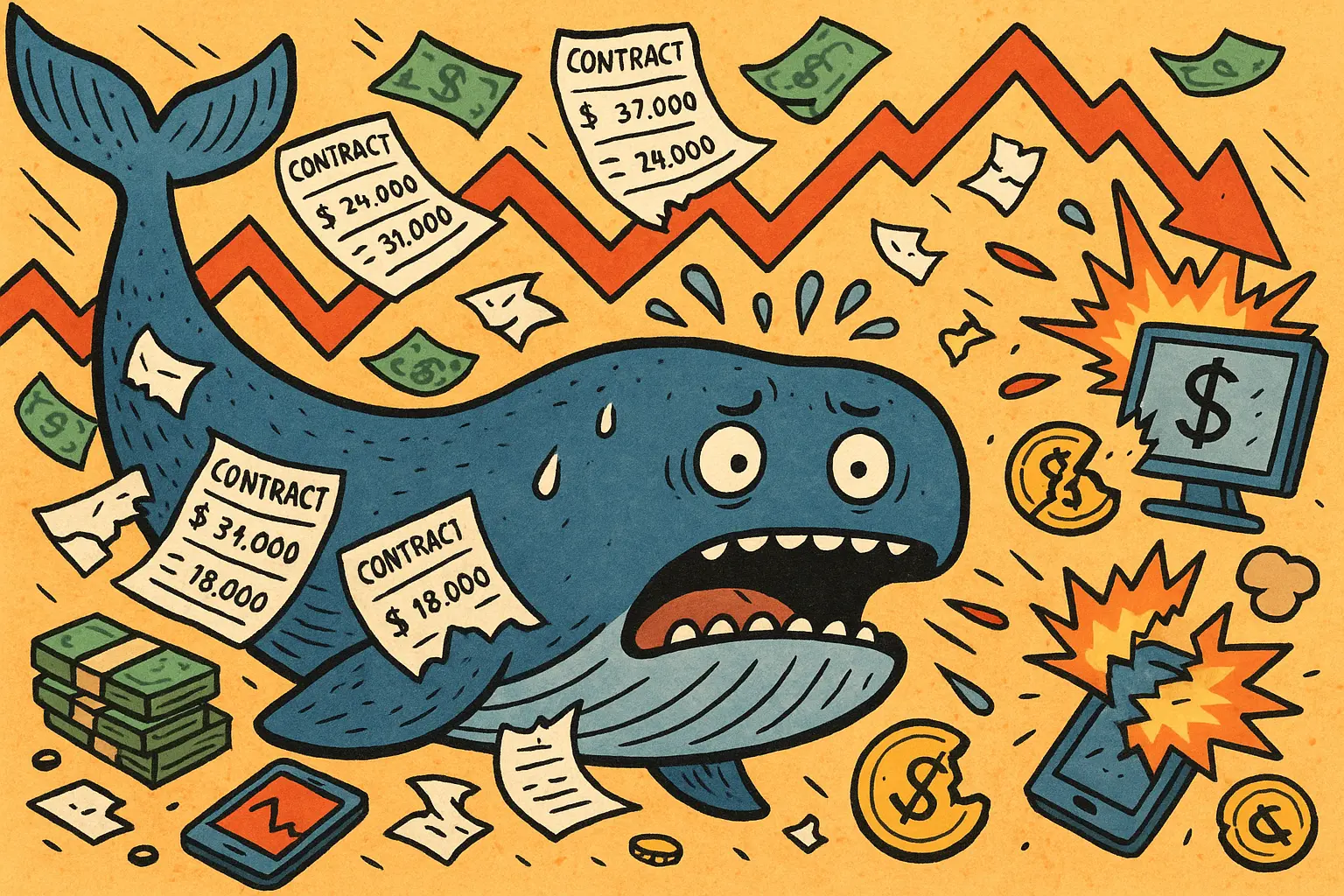
According to data from on-chain monitoring platform Hyperinsight, a whale address known for repeatedly chasing breakouts to build positions and shorting after drops (0x965) was hit by another round of cascading liquidations on April 3. That day, S&P500 longs, TAO longs, and the BRENTOIL short collectively liquidated for $23.85 million. Looking back over the past 7 days, the address has triggered 37 liquidation events in total, with an aggregate size of up to $116 million.
The Latest Wave of Liquidations: S&P500 Long Wipes Out the Highest Single Intra-Day Amount on the Whole Network
The liquidation on April 3 involved three positions with different directions being forcibly closed at the same time. The S&P500 long liquidation amount was $17.3 million, making the single position the largest liquidation address on the entire network for that day. In the same round, the TAO long and the BRENTOIL short were also sequentially tagged to their liquidation prices, and the three trades totaled $23.85 million.
After the liquidations were completed, the address immediately injected another $0.91 million into Hyperliquid and rebuilt new positions. This behavior continues its fixed operating pattern from prior instances—adding funds immediately after liquidation and then reopening positions.
Full Picture of Weekly Liquidations: Analysis of Behavior Behind 37 Liquidations
Over the past 7 days, the address repeatedly operated across multiple underlying assets including BTC, ETH, HYPE, S&P500, and BRENTOIL, triggering a total of 37 liquidation events, with an aggregate size of $116 million. Its core behavior characteristics can be summarized as follows:
Cycle Liquidation Pattern: After each liquidation, new capital is injected again, which is then used to re-establish high-leverage positions on the same or closely related underlying assets, forming a continuous loop of “liquidation—adding margin—then liquidation again.”
High Liquidation Frequency Caused by Directional Bias: The timing for opening positions often comes after the market experiences major volatility. The address tends to go long on assets that have already surged significantly, or short on assets that have already dropped significantly. This leads to relatively high position costs, so even a minor pullback triggers forced liquidation.
The $116 million cumulative liquidation size over the week makes this address a highly followed case among the on-chain monitoring community.
Current Position Status and Liquidation Risk
As of the time of posting, the whale has shifted its focus toward BTC and ETH longs. It has again opened a high-leverage position with a size of $11 million; its current unrealized loss is already 46%. If the market continues to fall, the key trigger prices for the next round of forced liquidation are as follows:
BTC Liquidation Price: $66,042
ETH Liquidation Price: $2,022
Once the above levels are broken, the address will face its 38th liquidation event this week.
Frequently Asked Questions
What is liquidation?
Liquidation refers to the mechanism in crypto leveraged trading where, when the market price moves in an unfavorable direction by a certain amount and the account margin falls below the maintenance margin requirement, the trading platform forcibly closes the position. The position holder will lose part or all of the margin they have deposited.
Why does this whale keep getting liquidated but continues adding to its positions?
Based on on-chain data, the address shows a directional bias toward chasing pumps to go long and chasing drops to go short. Combined with high-leverage operations, even a small price pullback triggers liquidation. After liquidation, the continued injection of new capital and reopening positions causes liquidation events to repeat at high frequency. In on-chain analysis, this kind of behavior is often used as a cautionary example to illustrate systematic risks from pairing high leverage with low-quality entry timing.
Do large liquidations on Hyperliquid affect the market?
On decentralized perpetual contract platforms like Hyperliquid, when large positions are forcibly liquidated, if the liquidation size exceeds the platform’s insurance fund capacity, it may trigger the ADL (automatic deleveraging) mechanism. This would cause traders holding opposite positions to passively bear part of the loss, creating a short-term impact on the market’s overall liquidity structure.
Disclaimer: The information on this page may come from third parties and does not represent the views or opinions of Gate. The content displayed on this page is for reference only and does not constitute any financial, investment, or legal advice. Gate does not guarantee the accuracy or completeness of the information and shall not be liable for any losses arising from the use of this information. Virtual asset investments carry high risks and are subject to significant price volatility. You may lose all of your invested principal. Please fully understand the relevant risks and make prudent decisions based on your own financial situation and risk tolerance. For details, please refer to
Disclaimer.


