In the crypto market, trading decisions often require processing large volumes of real-time data simultaneously, including price fluctuations, on-chain capital flows, and shifts in market sentiment. Traditional manual trading is not only inefficient but also prone to emotional interference, making it difficult to execute strategies consistently over time.
Against this backdrop, Crypto Skills, as core components of AI agents, are becoming a crucial bridge between strategy and execution. Within the ecosystem of Gate for AI, the integration of Gate Skills Hub and AI Exchange is transforming trading from manual operations to automated execution, forming a key part of the infrastructure for intelligent trading.
Basic Components of Trading-Oriented Crypto Skills
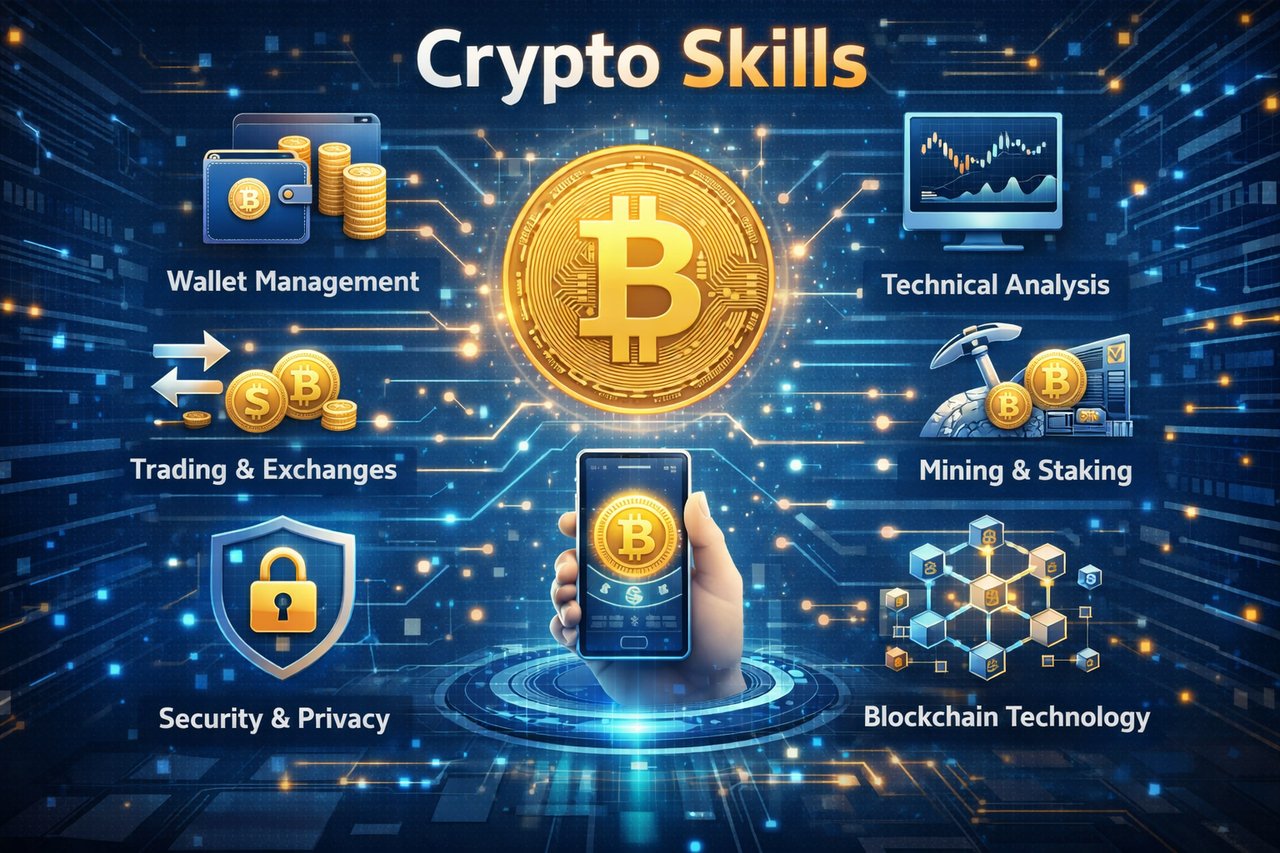
Trading-oriented Crypto Skills typically consist of multiple functional modules, each responsible for a critical step in the trading process.
First are data-related Skills, which retrieve market data, order book information, and on-chain data to provide inputs for strategies. Next are analysis Skills, responsible for calculating technical indicators, identifying signals, and making strategic decisions. Finally, execution Skills handle order placement, cancellation, and take-profit or stop-loss actions.
In addition, there are risk control Skills for position management and risk limitation, as well as logging and monitoring modules used to track and optimize strategy performance. Together, these components form a scalable trading capability system.
Building Trading Strategies with Crypto Skills
Within the infrastructure provided by Gate for AI, users can construct customized trading strategies by combining different Crypto Skills.
For example, a basic strategy may include:
-
Market data Skill, retrieving real-time BTC/USDT prices
-
Technical indicator Skill, calculating moving averages (MA) or RSI
-
Signal detection Skill, identifying golden crosses or overbought and oversold conditions
-
Execution Skill, automatically placing trades
With this modular approach, trading strategies are no longer rigid scripts but flexible collections of Skills that can be easily combined and iterated. This significantly improves development efficiency and makes strategies easier to test and optimize.
A Typical Trading Workflow with AI Exchange
Within the AI Exchange framework, a standard automated trading process can be broken down into the following steps:
-
Data collection, retrieving real-time market and on-chain data
-
Signal generation, analyzing market trends and producing trading signals
-
Strategy evaluation, deciding whether to execute trades based on predefined logic
-
Order execution, calling trading interfaces to complete buy or sell actions
-
Status monitoring, tracking orders and position changes
This workflow creates a closed loop from data input to trade execution, greatly improving both efficiency and responsiveness.
Multi-Skill Orchestration: Building a Complete Trading System
A single Skill is rarely sufficient to support complex trading needs, which is why multi-Skill orchestration is essential for building a complete system.
For example, an advanced trading system may include:
-
Multi-source data Skills, combining exchange and on-chain data
-
Multi-strategy Skills, such as trend-following and arbitrage strategies
-
Execution routing Skills, selecting the most efficient trading path
-
Risk control Skills, dynamically adjusting positions
Through orchestration, AI agents can call different Skills under varying market conditions, enabling dynamic strategy switching and optimization. This gives trading systems significantly greater adaptability.
Risk Management in Crypto Skills Trading
Risk control is critical in automated trading. Crypto Skills can implement risk management mechanisms at multiple levels.
First is position control, such as limiting the size of individual trades or total exposure. Next are stop-loss and take-profit mechanisms, ensuring timely exits during market volatility.
Additionally, anomaly detection Skills can be introduced to automatically pause trading during extreme market movements or data irregularities. These mechanisms help effectively reduce systemic risk.
Practical Path in the Gate Skills Hub
Within the Gate for AI Skills Hub, users can gradually build their trading systems through the following approach:
First, select basic data and execution Skills to create a minimal viable strategy. Then, introduce analysis and signal Skills to improve strategy accuracy. Finally, incorporate multi-Skill orchestration and risk control modules to build a fully automated trading system.
This process resembles modular assembly, allowing users to achieve automated trading capabilities without building complex systems from scratch.
Conclusion
Crypto Skills are reshaping the underlying logic of crypto trading. From strategy design to automated execution, modular Skills make trading systems more flexible, efficient, and scalable.
By combining Gate Skills Hub with AI Exchange, traders can lower technical barriers while building professional-grade automated trading systems. As the Skill ecosystem continues to evolve, intelligent trading is likely to become the dominant model.
FAQs
What are Crypto Skills?
Crypto Skills are functional modules designed to perform specific crypto-related tasks, such as data analysis, trade execution, or risk management.
How can you build a trading strategy with Crypto Skills?
By combining data, analysis, and execution Skills, you can form a complete strategy logic that runs automatically.
Is automated trading suitable for beginners?
With simplified tools like the Skills Hub, beginners can gradually build basic strategies, though understanding risk remains essential.
Can Crypto Skills replace manual trading?
They can replace manual execution, but strategy design and optimization still require human involvement.
What are the advantages of Gate Skills Hub?
Its strengths lie in modularity, ease of use, and deep integration with trading systems, making it easy to build automated trading solutions quickly.