Author: Bradley Peak, CoinTelegraph; Translated by: Bai Shui, Jinse Caijing
1. What is a reciprocal tariff?
Reciprocal tariffs sound like a textbook trade term, but their meaning is actually quite simple: if one country imposes tariffs on your goods, you should take the same measures in retaliation. It can be seen as a tit-for-tat strategy in global trade – governments can use this to express, “If you charge our exporters 20%, we will charge your exporters the same amount.”
The roots of this concept can be traced back to the 1930s when the United States passed the Reciprocal Trade Agreements Act. The goal at that time was to break down trade barriers through mutual agreements rather than trade wars. But fast forward to today, the term has resurfaced - this time, it has become sharper.
For example, in early 2025, in order to address what they considered unfair trade practices and a huge trade deficit, the U.S. government under President Donald Trump imposed a series of escalating tariffs on Chinese imported products. These tariffs initially set at a baseline of 10% have increased continuously, reaching an astonishing 145% on various Chinese goods.
China also made the same response by implementing its own series of reciprocal tariffs. Initially, Beijing imposed a 34% tariff on all U.S. imported products, which was later raised to 84%, and ultimately reached 125%, targeting a variety of U.S. products including agricultural products and machinery.
So, what does this have to do with cryptocurrency? You will understand — but first, let’s dive into how these tariffs actually work.
2. How do reciprocal tariffs work?
Although the United States has recently adopted a formula based on trade imbalances to determine its tariff rates, other countries such as China often adopt their own set of tariffs in response, which may not follow the same calculation method.
How does the United States calculate tariffs
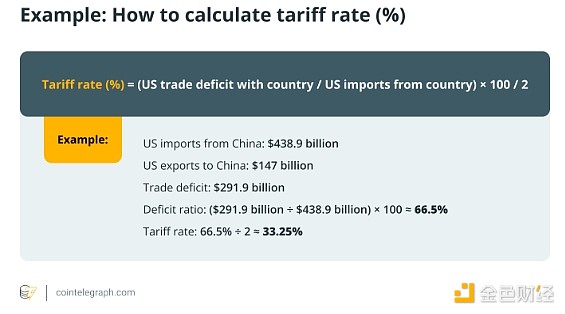
In 2025, the United States implemented a tariff strategy based on the calculation of tax rates according to trade deficits with specific countries. The formula used is:
Tariff rate (%) = (U.S. trade deficit with that country / U.S. imports from that country) × 100 / 2
For example:
- The United States imports from China: $438.9 billion
- U.S. exports to China: $147 billion
- Trade deficit: 291.9 billion USD
- Deficit rate: (291.9 billion USD ÷ 438.9 billion USD) × 100 ≈ 66.5%
- Tariff rate: 66.5% ÷ 2 ≈ 33.25%
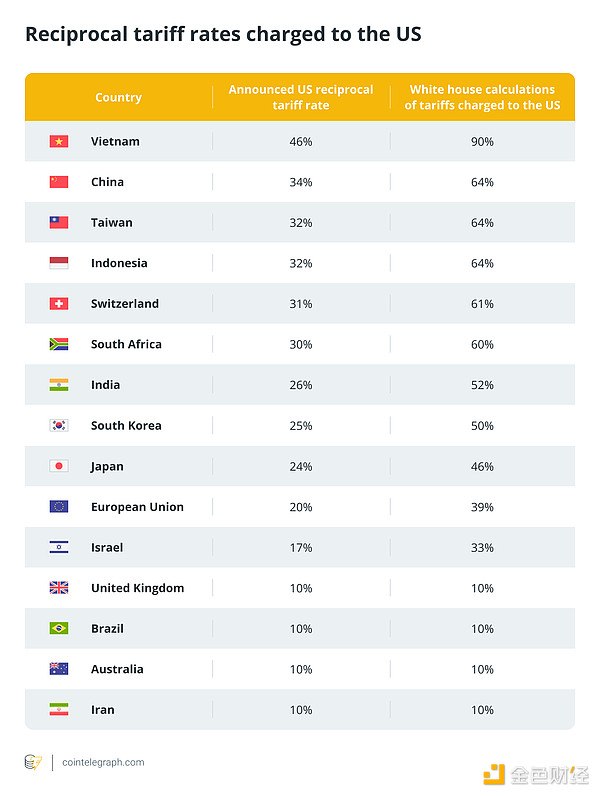
This practice will lead to the imposition of a 34% tariff on Chinese imported products by the United States in April 2025. Furthermore, these new tariffs will not replace the old tariffs, but will be added on top of them. Therefore, if a certain product already incurs a 20% tariff, and now a 34% reciprocal tariff is imposed, importers will suddenly have to pay a total of 54% in tariffs. This jump in prices will quickly result in a significant increase in the prices of foreign goods.
How does China respond
When the United States imposes tariffs, China often retaliates against industries that are politically and economically important to the United States, especially those that may affect key voter bases.
Target industry:
- Agriculture: China frequently targets American agricultural products such as soybeans, pork, and beef. For example, in 2018, China imposed a 25% tariff on American soybeans, which had a significant impact on farmers in states like Iowa, where soybean farming is a major industry.
- Aerospace: In 2025, China will suspend imports of Boeing aircraft and stop purchasing aircraft components from American companies, impacting the American aerospace industry.
Phased Implementation
China usually implements tariffs in phases in order to make strategic adjustments and negotiations:
- In early 2025, as the United States raised tariffs, China initially imposed a 34% tariff on all American goods. Later, in response to the continuous escalation of U.S. tariffs, this rate increased to 84%, ultimately reaching 125%.
- As a retaliatory measure, China has also imposed tariffs of 10%-15% on a variety of agricultural products from the United States, including corn, soybeans, and wheat.
The United States uses specific formulas to calculate tariffs, while China’s approach is more of a strategic retaliation aimed at applying economic and political pressure rather than directly matching tariff rates.
Did you know? Policymakers sometimes choose slightly higher numbers to convey a stronger political message—especially when they want to appear tough on trade issues or take a hard stance against certain countries. A unified “34%” sounds more decisive and careful than “33.25%”.
3. The Economic Impact of Reciprocal Tariffs
Reciprocal tariffs impact the global economy in very tangible ways. When the United States and China began to attack each other with import taxes, other countries felt the aftershocks.
Global trade slowdown
At the beginning of 2025, the World Trade Organization delivered a grim message: global trade is expected to grow by about 3%, but it is currently nearly stagnant, close to just 0.2%. The WTO directly pointed to the United States’ aggressive tariff strategy and its domino effect on other economies. As countries have taken their own measures to respond, the flow of goods has come to a halt. Exports are down, imports are down, and there is a lot of uncertainty.
Developing countries are under pressure
Smaller economies like Cambodia and Laos, which rely on exporting cheap goods to large markets like the United States, have been hit particularly hard. When tariffs rise, American buyers tend to back off. This means that factories in those areas that struggle to absorb the shock face reduced orders, unemployment, and shrinking incomes.
Domestic prices are rising
At the same time, American consumers are also beginning to feel the pressure. Tariffs on Chinese goods have caused prices for all products, from electronics to basic household items, to become more expensive. Even American companies that rely on imported components are paying more and passing these costs onto downstream businesses. Inflation is already high, and this will only make it worse.
Did you know? The International Monetary Fund predicts that the trade war could reduce global GDP growth from 3.3% in 2024 to 2.8% in 2025.
4. The Impact of Reciprocal Tariffs on Cryptocurrency
When governments around the world start imposing tariffs on each other, it sends a signal of instability — and financial markets hate uncertainty. When global trade flows are disrupted, stocks, bonds, and cryptocurrencies all react.
market volatility
In early April 2025, when the United States announced a 50% tariff on Chinese imports, the cryptocurrency market responded rapidly. The price of Bitcoin fell to $74,500, and Ethereum dropped over 20%. This sharp decline highlighted the sensitivity of cryptocurrencies to macroeconomic changes and investor sentiment.
However, after President Trump suspended most tariffs for 90 days, the situation began to stabilize. As of April 22, Bitcoin had rebounded to over $92,000, reflecting the cryptocurrency market’s responsiveness to policy changes.
mining
Due to tariffs on imported mining equipment, Bitcoin miners in the United States are facing increased operating costs. With tariffs on necessary hardware from countries/regions such as mainland China and Taiwan reaching up to 36%, miners are currently facing higher capital expenditures.
This is especially difficult for smaller businesses. Larger companies may be able to absorb the additional costs or renegotiate supplier agreements—but what about small or medium-sized mining companies? They are the ones getting squeezed. As profit margins shrink, some businesses may be forced to close or relocate to tax-free jurisdictions.
Did you know? Due to tariffs on mining hardware made in China, American Bitcoin miners are facing a 22%-36% increase in equipment costs at the beginning of 2025, leading some miners to consider relocating their operations overseas.
investment trends
Economic uncertainty often drives investors to seek safe havens—and cryptocurrencies increasingly fit this requirement. As traditional markets become volatile due to factors such as global tariff escalations, many investors turn to Bitcoin and other digital assets to hedge against inflation, currency devaluation, or geopolitical risks.
Institutional interest has also risen significantly. As governments around the world engage in trade wars and raise cross-border operating costs, cryptocurrencies are beginning to look like a more stable long-term investment. For example, in the first quarter of 2025, some hedge funds and sovereign wealth instruments started allocating digital assets to cope with these global macro pressures.
According to reports, the establishment of a strategic cryptocurrency reserve in the United States (holding both BTC and ETH) clearly indicates that cryptocurrencies are no longer viewed as a fringe asset in the eyes of traditional finance or policymakers.
V. Strategic Considerations for Cryptocurrency Stakeholders
For anyone in the cryptocurrency space—whether you are building infrastructure, mining cryptocurrencies, or managing investor portfolios—these policy shifts are very real and very relevant.
diversification
If you are a miner or a hardware-dependent startup relying on a supplier or country for equipment? This is a liability. Tariffs can soar overnight, significantly cutting into your profits and forcing you to seek expensive solutions.
Diversifying the supply chain—whether through sourcing from neutral countries or investing in domestic alternatives—can mitigate the impact.
Understand the regulatory environment
Cryptocurrency companies can no longer turn a blind eye to policies. Tariffs, trade barriers, and sanctions—these are all forces that affect the market. If you are involved in mining, cross-border payments, or even just hardware transportation, you need to pay close attention to the developments in local and international trade.
At this time, having the support of legal and trade experts is no longer a luxury, but a survival tool.
Rethink the narrative
This is a unique opportunity to reposition cryptocurrency. As the traditional economic system is impacted by trade wars and retaliatory tariffs, the concept of decentralized, borderless financial alternatives begins to resonate on a whole new level.
Cryptocurrency has long positioned itself as a tool for hedging against inflation and achieving financial freedom. Against the backdrop of rising global protectionism and economic fragmentation, this information carries more weight than ever.
Smart projects and investors tend to favor this narrative, growing through storms rather than merely enduring them.


